Disclaimer: The views and opinions expressed in this article are solely those of the author. The mention of any products, services, or methods does not constitute an endorsement.
The PC Is Moving Beyond Raw Frames
For most of PC gaming history, the machine was judged by a simple question. How well does it run the game?
That question still matters. Frames win fights. Low latency saves rounds. A stable system can separate a clean clutch from a stutter-filled death screen. Nvidia has built a massive part of its gaming identity around that reality, from GeForce GPUs to Reflex, DLSS, ray tracing, broadcast tools, and driver-level game optimization.
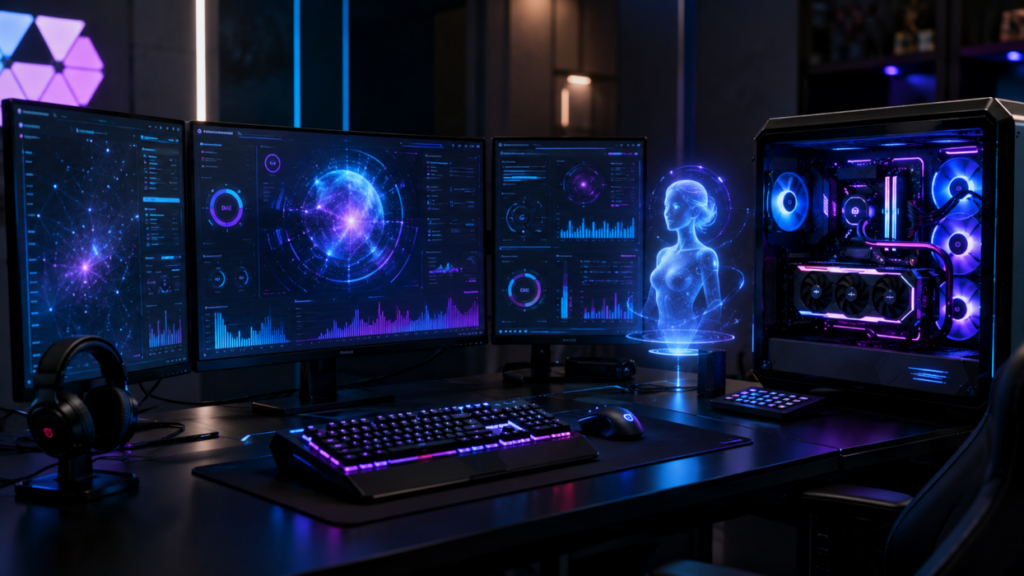
OpenShell points toward a different kind of PC future. Not a replacement for performance, but a layer sitting beside it. The idea is that a powerful gaming computer should not only render the match, encode the stream, reduce latency, and push pixels. It should also be able to run intelligent agents safely on the same machine.
That sounds abstract until you put it in gaming terms. An agent could watch system load, manage overlays, help configure settings, monitor performance problems, assist with streaming, retrieve useful information, and interact with game-adjacent tools without needing full access to every file, account, credential, and network connection on the PC. That last part matters. A helpful AI on a gaming rig is only useful if it does not become a security nightmare.
OpenShell is Nvidia’s answer to that problem. It is not just another chatbot window. It is a runtime built to contain autonomous AI agents inside controlled environments, with rules that define what they can touch, what they can send, and what they are allowed to do.
OpenShell Is About Control, Not Just Intelligence
The gaming industry has spent years selling smarter systems. Smarter upscaling. Smarter frame generation. Smarter matchmaking. Smarter anti-cheat. Smarter NPCs. The word “AI” gets slapped on everything now, sometimes deserved, sometimes not.
OpenShell is different because it deals with the ugly side of AI agents. Agents do not just answer questions. They can take actions. They can read files, call tools, contact services, modify settings, run code, and chain tasks together. That power is exactly why people are excited about them. It is also why sane users should be nervous.
A gaming PC is not a disposable sandbox. It often holds saved passwords, Discord tokens, payment sessions, browser profiles, game accounts, creator assets, tax documents, private messages, mod tools, screenshots, source code, and years of personal files. Giving an AI assistant broad access to that machine without strong boundaries would be reckless.
OpenShell puts the focus on boundaries. Nvidia describes it as a runtime for autonomous agents that uses sandboxed execution and kernel-level isolation. It also uses declarative YAML policies, meaning permissions can be defined in plain configuration instead of being trusted to vague prompt instructions. In plain English, the agent should not be trusted just because someone typed “do not read private files” into a prompt. The runtime should enforce the rule.
That is the right direction. Prompt promises are not enough. Gamers already know this from anti-cheat, modding, admin tools, and server permissions. Rules that only exist as polite instructions are not real rules. Enforcement has to happen lower in the stack.
Why This Matters for Gaming
OpenShell is not being marketed as a pure gaming feature in the same way DLSS or Reflex are. That makes it easy to miss why it could matter to players. The connection is not only about what OpenShell does today. It is about the type of gaming PC Nvidia and Microsoft are trying to build.
The next wave of gaming assistants will not be limited to “what settings should I use?” or “how do I beat this boss?” Those features are already here in early form through tools like Nvidia Project G-Assist and Microsoft’s Copilot for Gaming experiments. The real shift comes when agents can operate across the full PC environment while respecting hard privacy and security limits.
Picture a ranked player preparing for a match. A local agent checks GPU driver status, confirms Reflex settings, caps background recording to a sane bitrate, closes a noisy updater, sets the right microphone profile, checks ping to common regions, and warns that a browser tab is eating memory. That is not science fiction. Most of those tasks are boring PC maintenance. The difference is that an agent could perform them as a pre-match routine rather than waiting for the player to dig through five menus.
For streamers, the appeal is even easier to see. A safe local agent could prepare scenes, watch audio levels, flag dropped frames, manage clips, pull match stats, and help with titles or descriptions. For esports admins, agents could assist with bracket checks, server notes, match reports, rules references, and archival work. For legacy communities, that is a big deal. Old ladders, player profiles, team histories, screenshots, demos, and match logs are messy. Intelligent local tools could help preserve them without handing every private archive to a cloud service.
The catch is trust. Nobody wants a gaming assistant that behaves like spyware with a cute voice. OpenShell is interesting because it tries to make agent behavior governable before these assistants become normal.
The PC as a Teammate, Not a Replacement Player
The phrase “AI teammate” can mean several things, and the difference matters. One version is an in-game companion that fights beside you. Nvidia’s ACE technology has already moved in that direction with AI-powered characters, including PUBG’s Ella in Ally Duo Mode. That kind of co-playable character is easy to understand because it looks like a squadmate.
OpenShell points to a broader version of the same idea. The teammate may not be standing next to you in the game world. It may be sitting under the hood of your PC, helping the entire gaming session run better.
That version is less flashy, but it may end up more useful. A bot that follows you around in a shooter can be annoying if its callouts are bad or its timing feels off. A system agent that quietly catches performance issues, protects privacy, and handles routine tasks could become part of daily PC gaming without drawing attention to itself.
Gamers do not need AI that talks nonstop. They need AI that shuts up when the round starts, keeps the system stable, and speaks only when the information is worth hearing. That is the bar.
The best gaming teammate is not always the loudest one in voice chat. Sometimes it is the player who watches flank, keeps comms clean, and does the boring job correctly. A good PC agent should behave the same way.
G-Assist Was the First Public Taste
Nvidia’s Project G-Assist gave gamers a preview of where this is going. The assistant can answer questions about system settings, game performance, frame rates, power draw, and hardware behavior. It can run locally on RTX hardware and work through voice or text, which makes it feel more tied to the PC than a generic cloud chatbot.
Early reactions have been mixed, and that is fair. Local AI assistants have real costs. They need storage, memory, GPU time, model updates, and careful design. If an assistant tanks performance during a competitive session, gamers will uninstall it without mercy. Nobody wants a helper that becomes the reason their frame time graph looks cursed.
Still, G-Assist shows the basic shape of Nvidia’s plan. The company does not want the GPU to be only a rendering device. It wants the RTX PC to become a local AI workstation for gamers, creators, developers, and power users. OpenShell fits into that plan by giving agent behavior a safer operating space.
This is where the story gets more serious than “AI can optimize your graphics settings.” Settings advice is a starter feature. The deeper play is a trusted local agent model that can connect to tools, understand hardware, follow policy, and act under user-defined limits.
Security Will Decide Whether Gamers Accept It
Gamers are not anti-technology. They are anti-nonsense. They adopt new tools quickly when those tools give real advantages. Voice chat, Discord, overlays, capture software, performance monitors, aim trainers, mod managers, cloud saves, and replay tools all became normal because they solved problems.
They also reject tools that feel invasive, heavy, or shady. Kernel anti-cheat remains controversial for a reason. Launchers are hated when they multiply like weeds. Overlays get disabled when they break games. RGB software has become a meme because some of it behaves like malware wearing a rainbow jacket.
AI agents will face the same judgment. If they need too much access, use too many resources, or create privacy risk, players will push back hard. OpenShell’s sandboxing and policy model are Nvidia’s attempt to deal with that reaction before it gets out of control.
The key concept is separation. An agent that checks a game’s graphics settings does not need access to a tax folder. An agent that manages stream scenes does not need to read browser cookies. An agent that answers hardware questions does not need unrestricted network access. Policies should reflect that.
This is where YAML rules may sound boring, but they matter. Clear permissions make agents auditable. They give developers, admins, and advanced users a way to define what the assistant can do. That is much better than trusting a black box that says “don’t worry, bro.”
Competitive Gaming Needs Quiet AI
Esports has a special problem with AI helpers. The line between assistance and unfair advantage can get messy fast.
A PC agent that closes background processes before a match is fine. A tool that gives hardware diagnostics is fine. A local assistant that tells a player their microphone is clipping is fine. A system that reads live game state and gives tactical instructions during a competitive match becomes a very different issue.
Tournament operators, leagues, and anti-cheat teams will need to draw lines. That will not be easy. Some AI tools will be harmless quality-of-life features. Some will be coaching tools. Some will be flat-out cheating. The difference may depend on the game, the mode, the timing, and whether the tool reads information unavailable to the player.
OpenShell does not solve the rules problem by itself. It does, however, offer a path toward more transparent control. If agents run inside governed environments, leagues and platforms may eventually require certain policies for competitive play. A tournament client could allow performance monitoring while blocking live tactical analysis. A ladder platform could permit post-match summaries while banning real-time input suggestions.
That kind of policy-based approach would not be perfect. Cheaters always look for side doors. Still, it beats pretending AI tools will stay outside competitive gaming. They will not. The only real choice is whether communities define boundaries early or wait until the mess is already in the bracket.
Legacy Communities Could Benefit More Than They Expect
For a revived multiplayer hub with old ladders, restored leaderboards, player profiles, and team records, OpenShell-style agent systems are worth watching closely. Legacy communities have different needs than giant publisher ecosystems. They often run on volunteer labor, custom code, old databases, forum archives, scattered screenshots, and years of player history.
An intelligent local agent could become a serious admin assistant. It could help compare old match records, flag missing metadata, format player bios, detect broken links, prepare news posts, check rule pages for contradictions, and organize archived assets. The value is not in replacing admins. The value is in reducing the grind that burns admins out.
That matters for communities coming back after long pauses. A 10-year hiatus leaves a lot of dust. Restoring old systems is satisfying, but it also creates endless cleanup work. Profiles need checking. Ladder names need consistency. Screenshots need sorting. Old tournament pages need context. Search systems need better metadata. An agent that can work safely near those files without exposing private credentials would be useful.
The same applies to gaming journalism. Writers covering platforms, patches, esports changes, and industry shifts need research support, draft organization, and fact tracking. A local governed agent could help collect notes without sending everything to a remote model. For independent sites, privacy and ownership are not side issues. They are survival issues.
The Hardware Angle Is Still Real
None of this escapes the hardware question. Local AI costs resources. Running agents on the same machine that is also gaming, streaming, recording, and chatting will require careful scheduling. RTX GPUs are powerful, but competitive players are sensitive to anything that adds latency or causes frame pacing problems.
Nvidia has a clear incentive here. The more useful local agents become, the more valuable AI-capable GPUs become. RTX started as a ray tracing brand for gamers. It has steadily become an AI brand as well. DLSS trained players to accept AI as part of rendering. G-Assist and agent runtimes push AI into the broader PC experience.
This creates a split. High-end users will get the best local agent features first because they have the VRAM and compute headroom. Budget players may be stuck with smaller models, cloud routing, or limited features. That could become another PC gaming gap, right next to refresh rates, input latency, and GPU class.
Nvidia and Microsoft will need to keep the experience scalable. If AI teammates only work well on expensive rigs, they become a premium gimmick. If they work quietly across a wide range of RTX systems without hurting play, they become part of the standard PC gaming stack.
The Cloud Question Will Not Go Away
OpenShell also sits inside a larger fight between local AI and cloud AI. Local agents are attractive because they can be faster, more private, and more aware of the machine. Cloud models are attractive because they can be larger, stronger, and easier to update.
Nvidia’s current direction seems to accept both. OpenShell policies can help decide what stays local and what can be routed elsewhere under privacy rules. That hybrid model makes sense for gaming. A local model can handle system tasks, simple commands, and privacy-sensitive work. A cloud model can answer broader questions or process heavier reasoning when the user allows it.
The danger is lazy design. If every hard question gets shipped to the cloud, the privacy pitch weakens. If local models are too limited, users will stop trusting the assistant’s answers. The best version is a PC agent that knows when to stay local, when to ask permission, and when to say it cannot safely complete a task.
That restraint will matter. Gamers have long memories. If AI assistants overreach early, the backlash will be brutal.
Active PCs Change the Meaning of Ownership
OpenShell represents a shift in what a gaming PC can be. The old model was user-driven. You opened the app, changed the setting, launched the game, started the stream, checked the driver, and fixed the problem. The new model is agent-assisted. The PC can observe, suggest, prepare, and act within limits.
That can be great. It can also get creepy fast.
Ownership has to remain with the player. The user should define the rules. The user should see what the agent did. The user should be able to shut it off. The user should be able to inspect permissions without needing a computer science degree. If Nvidia, Microsoft, and developers get that wrong, AI agents will feel like another layer of platform control sitting between gamers and their own machines.
The better version is more empowering. A PC that actively helps maintain itself, protects the user’s data, supports creative work, improves game setup, and reduces admin chores would be genuinely useful. Not flashy. Useful.
That is where OpenShell has the most potential. It is not the fun part of AI gaming. It is the seatbelt, the locked door, and the rulebook. Without that layer, active gaming PCs become risky toys. With it, they might become the first real step toward intelligent rigs that help players without taking over the match.