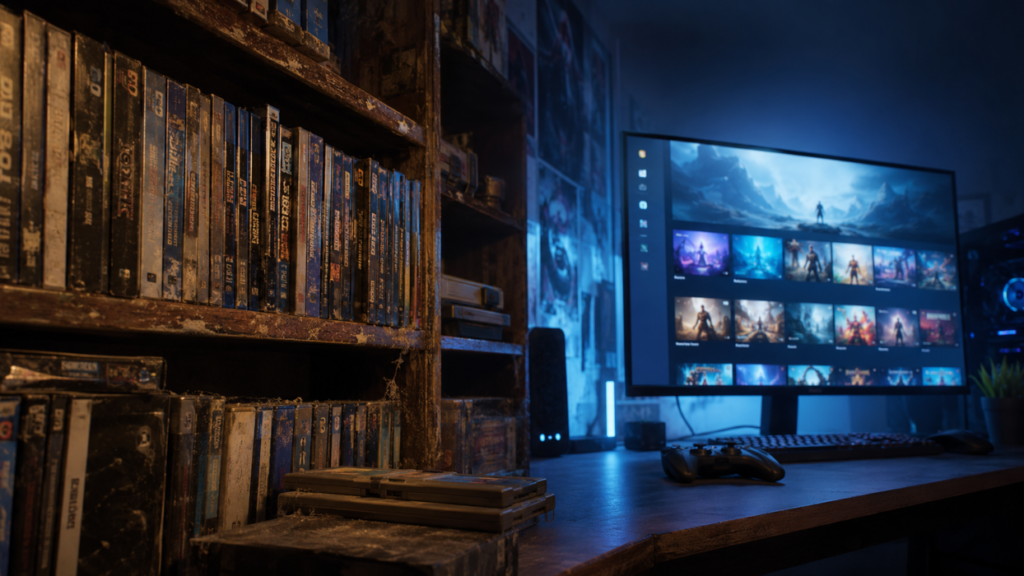
Gaming did not wake up one morning and suddenly become digital. The industry walked us here one storefront, one launcher, one battle pass, one shutdown, and one “license agreement” at a time. What used to be a simple question of whether you owned a cartridge, disc, or box has become a far messier debate about access, accounts, servers, storefronts, and whether a purchase still means what players think it means.
For older multiplayer communities, this hits differently. We remember shelves full of PC boxes, console cases, clan match nights, rented servers, patched executables, and games that stayed alive because players kept them alive. A title did not need corporate oxygen forever. If the community cared enough, the community found a way.
That old model is being squeezed hard. Digital storefronts replaced shelves. Live service models replaced standalone releases. Server dependencies replaced LAN menus. Now the industry seems ready to ask players to accept the next step, a market where physical media becomes rare, ownership becomes thinner, and access depends on a company’s continued interest in letting the product exist.
The problem is not that digital games exist. Digital distribution is convenient. It made indie games easier to publish, old games easier to find, and multiplayer updates faster to push. The problem is that the industry keeps selling convenience while quietly removing the safety net that made ownership feel real.
Sony Reminded Everyone What “Purchased” Can Really Mean
Sony has become one of the clearest examples of why players are nervous. In 2023, PlayStation users were told that Discovery video content they had previously purchased would be removed from their libraries because of licensing issues. Sony later reversed course after backlash, but the damage was already done. Players saw the warning sign. A digital purchase could be changed by a contract they never negotiated.
That story returned in a different form in 2026, when reports said Sony would remove 551 previously purchased StudioCanal films from PlayStation libraries in several European regions starting September 1, 2026. The reason again came down to licensing, not whether the customer had paid for the movie. That distinction matters. The user bought access. The platform controlled the terms. The licensing deal decided the ending.
Gamers noticed because the same logic applies to games. Movies and games are different products, but digital storefront dependency works in similar ways. If the platform controls access, the publisher controls authentication, and the license controls availability, then the customer is not holding much. They are trusting a chain of companies to keep the lights on. That trust is wearing thin.
GTA 6 May Become the Symbol of the Shift
Grand Theft Auto 6 is not just another release. It is the kind of game that bends the market around itself. So when reports claimed Rockstar had no plans to print physical GTA 6 discs at launch or in the months after, it hit like a flare in the night sky. According to those reports, a boxed version may exist, but as a code-in-a-box product rather than a real disc. Rockstar and Take-Two had not made that a clean official statement in the reporting, so it should be treated as reported information rather than settled fact. Still, the reaction was predictable. Players saw the direction of travel.
If GTA 6 launches without a true disc, that would not be a small retail experiment. It would be one of the biggest entertainment releases on earth telling the market that physical ownership no longer needs to be part of the main event. Collectors would lose the version they care about. Used game buyers would lose options. Families would lose easy sharing. Game stores would lose a product that used to bring people through the door.
Some players will say it does not matter because everyone downloads massive day-one patches anyway. That argument has weight, but it misses the emotional and legal point. A disc may no longer contain the whole modern game, but it still represents a form of transfer, backup, proof, and independence from a storefront account. It is not perfect ownership. It is still more ownership than a code trapped inside one account system.
The industry knows this. That is why the direction is so attractive to publishers. No used sales. No lending. No resale. No scratched disc returns. No secondhand market. No retail shelf pressure. Everything flows through the official store, and every player becomes permanently attached to an account. Great for control. Not great for players.
Live Service Games Made Ownership Feel Temporary
The move toward all-digital gaming did not start with GTA 6 rumors or Sony movie removals. Live service games have been training players for this world for more than a decade. The pitch was simple. Games would grow over time. New seasons. New cosmetics. New maps. New events. New reasons to log in every week.
Some live service games are excellent. Players have built real communities around them. Competitive ecosystems have thrived inside them. Nobody can honestly say the model has produced nothing good.
The cost is permanence. A live service game is not a fixed object. It is a moving target, and the version players loved last year may not exist anymore. Maps vanish. Modes rotate out. Balance changes rewrite the game. Licensed content expires. Servers close. Even single-player-adjacent games can become useless if they were built around online checks.
Physical discs never solved every preservation problem, but they gave players a baseline. You could put an old game in an old console and often get something playable. Maybe the servers were dead, maybe the patch was missing, maybe DLC was gone, but the core product had a fighting chance. With always-online design, that chance can drop to zero. That is where players get angry. Not mildly annoyed. Angry.
Stop Killing Games Turned Frustration Into Pressure
The Stop Killing Games movement grew because players are tired of watching paid games disappear. The campaign gained major attention after Ubisoft shut down The Crew, a game that needed online support to function. The complaint was not simply that support ended. Support ends eventually. The complaint was that a sold product became unplayable without a reasonable path for owners to keep using it.
The movement has since pushed consumer action in multiple regions, including the European Citizens’ Initiative known as Stop Destroying Videogames. That effort passed the signature threshold required for formal consideration, with reports noting about 1.3 million verified signatures. It has also fed into legal and political fights over whether publishers should have to provide some end-of-life plan for online-dependent games.
This is not a fringe collector tantrum. It is a consumer rights argument. Players are asking a plain question. If a company sells a game, markets it as a product, takes money for it, and builds years of purchases around it, should it be allowed to make that game vanish completely when the business plan changes?
Publishers do not want that question answered in law. They prefer the softer language of licenses, services, safety, and support costs. Players hear that and think of every shutdown, delisting, missing mode, expired license, and broken launcher they have already lived through.
The ESA Private Server Argument Lit the Fuse
The private server debate made the whole issue even hotter. During discussion around California’s Protect Our Games Act, the Entertainment Software Association faced backlash after comments that framed private and community servers, including references involving Minecraft and Call of Duty, as illegal or piracy. That landed badly because the examples were messy from the start. Minecraft, owned by Microsoft, has a long history of community servers. Many PC games have official or tolerated server tools. Competitive gaming itself was built on player-hosted infrastructure.
The ESA later softened the framing, saying private servers can raise intellectual property and safety issues rather than simply treating the entire concept as criminal. That walk-back did not erase the original message players heard. The industry’s trade group seemed to be saying that if official servers die, community solutions are not a lifeline. They are a threat.
That is a ridiculous position when stated broadly. Unauthorized monetized servers, stolen code, fake clients, malware, and brand abuse are real concerns. Nobody serious needs to pretend every private server is harmless. But lumping community preservation, player-hosted competition, modded servers, and piracy into the same bucket is lazy at best and hostile at worst.
The history of multiplayer gaming is inseparable from private servers. Quake, Counter-Strike, Unreal Tournament, Battlefield, Minecraft, Team Fortress, Call of Duty, and countless smaller scenes grew because players could host, mod, admin, and organize their own spaces. Community servers were not the black market of gaming. They were the backbone.
For a legacy esports community, this is not theory. Ladders, clans, forums, scrims, rivalries, and match archives all depended on player-run infrastructure. The official publisher created the game, but the community created the culture.
Digital Control Changes Competitive History
The all-digital shift does more than affect collectors. It changes how competitive history survives. A physical copy, a server binary, a LAN mode, a config file, and a community patch can preserve an old competitive scene long after the publisher has moved on. Without those pieces, history becomes whatever the rights holder allows to remain accessible.
That matters for esports. Games are not just content. They are places where people spent years building identities. Player names, team rivalries, ladder records, tournament brackets, forum arguments, highlight clips, and custom rulesets all become part of a shared record. When a game disappears, part of that record disappears with it.
Publishers often talk about games as services because it fits the money model. Players often experience games as homes. That gap explains much of the anger. A company sees an old server as a cost center. A community sees it as the last standing clubhouse from a decade of memories.
The more digital and server-bound games become, the easier it is to erase those spaces. Not always out of malice. Sometimes through licensing. Sometimes through expired contracts. Sometimes through backend cost. Sometimes because a sequel needs room. The reason barely matters to the player who paid, played, competed, and then watched the door get welded shut.
Physical Media Was Never Perfect, But It Gave Players Friction
There is a reason publishers like the digital model. It removes friction from sales, but it also removes friction from control. Physical media creates resistance. A disc can be resold. A cartridge can be borrowed. A boxed game can sit in a closet for twenty years and return to life. A used copy can compete with a new sale. A rental can become a discovery. A local store can move old inventory without asking a platform for permission.
Digital distribution trims all of that away. The storefront becomes the market. The account becomes the shelf. The license becomes the receipt. The platform becomes the gatekeeper.
Players are not against digital because they hate convenience. Most of us buy digital games constantly. Steam libraries are massive. Console libraries are packed. Game Pass, PlayStation Plus, and other subscription services have changed buying habits because they offer easy access. The issue is that access is being mistaken for ownership, and companies benefit from keeping that confusion alive.
A fair digital future would be possible. Players could have clear rights, reliable offline modes, transfer options, end-of-life server tools, refund rules for shutdowns, and legal room for preservation. The technology is not the blocker. The business model is.
The Next Fight Is Over What “Buy” Means
The word “buy” is doing a lot of work in modern gaming. Players see it and think ownership. Companies often mean a limited license under terms that can change. That mismatch is the heart of the all-digital argument.
If a game is sold as temporary access, say that clearly. If a movie can vanish from a library, say that before purchase. If an online game will die without servers, say what happens when support ends. If private servers are forbidden, say so before the community spends years building around the game. If a disc box contains only a code, do not dress it up like physical ownership.
Players can handle the truth. What they hate is the slow bait-and-switch feeling. They hate being told they are buying while the fine print says they are renting permission. They hate watching publishers celebrate communities during the marketing cycle, then oppose the tools that would let those communities survive after official support ends.
The all-digital world is not automatically anti-player. It becomes anti-player when every benefit flows upward and every risk flows downward. Faster downloads, cleaner patching, and wider access are real gains. Vanishing purchases, dead games, locked accounts, code-in-a-box releases, and hostility toward community servers are the bill players are being handed.
A legacy gaming community understands that better than most because we have already seen what survives after the hype leaves. It is not the publisher roadmap. It is not the seasonal shop. It is not the launcher splash screen. It is the players who kept showing up, kept hosting matches, kept recording results, kept arguing over rules, kept inviting new blood, and kept the old names alive long after the industry stopped paying attention.