PC Gaming Has a Memory Problem
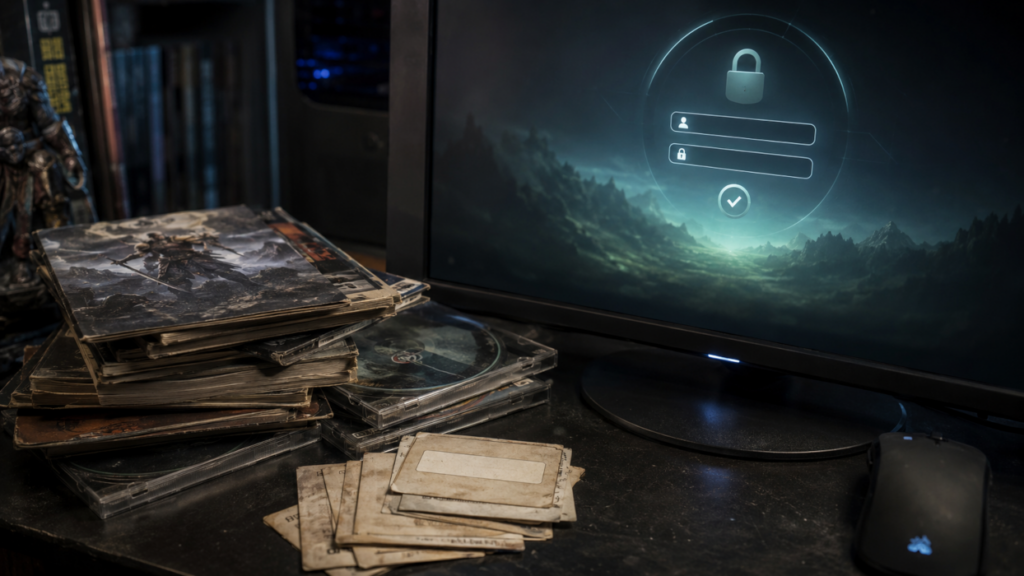
PC gaming has always sold itself as the platform that remembers. Old boxes in closets. Discs with scratched jewel cases. Fan patches. Mods hosted on forgotten forums. Dedicated servers kept alive by stubborn admins who refused to let a game die just because the publisher moved on. That stubbornness is part of the culture.
But the ground under PC gaming has shifted. Games are no longer just files on a disc or an installer sitting in a folder. They are accounts, licenses, launchers, authentication checks, cloud saves, matchmaking services, seasonal content, anti-cheat systems, and server-side logic. A game can be sitting in someone’s library and still be impossible to play.
That is the preservation problem of the all-digital, always-online era. Ownership has become access. Access has become conditional. History now depends on whether a company keeps a server running, honors an old license, maintains compatibility, or allows communities to build their own replacement infrastructure.
For a legacy multiplayer community, this hits close to home. Leaderboards, ladders, match records, player profiles, clan histories, tournament brackets, rivalries, screenshots, demos, and forum arguments are not side content. They are the record. They prove that people were there.
The Shift From Ownership To Permission
Digital distribution gave PC players a lot. No more lost discs. No more CD keys printed on manuals that disappeared in a move. No more hunting for patches on sketchy download mirrors. Steam, GOG, Epic, Battle.net, EA App, Ubisoft Connect, and other platforms made buying and installing games easier than ever.
Convenience came with a trade. Most modern digital purchases are license agreements, not true ownership in the old boxed-copy sense. Players usually buy permission to access software under terms controlled by the publisher or storefront. That distinction stayed invisible while libraries grew and games kept working. Then shutdowns started making it visible.
The Crew became the defining example. Ubisoft delisted the game in December 2023 and shut down its servers on March 31, 2024, making the always-online racing game unplayable for people who had bought it. Reuters reported in 2026 that French consumer group UFC-Que Choisir sued Ubisoft over the shutdown, with the case raising the direct question of whether a company can erase access to a paid product by closing its servers. Reuters also reported that Ubisoft had said customers bought limited access, not full ownership.
That argument might make legal sense inside a terms-of-service document, but it lands badly with players. Gamers do not talk about their libraries like rental lockers. They say, “I own that game.” They remember paying for it. They remember installing it. They remember grinding events, unlocking cars, earning rankings, or building communities around it. The law may treat access as temporary. Gaming culture does not.
Always-Online Design Breaks The Old Preservation Model
Classic PC preservation used to be messy but possible. If someone had the files, the patch, the executable, and the willpower, there was usually a path. DOSBox could run old DOS games. Fan patches could fix broken Windows compatibility. Community servers could replace old master lists. Mods could clean up bugs publishers abandoned years earlier.
Always-online design changes the equation. Some games no longer contain enough of themselves to survive. The client may require a login server. Progression may live remotely. AI routines, economy systems, item validation, matchmaking, or world states may rely on publisher-controlled infrastructure. Even single-player modes can get trapped behind authentication or launcher checks.
This is where preservation becomes more than archiving files. A preserved executable means little if it cannot pass a server handshake. A complete install is not complete if major systems were never shipped to the player’s machine. A game manual, soundtrack, and art book can survive while the playable experience disappears.
The problem is even sharper for competitive games. A multiplayer shooter without its server browser is not the same artifact. A strategy game without ranked ladders loses part of its social identity. An arena game without demo files, match history, and community rule sets becomes a shell. The code matters, but the competitive record matters too.
The Numbers Are Already Bad
The Video Game History Foundation and the Software Preservation Network published a 2023 study showing that 87 percent of classic video games released in the United States were no longer commercially available. The same report said only 13 percent of video game history was represented in the current marketplace, with no historical period in the study reaching 20 percent availability.
That number should bother anyone who cares about multiplayer history. Games vanish faster than people think. Even when a title remains famous, the version people actually played may be gone. The launch build, balance patch, tournament ruleset, modded server pack, anti-cheat version, and community map rotation may all tell different stories.
PC gaming has a better survival record than many closed console ecosystems because players can copy files, mod clients, host servers, and run compatibility layers. But “better” does not mean safe. Launcher dependency, DRM, legal risk, and missing server software can turn even PC games into locked museum pieces.
Preservation also has a discoverability problem. A game can technically survive but be functionally invisible. If the official site is dead, the forums are gone, the patch links are broken, and the server list no longer resolves, new players will not find it. Old players may not even know how to return.
GOG Shows One Path, But It Cannot Carry Everything
GOG remains one of the better examples of commercial PC preservation because its model centers on DRM-free releases and compatibility work. Its Preservation Program states that classic PC games should remain playable on modern systems and that its catalog entries in the program are maintained with long-term support in mind.
That matters. A DRM-free installer is not magic, but it gives players and archivists breathing room. It means a game can be backed up, moved, installed later, and played without asking a dead authentication server for permission. For old single-player PC games, that approach is about as clean as commercial preservation gets.
The limit is scale. GOG cannot preserve every game. It cannot force every rights holder to cooperate. It cannot recreate every lost source tree, expired license, music agreement, middleware dependency, or multiplayer service. It also cannot fully solve games built around live economies, matchmaking systems, or server-side worlds.
Still, the principle is strong. The more a game can run without external permission, the better chance it has to survive. DRM-free installers, offline modes, LAN support, dedicated server tools, documented file formats, and mod support all extend a game’s lifespan. These are not just consumer-friendly features. They are historical survival tools.
Stop Killing Games Turned Frustration Into Pressure
The Stop Killing Games movement formed around a simple demand. If publishers sell games that rely on central servers, they should provide a reasonable way for those games to continue functioning after official support ends. The campaign argues that players should not lose paid games because a publisher decides the service no longer fits its business plan.
In Europe, the issue moved beyond forum outrage. The European Citizens’ Initiative titled “Stop Destroying Videogames” seeks to prevent publishers from remotely disabling games before providing reasonable means for continued functionality. Reuters reported that the related initiative was presented to the European Commission with more than 1.3 million signatures, passing the threshold for review.
This does not mean every online game can live forever. Servers cost money. Security issues appear. Licensed content expires. Some games are built on systems that would be difficult to hand over. But the current model often treats shutdown as a hard delete, and that is the part players are pushing against.
A more responsible model would plan for end-of-life before launch. Publishers could ship dedicated server binaries. They could unlock offline modes. They could release final patches that remove authentication checks. They could document enough of the network behavior for communities to keep private servers alive. They could also preserve their own archives instead of pretending the next sequel replaces the last game.
Multiplayer Communities Are Archives Too
Official archives tend to focus on builds, source code, design documents, marketing material, and legal records. Those are valuable, but they do not capture what made multiplayer games matter to players. Communities keep the living record.
A ladder page tells you who dominated a season. A match report shows the meta. A clan roster shows alliances and rivalries. Forum posts show disputes over rules, accusations, sportsmanship, balance complaints, and the weird humor that made each community feel like its own neighborhood. Server logs, demo files, screenshots, and brackets are historical material, even if they were never treated that way at the time.
This is where older esports hubs have a rare role. A restored leaderboard is not just a nostalgia feature. It is proof of competitive activity. It preserves names, teams, wins, losses, tournament paths, and the structure players agreed to compete under. In a scene where so much history happened outside publisher control, community-run records may be the only evidence left.
Modern esports has better broadcast production, bigger prize pools, and cleaner data pipelines, but older multiplayer communities often had deeper player ownership. People ran the ladders, argued over rules, hosted servers, reviewed disputes, built maps, and recruited players one forum thread at a time. Preserving that record protects a different kind of esports history, one built from the bottom up.
The Legal Wall Still Blocks Serious Archiving
Libraries and museums can preserve some game materials, but access remains heavily restricted. The Video Game History Foundation has argued that outdated copyright rules prevent institutions from sharing preserved games digitally in the same practical way they can provide access to books, film, and audio. Its 2023 study noted that libraries and archives can digitally preserve games, but digital sharing is limited and often restricted to on-premises access.
That model makes little sense for networked games. A multiplayer game is not properly studied by sitting at a single terminal in a reading room. It needs clients, servers, accounts, matchmaking behavior, latency, patches, player interaction, and sometimes voice comms or forum context. A museum can store a box. Preserving a living competitive game is harder.
The legal system still treats many preservation attempts as suspicious because they may involve bypassing DRM, reverse engineering network calls, or copying software. That creates a strange result. The people most motivated to save games often operate in gray areas, while institutions move carefully and slowly. Meanwhile, publishers can shut down access quickly.
Players see the contradiction. The industry markets games as culture when it wants awards, grants, prestige, and emotional investment. Then parts of the same industry treats old games like disposable service contracts once revenue fades. PC gamers are not wrong to find that insulting.
What Publishers Should Build Into Games Now
Preservation should not be an emergency patch written after a shutdown announcement. It should be part of the production plan. That does not require every company to keep every official server online forever. It requires a clean exit strategy.
Offline modes should exist wherever possible. If a campaign, garage, bot mode, training mode, or local match can work without central servers, it should not be trapped behind them. LAN support should return as a serious feature, especially for competitive games that may outlive their official matchmaking. Dedicated server tools should be released for communities that want to keep playing.
Publishers should also separate account services from core play. A cosmetic shop can die without killing a deathmatch mode. A leaderboard can freeze without deleting local play. Seasonal events can end without breaking the base game. Better architecture makes end-of-life less destructive.
For esports titles, final patches could preserve tournament modes, spectator tools, replay playback, custom lobbies, and server hosting. Those features are not just extras. They are the tools future communities need to study and replay the game as it existed.
What Players And Communities Can Save Right Now
Players cannot fix every legal or technical barrier, but they can save more than they think. Communities should back up patch notes, rule sets, match results, brackets, team pages, player profiles, screenshots, demos, config guides, mod files, map packs, server tools, and forum posts. The boring stuff matters later.
Every community should treat its database like a historical asset. Export it. Mirror it. Document the schema. Keep read-only copies. Store dates in a clear format. Preserve user display names without exposing private information. Keep old URLs working where possible, because broken links are where history starts to rot.
Competitive communities should also write down context. A leaderboard without rules can be misleading. A tournament bracket without match format loses meaning. A player profile without team history is only half a record. The more context saved now, the less future readers have to guess.
PC gaming history will not be preserved by publishers alone. It never was. The platform’s strength has always come from players who host the servers, patch the clients, write the guides, save the files, and refuse to let old rivalries vanish just because a login server went dark.