
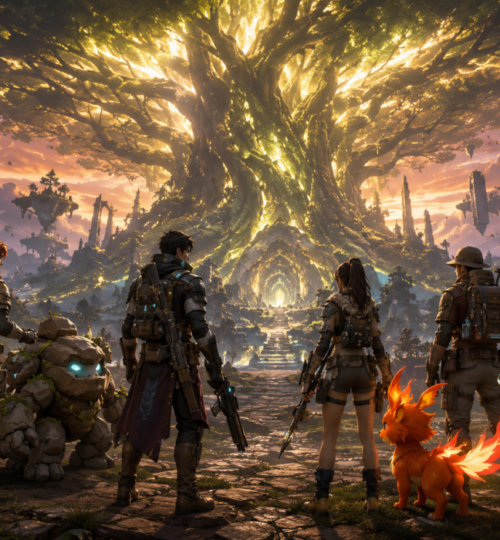
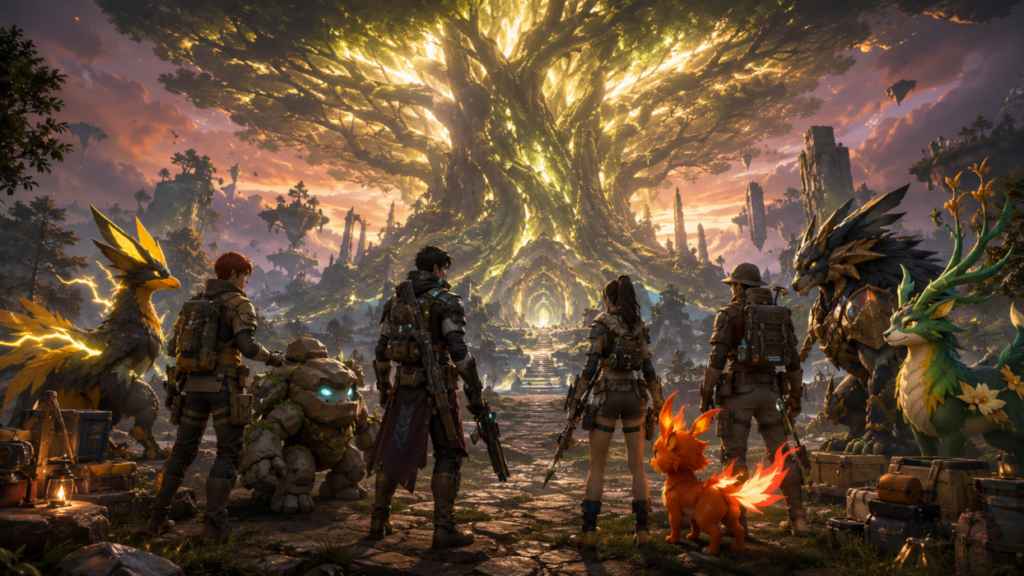
Palworld’s early-access explosion was easy to understand. It took creature collecting, survival crafting, automated production, open-world exploration, and third-person gunplay, then smashed them together with almost no concern for genre purity. The result was messy, funny, highly streamable, and much deeper than the viral jokes suggested. Version 1.0 had a harder job.
Pocketpair could not simply add another island, another batch of Pals, and a larger gun. The full release needed to turn a wildly successful sandbox into a game with a readable beginning, a structured climb, and an endgame capable of keeping experienced players active after their factories were finished. That required more than content. It required a new competitive rhythm.
Palworld officially left early access in July 2026, more than two years after its January 2024 debut. The full release added 72 Pals, bringing the total to 287, while expanding the world with Sunreach and opening the long-promised World Tree. It also reworked story progression, combat balance, tower bosses, base systems, multiplayer features, and Pal advancement. The launch did not turn Palworld into an esport overnight. It did, however, create the first believable foundation for organized competition.
Palworld Finally Has a Real Progression Spine
Early Palworld was often driven by player curiosity rather than game-directed purpose. Catch stronger creatures. Build a better production line. Breed for ideal passives. Defeat a tower boss. Start over on a private server. The pieces worked, but the route between them could feel loose. Version 1.0 gives that route a clearer shape.
The revised story now connects exploration, faction towers, Sunreach, and the World Tree more directly. New NPCs and continuous missions give context to activities that once felt like isolated objectives. The World Tree is no longer background scenery. It is the destination toward which the broader campaign points, and it houses some of the game’s hardest challenges.
That matters for competitive play because structured progression creates measurable checkpoints. A server can now compare more than raw character level or base size. Players can race through tower progression, measure boss-clear times, track resource efficiency, and compare how quickly teams reach Sunreach or the World Tree.
Speedrunning existed before 1.0, but the revised campaign makes it easier to define recognizable categories. Fresh-save tower races, no-trade progression, fixed-seed team runs, and World Tree completion events now have a firmer ruleset. The game still contains random breeding and loot outcomes, yet organized communities can control many of those variables through server settings and event rules. Palworld needed a backbone. It finally has one.
The Survival-Crafting Meta Shifted Toward Specialization
The largest change is not that players have more things to collect. It is that high-level accounts now have more reasons to specialize. The Awakening system lets players strengthen selected Pals through materials tied to the World Tree. Mutation adds rare breeding outcomes and new passive possibilities, turning long-term breeding into a more volatile form of roster construction. Condensing was also made less demanding, reducing the number of duplicate Pals required for maximum condensation from 116 to 48.
This changes the old breeding economy. Before 1.0, the dominant logic was often predictable. Identify the strongest combat Pal or best worker, stack desirable passive traits, breed repeatedly, condense, and apply souls. The process required time, but the target was usually known.
Mutation introduces uncertainty at the top. A player can still build toward a planned result, but exceptional offspring may create combinations that were not available through standard inheritance. Awakening then gives players another decision about where to commit rare endgame materials. The competitive effect is obvious. Teams must decide whether to build a narrow group of fully enhanced stars or a wider roster designed to counter different opponents. That is roster strategy, not merely collection.
The same idea applies to bases. Pal Labor Research received additional levels and revised effects, while work suitability progression and high-level worker choices became more demanding. The strongest production base is no longer just a pile of familiar workers arranged around crafting stations. It is a designed economy with research priorities, role assignments, supply routing, and opportunity costs.
Survival games often lose tension once a group becomes rich enough to automate every problem. Palworld 1.0 pushes back by creating expensive endgame projects that compete for the same time and materials. Combat development, base research, high-tier weapons, breeding, Awakening, and raid preparation all pull from the player’s production machine. The meta is now about allocation.
Wave-Based Base Raids Turn Construction Into Defense Planning
Base raids were once an inconsistent irritation. Terrain exploits, pathfinding failures, and overwhelming automated defenses could reduce attacks to either chaos or free loot. The 1.0 rework gives raids a clearer competitive shape. Enemy attacks now arrive in waves, regional factions affect the attacking force, enemy strength scales with the Pals working at the base, and full clears provide rewards. Defensive structures no longer consume ammunition. Players who do not want to participate can pay a Negotiator to cancel an incoming attack.
Removing ammunition costs from base defenses is especially significant. It shifts the test away from stockpiling bullets and toward layout, worker assignment, firing angles, repair access, and target control. A poorly designed fortress can still fail even if it owns the same technology as a strong one. This creates room for community events built around defense rather than direct PvP.
A league could give every team the same building area, technology tier, material budget, and preparation time. Teams would then face identical raid settings, with scoring based on survival time, structural damage, Pal losses, repair costs, or waves cleared. Another format could restrict certain defensive structures and force teams to rely on assigned combat Pals.
That would look more like tower defense mixed with engineering than traditional esports, but competitive gaming has never required every contest to be a mirrored gunfight. Palworld’s identity is built around preparation. Base-defense competition fits the game better than forcing it to imitate a tactical shooter.
The Arena Is Faster, but Balance Will Decide Its Future
Palworld already had a PvP Arena before full release, but version 1.0 rebalanced it and shortened matches from five minutes to two. It also added the Arena Legend rank and tied high-end armor schematics to the Arena Merchant.
Two-minute rounds are a strong tournament decision. Short matches are easier to broadcast, easier to schedule, and less punishing when an early mistake creates a one-sided battle. They also increase the value of burst damage, opening tactics, Pal deployment order, and immediate target selection. That speed comes with risk.
Palworld combat contains far more variables than a standard arena shooter. Player weapons, armor, accessories, Pal stats, passive skills, active skills, condensation, souls, mutation, Awakening, and elemental matchups can all affect the outcome. If unrestricted loadouts become the standard, competitive Arena play could turn into a gear-check contest dominated by players with the longest breeding pipelines. A credible ruleset will probably require divisions.
One format could use open rosters and function as Palworld’s equivalent of an unlimited class. Another could cap Pal enhancement, ban selected passives, normalize player equipment, and require teams to submit rosters before a match. Draft formats could go further by preventing duplicate species or allowing each side to ban one Pal before selection.
The game also needs strong spectator support. Tournament organizers require stable camera tools, readable health and status information, match history, exportable results, and reliable dedicated-server controls. Palworld supports cross-platform multiplayer, four-player online co-op, and dedicated servers for up to 32 players, but server capacity alone does not create an esports product. Pocketpair has built the combat room. The administration layer still needs work.
PvE Racing May Be Palworld’s Best Competitive Format
The most natural Palworld competition may not be PvP at all. Raid bosses, hard tower bosses, oil rigs, World Tree encounters, and wave defense all create repeatable PvE targets. These activities reward preparation, execution, and team composition without requiring perfect player-versus-player balance.
Time-attack formats are the obvious starting point. Teams could compete for the fastest legal clear of a selected boss using fixed equipment rules. Organizers could score deaths, consumable use, Pal knockouts, or damage taken as tiebreakers. Weekly challenge modifiers could ban flying mounts, restrict weapon classes, limit healing, or require a roster built around a chosen element.
This style of competition has several advantages. It is easier to run asynchronously, which helps international communities. It allows smaller groups to participate without needing a full bracket. It also produces permanent records that can live beside legacy ladders, player profiles, and team histories.
For a community with roots in organized multiplayer competition, this is where Palworld could become unusually interesting. A traditional ladder asks who defeated whom. A Palworld operations board could track boss-clear records, base-defense scores, breeding achievements, resource races, and seasonal expedition results under one team profile. That variety would not weaken the competitive identity. It would reflect the game accurately.
Server Seasons Could Supply the Missing Stakes
Persistent survival servers always face the same problem. Established groups accumulate so much infrastructure that new players cannot meaningfully catch up. Even without open-world PvP, mature economies reduce uncertainty. Every resource becomes routine. Seasonal servers offer an answer.
A Palworld season could begin with fresh characters and end after four to eight weeks. Each phase could unlock a new ruleset or objective. Week one might reward tower progression. Week two could score base output. Later phases could introduce raid defense, Arena play, boss racing, and World Tree completion.
Guild roles, dedicated servers, cross-platform multiplayer, and the stronger campaign structure make this much more practical than it was during early access. Official server documentation is already maintained for version 1.0, giving community hosts a supported base for private events.
The scoring model would need to resist grind abuse. Raw material totals favor players who can remain online all day. Better objectives would reward efficiency, speed, successful defenses, limited-attempt boss clears, or head-to-head match results.
A seasonal model also lets organizers patch their own rules between events. If one Pal, passive, weapon, or base design becomes oppressive, the next season can restrict it without waiting for a global game update. That flexibility is valuable because Palworld’s biggest strength is also its competitive weakness. It has too many systems to balance cleanly under one unrestricted format.
Palworld Esports Would Need to Look Like Palworld
The wrong approach would be to strip away the survival systems and present the Arena as the only part worthy of competition. That would discard the production chains, breeding decisions, exploration routes, and base engineering that make the game distinct. The stronger model is a multi-discipline circuit.
Arena matches could test direct combat. Boss races could test execution and composition. Base-defense trials could test construction. Fresh-server events could test progression knowledge. Breeding or roster challenges could test long-term planning under fixed limits.
Teams would earn points across several disciplines, much like a club competing across multiple ladders. Specialists would matter. One player might be the best Arena shot. Another might understand breeding probabilities and passive combinations. A third might design the most efficient raid base. Leadership would involve assigning people to the work they perform best.
Palworld 1.0 has moved far enough beyond its viral launch identity to support that kind of structure. The next step is not a giant publisher-funded league. It is smaller community competition with transparent rules, archived results, controlled servers, and formats built around the full game rather than one isolated mode.