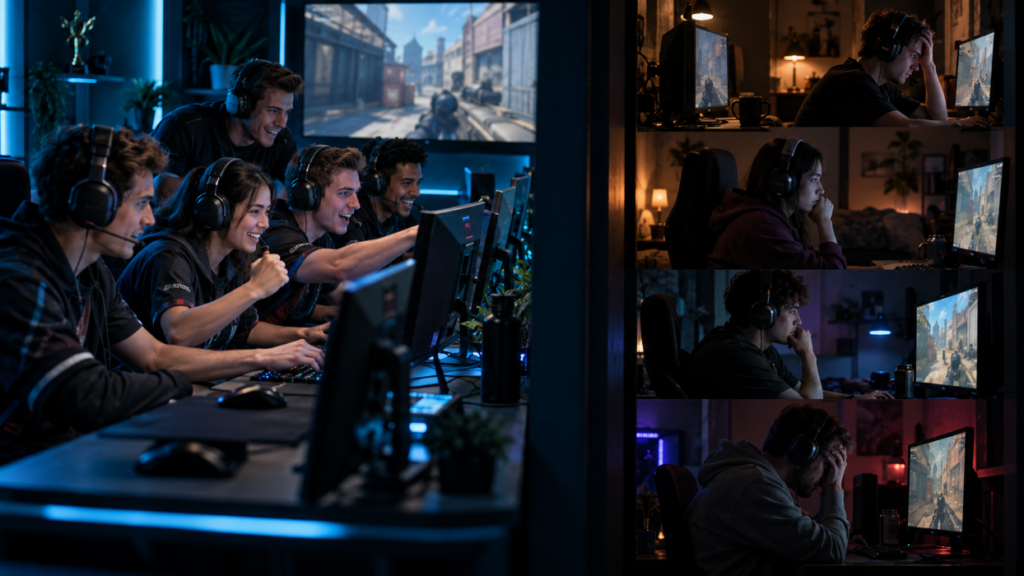
Ranked modes are built around a simple promise: play well, improve, and the ladder will eventually reflect your level. Solo queue complicates that promise because a player controls only one seat in a team game. Every match can contain unfamiliar teammates, role conflicts, uneven communication, smurfs, tilted players, off-role assignments, and opponents whose coordination is difficult to read before the first round or objective fight even begins.
That uncertainty is part of competitive multiplayer, yet it becomes a retention problem when players stop believing that the ranked system gives them a reasonable chance to express their skill. The anxiety around pressing the queue button often comes from that gap between personal responsibility and limited control. A player can care deeply about the result while knowing that much of the match will be shaped by strangers.
Research is increasingly catching up with a feeling competitive players have described for years. A 2026 study comparing competitive and casual collegiate gamers found significantly higher worry-related anxiety among competitive players, especially around performance and fear of failure. Earlier esports research has also linked self-efficacy with lower competition anxiety, suggesting that confidence in one’s ability changes how stressful competition feels.
Solo Queue Turns Rank Into a Social Risk
Rank is personal, but solo queue performance is collective. That mismatch creates a strange form of accountability. The ladder assigns one player a visible rating, badge, division, or point total, while the match itself may depend on four teammates in a five-player game or two strangers in a battle royale squad.
Veteran players learn to accept variance, but acceptance has limits. A top laner can win lane and still lose to a fed bot side. A VALORANT player can hold a site correctly and watch a teammate force an unnecessary peek. An Apex player can make the right rotation and still be dragged into a bad fight by a squadmate. Over enough matches, those events should become part of the larger statistical picture, but players experience ranked one match at a time.
That matters because the emotional cost is immediate while the statistical correction is slow. A theoretically fair rating system can still feel hostile if it requires dozens of games to recover from a short run of poor team outcomes. The player’s question stops being “Am I improving?” and becomes “Do I want to risk another one?”
The problem grows when the system makes personal progress highly visible. Rank points, promotion thresholds, demotion borders, win streaks, seasonal resets, and public profiles give every match a measurable consequence. These systems can motivate continued play, but they also turn a routine queue decision into a potential loss event.
Loss of Control Is the Core Solo Queue Stressor
Competitive anxiety does not automatically make players perform worse. Research in esports has found a more complicated relationship, including evidence that moderate arousal can coexist with strong performance. A 2025 study of professional esports players also found that players who lost a playoff match reported higher post-match cognitive and somatic anxiety and lower self-confidence than winners.
Solo queue adds another ingredient: attribution. Players are constantly deciding why a match was won or lost. Sometimes the answer is obvious. They whiffed, mispositioned, wasted an ultimate, lost a lane, or called the wrong rotation. Those losses can sting, but they also provide usable information.
The harder losses are the ones that feel causally disconnected from the player’s own decisions. An autofilled jungler gets invaded repeatedly. A support abandons lane after one argument. A teammate disconnects. A premade pair ignores the rest of the squad. Even ordinary mistakes can be interpreted as sabotage once the match becomes emotionally charged.
A 2026 study on poor gameplay in competitive team games found that players reacted more negatively when behavior appeared to be deliberate sabotage, and that poor play was judged less acceptable in more competitively framed settings. That distinction matters because ranked mode raises the perceived cost of every mistake. An identical misplay can feel trivial in an unranked match and infuriating when rating is on the line.
Matchmaking Quality Becomes a Retention Feature
Matchmaking is often discussed as a technical system for producing balanced games, but it also functions as a trust system. Players rarely know the exact hidden rating calculations, search windows, party adjustments, role weighting, or queue population behind a match. They judge the system through outcomes.
Large skill gaps are especially damaging because they make defeat feel predetermined. A 2024 study using roughly six million matches from more than 262,000 players found that being matched against stronger opponents and experiencing larger skill differences were associated with increased churn. The same research also found that win and loss patterns affected whether players stayed active. The game studied was not a modern tactical shooter or MOBA, so the results should not be treated as a universal formula, but the retention signal is relevant to competitive matchmaking design.
A separate 2026 survival analysis of League of Legends log data involving 295,008 players found that performance and social factors were associated with churn, while higher game tier was linked with greater churn in the study’s model. The authors interpreted that result as possibly reflecting frustration tied to higher-tier play. That finding fits a familiar ranked pattern: the better players become, the more sensitive they often become to queue quality, teammate competence, rating swings, and match integrity.
This creates a hard design problem. Strong players usually want stricter matchmaking, but stricter matchmaking can increase queue times. Faster queues reduce waiting, but broader search ranges can produce matches that feel less fair. Every competitive game is constantly trading time-to-match against match quality.
2026 Ranked Systems Are Trying to Reduce Perceived Unfairness
League of Legends provides one of the clearest examples this year. Riot’s 2026 ranked changes introduced stronger autofill parity, first trying to match autofilled players against opponents who are autofilled in the same role, then trying to equalize the number of autofilled players on each team. Riot also introduced Aegis of Valor to reduce the frustration attached to off-role games, although the system was adjusted in July so its reward structure centered on winning rather than loss protection.
The significance goes beyond League’s specific LP rules. Autofill creates a textbook solo queue control problem because the system can place a player into a role they did not choose, then judge the match through the same ladder that measures their preferred-role performance. Role parity tells the player that the inconvenience is at least being shared more evenly.
VALORANT has taken a different approach to rank pressure. Riot added Rank Shields in 2025, giving players in Tier 1 of most ranks limited protection before dropping into the previous rank. The game also added Ranked Rollbacks for rating lost against confirmed cheaters, and in June 2026 Riot adjusted Ranked Rating calculations and competitive lobby consistency. These features do not remove losing, but they reduce specific cases where progress feels disconnected from legitimate competition.
Apex Legends has been experimenting even more directly with solo queue conditions. In summer 2026, Respawn ran a Diamond-and-above ranked test that temporarily prevented premade squads from entering those lobbies, creating a solo-queue-only environment at those ranks. The studio framed the test as a way to gather data on high-level matchmaking, while broader 2026 matchmaking tests also targeted queue time, skill disparity, and teammate quality.
These are different games with different match structures, yet the direction is similar. Developers are increasingly treating perceived fairness, group composition, rating protection, role parity, and match integrity as parts of the ranked experience rather than invisible backend concerns.
Premades Change the Emotional Math
Solo players tend to notice premades because coordination is power. Two or three players with established comms can execute faster, trade more reliably, and make coordinated decisions without spending the early game learning how each other communicates. Matchmaking systems can compensate with rating adjustments or group matching, but the solo player’s perception still matters.
Premades also change the social structure inside a team. A duo can reinforce each other’s calls, defend each other during arguments, or make decisions that prioritize their pair over the full team. Most duos are simply friends playing together, yet the solo player has no way to know whether the pair will cooperate with the lobby or operate as a separate unit.
This is why high-rank grouping rules receive so much attention. League restored some duo access in high-level play in 2026, then restricted it again at Grandmaster and Challenger while allowing closely ranked Master players to duo. Riot said smaller player pools and extreme skill levels made duo influence harder to offset without harming match quality.
The deeper issue is competitive legitimacy. Players will tolerate losses when they believe the match was earned. They become far less tolerant when a loss appears to come from a structural advantage the queue created before the game started.
Streaks Turn Normal Variance Into Queue Avoidance
Ranked anxiety often peaks after the player is already tilted. One loss becomes two. The second game includes a bad draft, a disconnect, or a teammate argument. The third queue begins with the player thinking about recovering points rather than playing the match in front of them.
That behavior has been visible in game data for years. Research on solo-queue League of Legends found that player performance could deteriorate over longer sessions and that recent win rate and session length helped predict whether a player would stop playing. More recent churn research has also found associations between consecutive outcomes and continued participation.
This is where ranked systems can accidentally create a casino-like recovery mindset without any gambling mechanic being involved. The player sees a concrete deficit and wants to erase it before logging off. Each additional loss raises the emotional importance of the next match, which can produce worse decision-making, shorter patience, and harsher reactions to teammates.
For retention, the danger is not one rage quit. It is the learned association between ranked play and emotional debt. Once players begin protecting their mood by avoiding the queue, the ladder loses one of its most important habits: the assumption that pressing “Play” is worth the risk.
Better Ranked Design Gives Players More Reasons to Trust the Next Match
The strongest retention improvements may come from systems that make competitive loss easier to interpret. Clear rating movement, credible anti-cheat enforcement, role parity, tighter party rules, reliable punishment for sabotage, and visible protection against exceptional cases all tell players that the ladder has rules they can understand.
This does not mean every loss should be softened. Competitive players are often suspicious of systems that appear to manufacture outcomes, hide skill differences, or protect everyone from demotion. A ranked ladder needs consequences or the rating stops carrying meaning. The goal is to make those consequences feel connected to actual competition.
Solo queue will always contain uncertainty because the strangers are the point. Matchmaking turns a large player population into temporary teams, and those teams will never behave with the consistency of an established roster. Good ranked design therefore cannot promise control. It can promise that the uncontrollable parts are being handled as fairly as the population, queue time, and game structure allow.
For competitive multiplayer games in 2026, that promise is increasingly tied to retention. Players can survive a bad teammate, a bad night, or a painful demotion. They are much more likely to leave when repeated matches convince them that the queue itself is the opponent.