Disclaimer: The views and opinions expressed in this article are solely those of the author. The mention of any products, services, or methods does not constitute an endorsement.
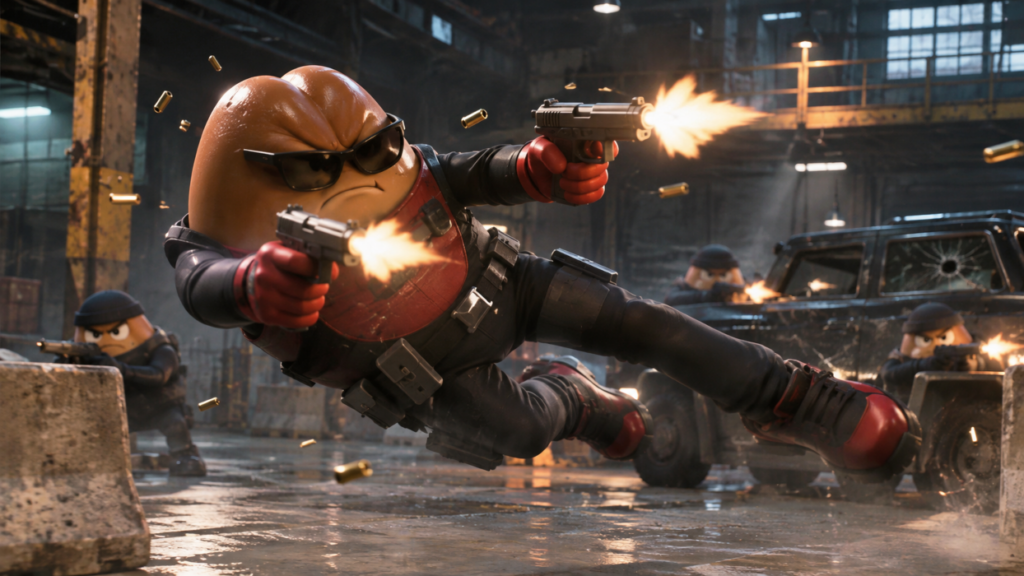
A heavily armed coffee bean diving through gunfire, flipping through the air, and eliminating enemies in slow motion sounds like a joke stretched well beyond its original premise. Yet that description captures much of the appeal behind Killer Bean, an independent action game that arrived on Steam Early Access on June 8, 2026. Its combination of exaggerated gunplay, absurd humor, and open-world destruction draws heavily from the action games and animated films that defined the early 2000s.
Developed by animator Jeff Lew through Killer Bean Studios, the game has attracted attention for its unusual origins and ambitious scope. Players can switch between first-person and third-person combat, explore procedurally generated environments, drive vehicles, and perform cinematic finishing moves. An August update also introduced online player-versus-player combat, giving the project a competitive component that was absent at launch.
Nearly five months into Early Access, the game’s commercial performance and player reception present a mixed picture. Its entertaining combat mechanics have developed a following, while technical problems, uneven mission design, and a declining active player population raise questions about how much of its potential has been realized.
From Internet Animation to an Open-World Shooter
Killer Bean has roots extending back to the early days of computer-generated internet animation. Jeff Lew created his first Killer Bean short in 1996 while teaching himself animation, eventually producing Killer Bean 2: The Party in 2000. The character later starred in the feature-length animated film Killer Bean Forever, released on DVD in 2009.
The series developed a cult following through its deliberately excessive action sequences and unusual cast of anthropomorphic coffee beans. Its visual identity combined martial arts, gunfights, slow-motion acrobatics, and deadpan dialogue. The franchise eventually found renewed attention through online video sharing and meme culture, introducing the character to audiences who had never encountered the original animations.
That history helps explain why the game attracted interest long before its release. Lew had already established an animation style built around improbable shootouts and physical comedy, making an interactive adaptation a natural extension of the original films. Translating carefully animated action sequences into responsive gameplay required building environments, artificial intelligence, and progression systems around the character’s distinctive fighting style.
The result resembles an unusual combination of Max Payne, open-world crime games, and early-2000s arcade shooters. Much of the appeal comes from performing spectacular maneuvers that would look ridiculous in a conventional military shooter but fit comfortably within Killer Bean’s fictional universe. The game’s exaggerated presentation also gives its developer considerable freedom to experiment with unconventional weapons, movement abilities, and combat encounters.
Gameplay Built Around Slow Motion and Spectacular Gunfights
The central gameplay experience places players in control of Killer Bean, an assassin who has turned against the Shadow Agency after discovering its corruption. His mission involves fighting the organization’s forces while confronting dangerous enemies, including rival assassins known as Shadow Beans. The story provides a loose framework for a game primarily concerned with combat experimentation and action sequences.
Combat emphasizes movement and cinematic presentation. Players can dive, dodge, slide, fire weapons, use melee attacks, and trigger slow-motion sequences that make encounters resemble choreographed action scenes. Switching between first-person and third-person perspectives allows players to experience the shooting mechanics more directly or watch their character perform elaborate movements.
Bullet time is particularly important to the game’s identity. Slowing the action creates opportunities to line up shots while maneuvering through incoming fire, recalling the mechanics popularized by Max Payne. The system gives players more control over the timing and presentation of their attacks, allowing them to chain movement and gunfire into sequences that resemble the animated films.
Killer Bean also possesses exaggerated special abilities, including a trick shot involving a bullet tossed into the air and an elaborate breakdancing attack. These mechanics reflect Lew’s animation background, where the visual impact of an action sequence can be as entertaining as the destruction it produces. Ragdoll physics add another unpredictable element, sometimes turning routine encounters into chaotic displays of enemies and vehicles reacting to explosions.
The official Steam listing describes a single-player campaign alongside several additional modes. The Party involves attacking disruptive dance parties, Battle Arena pits players against endless enemy waves, and Conquest allows participation in a territorial conflict between opposing factions. These modes offer alternatives to the main campaign’s objectives and provide different settings for experimenting with the combat mechanics.
The game also includes procedurally generated islands containing four different biomes, multiple enemy factions, bosses, vehicles, aircraft, and mechanical enemies. Randomized weapon skills and campaign variables are intended to encourage repeated playthroughs, although the complete procedural campaign system remains an ongoing development goal. The difficulty lies in ensuring that this variety produces meaningful gameplay differences rather than simply changing the scenery or the enemies encountered.
The Appeal of Early-2000s Action Gaming
Much of Killer Bean’s personality comes from its willingness to embrace an older style of action entertainment. Games such as Max Payne, Serious Sam, and Freedom Fighters emerged during a period when developers frequently built experiences around distinctive combat mechanics, exaggerated encounters, and memorable visual identities. Their approaches differed considerably, but each placed recognizable gameplay ideas at the center of its design.
Killer Bean fits comfortably within that tradition. Its combat sequences encourage dramatic movement, and its deliberately absurd protagonist allows the developer to introduce mechanics that might feel out of place in more serious shooters. The game also benefits from the distinctive character animation that made the original films recognizable.
Diving through a gunfight, performing a spinning attack, or launching an enemy into an exaggerated ragdoll reaction creates a visual reward separate from completing an objective. This helps explain why some players remain enthusiastic despite acknowledging technical shortcomings. They enjoy the movement system, the ridiculous action, and the freedom to experiment with different approaches to combat.
Spectacular animations can nevertheless lose their impact when encounters repeat the same patterns or enemies behave inconsistently. A campaign needs objectives, enemy behavior, and progression systems capable of sustaining the initial excitement. For Killer Bean, the challenge is giving players enough meaningful situations in which to use its unusual collection of combat abilities.
How Killer Bean Is Performing in Steam Sales
The game’s Early Access launch produced measurable interest, although an official total for copies sold has not been publicly verified. Valve does not routinely publish individual game sales figures, making independent estimates and Steam activity statistics useful indicators of performance. These measurements offer insight into the game’s commercial reach but cannot establish its exact revenue.
As of November 1, 2026, SteamDB’s tracking of Killer Bean listed approximately 2,400 user reviews and an all-time peak of 1,933 concurrent players, reached on June 8. Third-party ownership estimates available around this period varied considerably, with VG Insights suggesting roughly 53,500 owners, Gamalytic approximately 57,600, and PlayTracker around 95,200.
These figures should be understood as estimates rather than confirmed sales. The services employ different methods to infer ownership from publicly available information, and actual purchases, refunds, and revenue remain private. The estimates nevertheless suggest a game that has reached tens of thousands of customers rather than achieving the large-scale commercial success associated with established action franchises.
Killer Bean has a regular U.S. Steam price of $14.99, with promotional discounts having reduced it to $11.99. That relatively modest entry price makes the game accessible to players curious about the character or interested in independent action games. Pricing alone, however, cannot explain how many customers continue playing after their initial purchase.
Player activity presents a less encouraging picture. After reaching nearly 2,000 simultaneous players on launch day, concurrency fell sharply during the following months. By late October, SteamDB was frequently recording only single-digit or low-double-digit player counts, with daily peaks far below the launch period.
Concurrent-player statistics do not measure total ownership or everyone who plays during a day. A substantial decline nevertheless indicates that Killer Bean has struggled to maintain an active Steam audience after its initial release. This becomes especially relevant to its multiplayer ambitions, since online matches depend on enough people being available at compatible times.
Player Reviews Reveal Enthusiasm and Frustration
Killer Bean’s reception has been mixed in substance, even though its overall Steam rating remains positive. By early November 2026, approximately 74% of the roughly 2,400 reviews tracked across languages were positive, producing a Mostly Positive classification. Recent reviews have generally been more favorable than the initial launch response, although they represent a smaller group of players.
Supporters frequently praise the game’s unconventional personality, cinematic movement, and the considerable work invested by its independent developer. Many recognize that Lew is attempting to build an ambitious shooter with a limited development team and are willing to accept unfinished systems while development continues. Some reviews focus on the entertainment provided by individual combat encounters rather than the overall depth of the campaign.
Other players have been considerably less forgiving. Complaints have included unreliable enemy AI, repetitive objectives, inconsistent weapon handling, bugs that interrupt missions, and environments that can feel empty despite their size. Some have questioned whether the available content provides enough variety to support extended play.
Independent criticism has echoed those concerns. In a June 10 review published by Kotaku, Zack Zwiezen criticized the repetitive shooting and hacking objectives, weak enemy behavior, awkward vehicle handling, and technical problems. The assessment was particularly harsh toward the game’s mission design, arguing that its entertaining concepts had not yet produced a satisfying experience.
That criticism identifies a genuine design problem for an ambitious Early Access shooter. A large collection of mechanics creates possibilities, but those mechanics need missions that make effective use of them. Repeatedly defeating enemies or interacting with similar objectives can become tiresome when the underlying encounters offer limited tactical variety.
The more favorable reviews often express optimism about what the game could become after additional development. That optimism is understandable, particularly given Lew’s continuing updates, but it also means some positive reception reflects confidence in the developer rather than satisfaction with every aspect of the current release. Evaluating the game therefore requires distinguishing the entertainment already available from the features and improvements still being promised.
Ongoing Updates Are Expanding the Open World
Development has continued since launch, with updates addressing bugs, performance issues, enemy behavior, movement, and additional activities. The developer has also responded to feedback concerning the limited variety of the initial campaign and the need for a more interactive open world. Several updates have concentrated on giving players more to do between conventional combat missions.
An important expansion arrived in October 2026 with the introduction of a larger city environment. The new area includes police patrols, pedestrians, rival gangs, vehicle theft, and criminal activity that can provoke responses from law enforcement. These additions move the game closer to the open-world crime sandbox suggested by some of its earlier promotional material.
The October 20 City Sandbox update expanded the available activities to include stealing vehicles for a chop shop, intercepting valuable cars, escorting cash vehicles, and attacking rival gangs. Police can pursue players after witnessing crimes or receiving reports from pedestrians, while rival factions introduce additional hazards. The update gave the city more opportunities for spontaneous confrontations beyond the main mission structure.
These systems create opportunities for encounters that emerge from player decisions rather than predetermined sequences. A vehicle theft might attract police attention, while retreating into hostile gang territory could produce a confrontation involving several factions. Their interactions could eventually provide a more entertaining foundation for the open-world campaign, particularly if enemy responses and mission objectives become more varied.
The October 29 update added another activity involving an armored money truck that players can disable by destroying its tires. That patch also addressed several vehicle, movement, and animation bugs, demonstrating that technical refinement remains a substantial part of development. The continued attention to vehicle behavior is especially relevant as driving becomes more closely connected to the game’s open-world activities.
Lew has discussed further ambitions for the city, including randomized missions, additional interiors, character development, and new ways to interact with the environment. Those ideas remain development plans until implemented, particularly considering how much work remains on existing systems. Their eventual value will depend on whether they produce more varied and satisfying encounters rather than simply increasing the number of available activities.
Does Killer Bean Support Competitive Multiplayer?
Killer Bean now has competitive multiplayer functionality, although its online component remains relatively limited. The developer introduced PvP in an August 15, 2026 update, adding two familiar shooter modes: Free For All and Team Deathmatch. These modes allow players to compete directly rather than fighting only computer-controlled opponents.
The official multiplayer announcement described an initial selection of ten maps, four firearms, basic cosmetic options, and configurable player-hosted matches. Players can dive, slide, dodge, shoot, perform melee attacks, and use grenades, while AI-controlled opponents can fill matches when human players are unavailable. This gives small groups a way to play even when public multiplayer activity is limited.
Servers operate through Steam’s peer-to-peer networking rather than a conventional dedicated-server system. Hosts can adjust various match settings, providing flexibility for private games and organized sessions. The architecture also places greater importance on the host’s connection and the reliability of the underlying networking implementation.
One particularly interesting distinction separates multiplayer combat from the single-player experience. Slow-motion gameplay was excluded from the initial PvP implementation, with Lew citing an existing video game patent as the reason. Multiplayer also launched exclusively in first-person perspective, with third-person options discussed for future development.
Removing bullet time changes the competitive experience considerably. Without the ability to manipulate the speed of combat, multiplayer encounters depend more directly on positioning, aim, movement, and reaction time. That makes Killer Bean’s PvP mechanically closer to conventional arena shooters than its single-player action sequences might suggest.
There are significant differences between supporting online matches and operating a complete competitive system. Steam lists leaderboard functionality, but the available documentation does not establish a mature ranked matchmaking environment with skill-based divisions, formal seasonal competition, tournament administration, or a dedicated esports structure. Players looking for those features should distinguish the game’s existing PvP modes from a fully developed competitive platform.
For organized gaming communities, the existing Free For All and Team Deathmatch modes provide a foundation for informal competitions. Players could arrange private matches and record results externally, provided the game’s hosting options and stability meet their requirements. The absence of an established tournament infrastructure would place more responsibility on community organizers.
The peer-to-peer architecture creates practical considerations for more serious events. Network performance may depend on the host’s connection, and player-hosted sessions do not automatically provide the neutrality, consistency, or administrative control of dedicated competition servers. Those limitations become more consequential when match results are used to determine rankings, tournament advancement, or prizes.
Could Killer Bean Become a Serious Competitive Game?
The game’s movement mechanics offer possibilities for skill-based competition. Slides, dives, dodges, grenades, and close-range attacks create decisions about timing and positioning, while multiple maps provide room for different approaches to combat. A competitive rule set could emphasize those mechanics without requiring the full complexity of the single-player campaign.
For Team Deathmatch, the most immediate competitive potential lies in organized matches among friends or established gaming groups. Such matches could emphasize coordinated attacks, map knowledge, and movement techniques, provided weapon balance and networking remain consistent. Small community events would also allow organizers to evaluate the multiplayer experience without depending on a large public matchmaking population.
The game’s small active Steam population represents a greater immediate obstacle than the absence of advanced competitive features. Even a well-designed multiplayer shooter struggles when too few people are available to populate matches, particularly across different regions and schedules. AI opponents can help fill sessions, but they cannot replace the consistency and competitive depth of a healthy human player population.
The limited starting weapon selection and developing multiplayer systems also leave questions about long-term balance. Competitive communities generally expect predictable weapon behavior, stable hit registration, reliable server performance, and rules that can be consistently applied across matches. Problems in any of those areas can affect competitive results regardless of how entertaining the movement mechanics might be.
Killer Bean has not yet demonstrated those qualities at the scale required for sustained organized competition. Its current PvP implementation is better regarded as an experimental multiplayer addition with potential for small community events than as an established competitive platform. That assessment could change as development continues, but it would require evidence of improved technical consistency and sustained player participation.
Player-hosted games and configurable rules may still appeal to veteran players who enjoy arranging their own matches. These features recall aspects of earlier PC multiplayer communities, where organized competition often began with small groups experimenting with games before formal systems existed. The difference is that Killer Bean must still prove that its multiplayer mechanics can retain enough players to support regular competition.
The Challenge of Turning Spectacle Into Lasting Gameplay
Jeff Lew’s commitment to the project remains visible through the pace of development. The additions made since June have addressed several early complaints while expanding the game’s scope beyond its original campaign content. Maintaining that pace while improving existing mechanics will be an important challenge as Early Access continues.
The larger city and its developing faction interactions may prove especially valuable. More reactive environments could give players reasons to experiment with movement, vehicles, and combat outside scripted encounters. Randomized missions and meaningful progression would further improve the value of returning for additional sessions.
Continuing to add ambitious systems before existing mechanics have been fully refined carries risks. Large open-world environments, complex AI behavior, procedural missions, and online multiplayer each demand considerable development and testing. Maintaining all of them presents an unusual workload for a project associated so closely with a single creator.
The estimated sales figures suggest that Killer Bean has found a paying audience, while its generally positive Steam reception indicates that many players appreciate the direction of the project. Its falling concurrency and substantial early criticism reveal the difficulty of converting that interest into sustained participation. The remaining Early Access period will test whether new content can improve retention as effectively as it attracts attention.
For competitive players, the most meaningful developments to watch are continued refinements to PvP. Improved networking, weapon balance, additional match options, and a more consistent active population would do more for organized competition than simply expanding the number of available maps. Community-hosted events could become more practical if those improvements make match conditions predictable and repeatable.
Meanwhile, the evolving open-world city presents a separate opportunity to strengthen the single-player experience. Its criminal activities, faction responses, and randomized objectives could give the game’s elaborate combat mechanics a stronger purpose if they develop into a coherent campaign. The next challenge is making those systems interact reliably enough that encounters remain entertaining after the novelty of the animations has worn off.