
Disclaimer: The views and opinions expressed in this article are solely those of the author. The mention of any products, services, or methods does not constitute an endorsement.
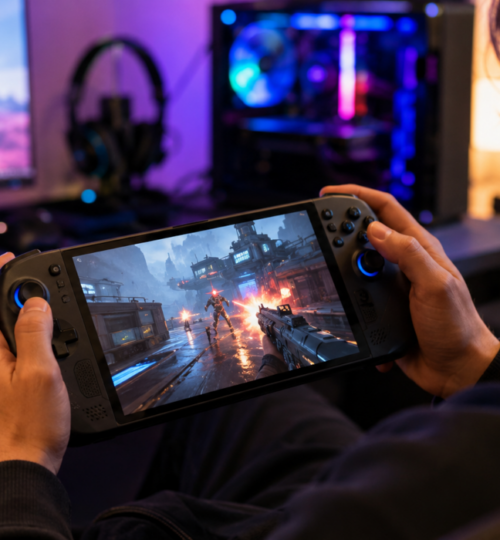
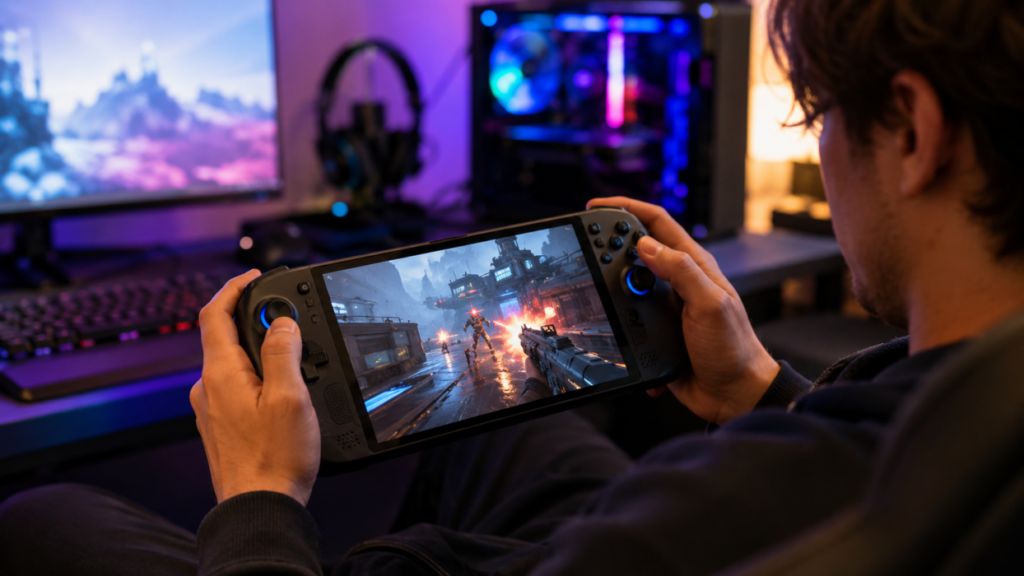
For most of PC gaming history, serious competitive play came with an unwritten hardware requirement. You sat at a desk. There was the tower, the high-refresh monitor, the mechanical keyboard, the mousepad large enough to double as a tablecloth, the headset, and enough cables behind everything to frighten an electrician. Portable gaming existed, but it belonged to another category. Handheld systems were excellent for travel, RPGs, platformers, and lighter multiplayer games. Nobody expected them to replace a competitive PC.
That line has become much harder to draw. The current generation of handheld gaming PCs can run the same Windows and Steam libraries as desktop systems while offering 90Hz, 120Hz, and even 144Hz displays, variable refresh rate support, modern AMD and Intel processors, fast NVMe storage, Wi-Fi 6E connectivity, configurable controls, and surprisingly capable integrated graphics.
A Lenovo Legion Go Gen 2, for example, offers an 8.8-inch OLED panel capable of 144Hz with variable refresh rate support. ASUS’s ROG Xbox Ally X combines AMD’s Ryzen AI Z2 Extreme processor with a 7-inch 1080p 120Hz FreeSync display, 24GB of LPDDR5X memory, and a 1TB PCIe 4.0 SSD. Valve’s older Steam Deck OLED remains relevant with its 90Hz OLED screen and low-latency display response.
These machines are not miniature gaming laptops anymore. They are becoming their own competitive platform.
From 30 FPS Portable Gaming to 120Hz in Your Hands
The biggest change is not simply that handheld PCs have become faster. Competitive gaming depends heavily on consistency, latency, controls, and visual response, areas where older portable hardware struggled badly. Playing a shooter at 30 frames per second on a small screen was acceptable for a campaign. It was miserable against another human running 144 FPS on a desktop.
Modern handheld hardware has changed the equation. A 120Hz display refreshes approximately every 8.3 milliseconds. A 144Hz panel drops that interval to roughly 6.9 milliseconds. That does not make handheld players magically equal to someone using a 360Hz desktop esports monitor, but the enormous gulf that once separated portable systems from competitive hardware has narrowed.
Variable refresh rate matters just as much. Competitive games do not always sit perfectly at 120 or 144 FPS on integrated graphics. Frame rates might bounce between 75, 93, 108, and 117 FPS depending on the map, smoke effects, player count, CPU load, and power profile. VRR allows the display to follow those changes instead of forcing frames into a fixed refresh schedule.
The result feels better than the raw FPS counter often suggests. ASUS supports FreeSync Premium on the 120Hz Xbox Ally X display, while Lenovo’s Legion Go Gen 2 supports a VRR range extending from 30Hz to 144Hz on its OLED panel. That is legitimate gaming hardware.
Competitive Games Are Often Perfect Handheld Workloads
There is another reason handheld esports makes more sense than people initially assume. Many of the biggest competitive PC games are not the hardest games to run.
Counter-Strike 2, Valorant, Rocket League, Overwatch 2, Rainbow Six Siege, Fortnite, fighting games, racing titles, MOBAs, arena shooters, and countless smaller competitive games are designed to run across broad hardware ranges. Developers want massive multiplayer populations, not a game restricted to $3,000 PCs.
That plays directly into handheld strengths. A portable PC does not need to reproduce Cyberpunk 2077 with every graphical feature enabled to prove itself as competitive hardware. It needs to hold a stable frame rate in the game the player actually competes in. Competitive players have been lowering settings for decades anyway.
Veteran Counter-Strike players were disabling visual effects and dropping resolutions long before handheld PCs existed. Quake players did it. Unreal Tournament players did it. Battlefield players did it. Competitive graphics settings have traditionally favored visibility, frame rate, and input response over visual spectacle.
Running a game at 800p, 900p, or 1080p using low or medium settings therefore does not automatically make a handheld setup compromised. In some games, that is already how competitive players prefer to play.
The Controller Problem Is Smaller Than It Used to Be
Controls remain the most obvious argument against serious handheld competition. A mouse is brutally precise. Thumbsticks are not. Nobody should pretend otherwise.
For games built around mouse aiming, especially Counter-Strike or Valorant, an equally skilled mouse player will generally have a significant control advantage over someone aiming exclusively with handheld analog sticks. That does not disqualify handheld hardware from competitive gaming. It changes which games and configurations make sense.
Rocket League already has a deep controller culture. Fighting games work naturally with handheld controls or attached gamepads. Racing games fit perfectly. Many third-person competitive games are controller friendly. Call of Duty and Fortnite have enormous controller populations.
Modern handhelds are also adding tools normally associated with higher-end controllers, including rear buttons, remapping, trigger configuration, gyro aiming, Hall effect components on some models, adjustable dead zones, and software profiles. Then things get more interesting. These devices are PCs.
Connect a compact mouse and keyboard through USB-C or Bluetooth and the handheld becomes a tiny competitive computer. Prop it up with a kickstand, connect the peripherals, and the player has essentially built a LAN station small enough to fit in a backpack.
Lenovo takes this concept especially far with detachable controllers and an integrated kickstand on the Legion Go family. A player no longer needs to choose permanently between handheld controls and traditional PC inputs.
Portable Does Not Have to Mean Playing on a Bus
People sometimes hear “handheld esports” and picture someone trying to play ranked Counter-Strike while standing on a subway. That misses the point. Portability changes where competitive gaming equipment can be taken, not merely where someone physically holds it while playing.
A player can carry a handheld PC to a friend’s house, hotel room, gaming meetup, college dorm, convention, small tournament, team practice, or LAN night without hauling a tower. A handheld, charger, folding keyboard, small mouse, headset, and mousepad can occupy less space than many gaming laptops by themselves. That matters for grassroots competition.
Competitive PC gaming grew through LAN parties, cybercafés, community servers, college clubs, local tournaments, and friends dragging computers into one another’s houses. Anyone who participated during that era remembers what moving desktop equipment involved.
CRT monitor included, if you are old enough. Handheld PCs remove much of that friction. A community tournament does not necessarily need twenty identical gaming towers if players can bring machines powerful enough to run the game themselves.
Dock It and the Definition Gets Even Stranger
The argument gets even more complicated once docking enters the discussion. Most modern handheld gaming PCs can output video through USB-C. The ROG Xbox Ally X includes USB4 and DisplayPort support, allowing the device to connect to external displays and peripherals.
Put a handheld into a dock, connect a monitor, mouse, keyboard, Ethernet adapter, and headset, and what exactly separates it from a small desktop gaming PC? Mostly wattage. That is an important distinction, but increasingly it is one of performance class rather than fundamental capability.
A high-end desktop GPU will destroy an integrated handheld processor in raw rendering power. Nobody is seriously arguing that a portable PC has replaced an RTX-powered tournament rig. Competitive games rarely require maximum rendering power, though. If the handheld can supply the frame rate required by the competition, then extra graphics horsepower has diminishing competitive value.
The strange result is that a player might practice on the couch using the integrated screen, connect the exact same device to a monitor for ranked play later that evening, then pack it into a case and bring it to a LAN the following weekend. One machine. Three configurations. That flexibility did not exist in PC esports twenty years ago.
Windows Gives Competitive Players an Important Advantage
Operating systems have become part of the handheld debate. SteamOS is arguably one of the reasons Valve’s Steam Deck became so approachable. It turns PC gaming into something much closer to the pick-up-and-play behavior expected from a console. Linux compatibility, however, can still become a problem with some multiplayer games, particularly titles whose anti-cheat implementations do not support the environment. That creates an unusual situation where Windows, despite its awkwardness on small touchscreens, remains extremely attractive for competitive handheld players.
The ROG Xbox Ally X runs Windows 11, giving players access to the broader Windows PC software ecosystem and avoiding many of the compatibility concerns associated with Linux-based handheld operating systems. Current comparisons between the Xbox Ally X and SteamOS handhelds continue to flag anti-cheat compatibility as one of the significant reasons competitive players may prefer Windows hardware. Microsoft and ASUS have also been pushing Windows toward a more console-like handheld experience through the Xbox Ally platform.
That matters. The best competitive handheld operating system probably is not the one with the prettiest interface. It is the one that launches the player’s games, anti-cheat software, voice communication, controller software, recording tools, and tournament applications without creating unnecessary trouble. Esports players have very little patience for an operating system becoming part of the match.
Battery Life Is Not the Limitation People Think
Battery life sounds like another automatic strike against handheld competition. Sometimes it is. Maximum-performance modes can consume power quickly, especially when a demanding game is pushing the processor and GPU continuously. Long practice sessions at high wattage can turn battery estimates into wishful thinking.
Competitive use does not require complete electrical independence, though. Nobody complains that a desktop esports PC needs a wall outlet.
For serious ranked sessions, players can simply connect the handheld to power. Modern machines have increasingly large batteries for mobile sessions, with Lenovo placing a 74Wh battery in the Legion Go Gen 2. Valve’s Steam Deck OLED uses a 50Wh battery, while manufacturers continue tuning processors around performance-per-watt rather than chasing desktop-class power consumption.
Battery power matters because it gives the player another option. Practice unplugged for an hour. Play casually from the couch. Review a replay in bed. Run aim training at lunch. Plug into power for serious matches. The handheld moves between those roles instead of forcing the player to build a separate device around each one.
Thermals Still Separate Good Handhelds From Great Ones
Portable PCs do have an enemy that desktop systems handle far more easily. Heat. A desktop gaming case has enormous thermal advantages. Large heatsinks, multiple fans, dedicated GPU coolers, unrestricted airflow, and much higher power budgets allow desktop components to sustain heavy workloads for hours. A handheld has to dissipate heat through something roughly the size of a thick controller.
That means sustained performance matters more than short benchmark runs. A handheld that produces excellent frame rates for five minutes and then drops clocks after prolonged heat buildup is far less useful for competition than a slightly slower device that maintains stable performance for an entire match.
This is where reviews, long-duration testing, and frame-time measurements become far more valuable than promotional performance numbers. Average FPS can lie.
Competitive players should care about sustained clocks, 1 percent lows, frame-time consistency, fan behavior, charging temperatures, power profiles, and whether performance changes after forty minutes of continuous play. Handheld esports will put more pressure on manufacturers to get those details right.
The Screen Size Has a Real Competitive Cost
Not every limitation can be engineered away. A seven-inch display is still seven inches. Small targets become physically smaller. Distant enemies are harder to identify. Interface elements designed for 24-inch monitors can become cramped. Games with dense HUDs may feel uncomfortable. Sitting closer helps, but there are obvious ergonomic limits.
The Legion Go Gen 2’s 8.8-inch display addresses some of that problem, and its 144Hz OLED panel pushes handheld screens much closer to what competitive players expect from dedicated gaming hardware. Still, nobody should expect professional Counter-Strike teams to abandon tournament monitors because an eight-inch OLED looks nice.
The more interesting audience sits below that level. Millions of competitive players take ranked games seriously without being salaried professionals. They join ladders, community tournaments, Discord leagues, amateur teams, college competitions, pickup matches, and online qualifiers.
Those players do not need the equipment used on a championship stage. They need equipment that does not get in their way. Handheld PCs are getting remarkably close.
The Price Problem Could Slow Everything Down
Performance has improved faster than affordability. Premium handheld PCs now push deep into gaming laptop pricing. Current high-end devices can approach or exceed $1,000, while some boutique systems climb dramatically higher. Recent 2026 buying guides have highlighted that widening price spread, with mainstream handheld recommendations ranging from lower-cost Steam Deck and Legion Go S models to roughly $1,000 flagship machines and niche systems costing far more.
That creates an awkward comparison. A $1,000 handheld must compete not only against other handhelds but against gaming laptops, used desktops, previous-generation hardware, and full desktop builds. Portability has value, but every buyer assigns that value differently. A teenager who moves between two homes may see a handheld PC as the perfect competitive system.
A college student with limited dorm space might reach the same conclusion. Someone with a permanent gaming room and a 240Hz monitor probably gets far more performance per dollar from a desktop. Handheld esports does not require handhelds to replace desktops. It only requires them to become good enough that choosing one no longer means giving up competitive gaming.
Competitive Communities Can Do Something Interesting With This
Handheld hardware opens a format that community esports organizers should be paying attention to. Handheld-only ladders could become legitimate competition categories.
Controller-only handheld tournaments could create their own rulesets. Fighting game communities could run portable brackets with minimal equipment. Racing events could build standardized handheld configurations. Community LANs could support bring-your-own-handheld divisions without needing rows of gaming PCs.
Even hardware restrictions could become part of the competition. Imagine a tournament requiring an integrated display, integrated controls, and a fixed performance profile. Instead of allowing players to spend indefinitely on faster hardware, the format would intentionally embrace the limitations of the platform.
Competitive gaming has done this before. Console tournaments standardized hardware because everyone played on the same machine. Fighting games built entire competitive cultures around controllers and arcade sticks. Mobile esports turned phones and tablets into tournament equipment.
The handheld PC sits somewhere between those worlds. It carries PC games, PC accounts, PC settings, PC mods, PC peripherals, and PC multiplayer services while behaving physically like a console. That combination deserves its own competitive identity.
Handheld Players Are Still PC Players
There is an old attitude in PC gaming that tends to define legitimacy through hardware.
- Real PC gaming requires a tower.
- Real competitive gaming requires mouse and keyboard.
- Real esports requires a desk.
Those rules were never technical laws. They were descriptions of the equipment people happened to have. The equipment has changed.
A Steam Deck OLED can display games at up to 90Hz. The ROG Xbox Ally X pushes that to 120Hz with VRR and a Ryzen AI Z2 Extreme processor. Lenovo’s Legion Go Gen 2 reaches 144Hz on an 8.8-inch OLED display. Windows handhelds can run the same launchers, game clients, communication software, and competitive titles used by desktop players.
The competitive question is no longer whether a handheld PC qualifies as a gaming PC. The more useful question is whether the machine can run a specific game at the performance level a player expects. Sometimes the answer will still be no. Increasingly, it is yes.
And somewhere tonight, somebody is going to beat a player sitting behind a giant RGB tower while holding the entire opposing gaming PC between two hands.