
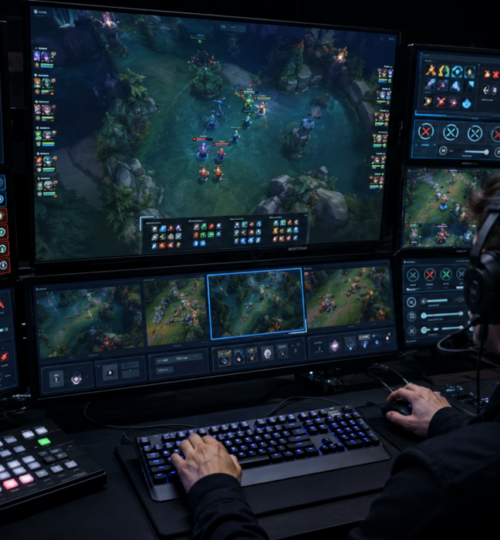
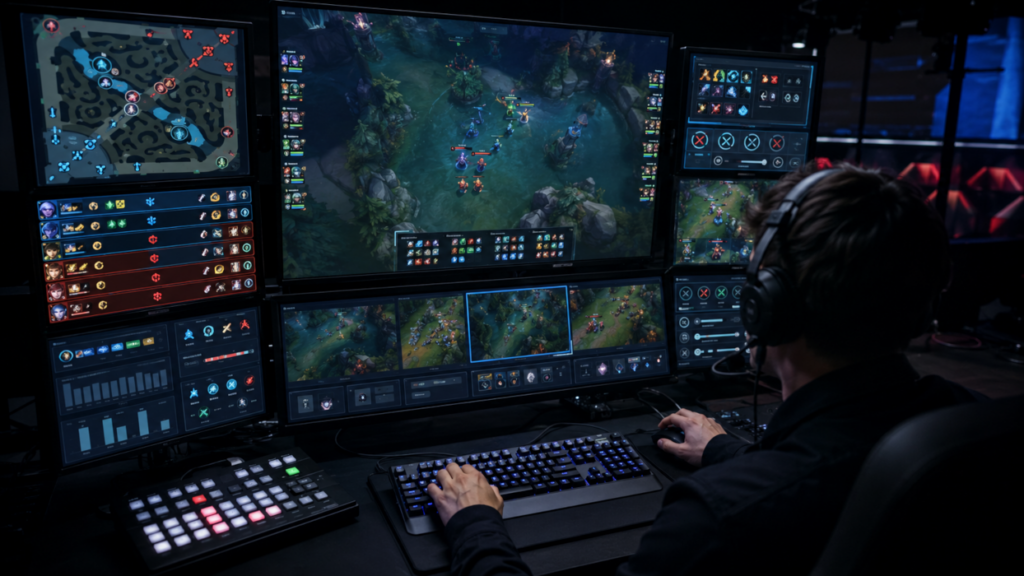
For years, competitive games often treated spectating as a secondary layer. The match existed first, then tournament organizers, broadcast crews, community developers, and production teams found ways to turn that match into something an audience could actually read. That model still exists, but the direction of travel is changing. Games with serious competitive ambitions are increasingly being built with observer data, replay systems, camera controls, clean feeds, and spectator-specific interfaces considered much earlier in development.
That matters because modern esports is no longer satisfied with a camera pointed at a player and a scoreboard in the corner. A good broadcast has to explain a match in real time. Viewers need to understand economy, health, equipment, positioning, ability state, objective progress, round history, team resources, and the developing shape of a fight without covering the screen in clutter. The better the observer system is tied to the game itself, the less the production team has to guess, scrape, reconstruct, or bolt on later.
The Observer Is Becoming Its Own Type of Player
A spectator client has very different needs from a normal player client. The player should only receive and display information that is legal and relevant to play, while an authorized observer may need a complete view of both teams, hidden positions, inventories, cooldowns, objective state, and other information that would be unacceptable in a live player HUD. Treating the observer as a distinct role inside the game architecture makes those permissions easier to define and much safer to manage.
That distinction is already visible in mature competitive games. VALORANT has had observer-specific functions since its early patches, including persistent custom-lobby player ordering, team-aware HUD behavior, observer minimap fixes, projectile-follow support, and tournament moderation controls. Riot continued refining that side of the game, and its 2025 VCT broadcast HUD added a revised round timeline, scoreboard, and dedicated clutch display.
Rainbow Six Siege has taken a similar path through years of spectator and replay development. Ubisoft has added caster HUD support, free cameras, replay improvements, operator information, team-color behavior for observation devices, and updated caster cards that can expose live location, current item use, and exact health in spectator mode. Those are not decorative additions. They are examples of the game exposing structured competitive state directly to the people responsible for presenting the match.
Data-Rich Broadcasts Start With Replicated Game State
The attractive part of an observer interface is what appears on screen, but the hard part sits underneath it. A production HUD can only be accurate if the game has a reliable way to expose the state of the match. Player names and scores are easy. Real-time position, inventory, health, utility, ability state, objective control, round transitions, eliminations, economy, and event timing require a coherent data model that stays synchronized with the server.
This is where engine architecture becomes directly relevant to esports. Unreal Engine’s replay system, for example, is built around its networking and replication systems. Epic documents that a replay can reconstruct a game from replicated information, checkpoints, and incremental changes, and that the replay driver can use a dedicated spectator controller. Epic also recommends planning multiplayer architecture early when a project may need networked play, because replication choices affect how game state is structured from the beginning.
That same foundation is valuable for live observing. If health, inventory, status effects, objectives, timers, and player identities already exist as clean, replicated state, an observer interface can subscribe to those systems instead of reverse-engineering them. If those values are scattered across client-only scripts, animation states, temporary UI widgets, or systems that were never designed to expose their data, a tournament HUD becomes much harder to build reliably.
Replays and Live Spectating Are Closely Related Problems
Replay systems are often discussed as tools for players, coaches, anti-cheat review, or content creation, but they also solve many of the same engineering problems that a serious observer mode must solve. Both systems need access to enough match state to reconstruct what happened. Both need cameras that can detach from normal player restrictions, and both benefit from event markers that can identify kills, objectives, ability use, and other moments worth revisiting.
VALORANT’s replay system, released on PC with Patch 11.06 in September 2025, provides all ten first-person views, a third-person free camera, player outlines, projectile following, variable playback speed, round skipping, time jumping, and timeline markers for events such as kills and ultimate use. That feature set is useful to ordinary players, but from a production standpoint it also demonstrates how much more useful a match becomes once the engine records meaningful state instead of producing only a flat video.
Epic’s engine documentation makes the connection even clearer. Its replay streamers can record locally, hold recent action in memory for instant replay, or send replay data over HTTP to another machine or server. The engine can also change actor relevance for replay recording, which matters because a normal client may never receive distant or hidden information that a full replay or broadcast observer needs.
A Good Spectator HUD Has to Explain, Not Merely Display
More data does not automatically produce a better broadcast. In fact, a badly designed observer interface can make a match harder to follow by filling every edge of the screen with numbers, icons, bars, timers, player cards, and alerts. The job of the interface is to decide which information deserves immediate attention and which information should remain available without constantly competing with the action.
That is why spectator design has become its own UI discipline. A player HUD is optimized for fast personal decisions. An observer HUD has to tell the story of ten or more players at once, often while a producer changes cameras and commentators are explaining a developing play. Team color, information grouping, icon consistency, animation speed, card size, readability at broadcast resolution, and even the order of players across the screen all affect how quickly an audience can understand what is happening.
Ubisoft’s recent caster-card changes in Siege are a good example of this process. The cards were simplified, rearranged, and given a more selective set of live information rather than simply accumulating every possible statistic. Riot described its 2025 VALORANT HUD in similar terms, focusing on clearer cues, a revised scoreboard, round timeline, and a special 1v1 clutch presentation.
Observer Cameras Need Game Knowledge Too
Camera control looks simple until a competitive match starts moving faster than a human observer can predict. First-person switching, third-person follow cameras, free cameras, objective snaps, projectile tracking, saved positions, and overhead tactical views all reduce the amount of manual camera work required to keep up. The most useful systems are aware of the game’s rules rather than behaving like a generic noclip camera.
Blizzard explored this years ago with Overwatch’s professional viewer tools. Its World Cup and Overwatch League viewers allowed first-person, third-person, overhead, and free views, along with player hotkeys, map overlays, saved camera bookmarks, playback speed control, and objective snapping. Those systems made it possible to study the same match from multiple angles because the viewer was running against recorded game state rather than a single broadcast video.
The same principle applies to live production. A camera system that knows where the objective is, which player just entered a clutch, where a projectile is traveling, or which team is committing resources can help an observer reach the relevant action faster. Fully automated observing remains difficult because competitive games contain feints, setup plays, and off-screen decisions that algorithms can misread, but game-aware camera assistance can reduce missed moments without taking editorial control away from human observers.
The Broadcast Layer Is Moving Closer to the Source
Traditional esports production often combines the game feed with external graphics systems. That remains useful because broadcast teams need sponsor graphics, desk segments, lower thirds, statistics packages, remote feeds, and event-specific branding that do not belong inside the game client. The shift is that more of the match-specific information can now originate from authoritative game systems rather than being re-created outside them.
Counter-Strike has long been an example of how game data can be distributed for spectators. Valve’s broadcast architecture sends game-state fragments from the game server for spectator playback, including full snapshots and incremental changes, while Source 2 carries that model forward for Counter-Strike 2 playcast workflows. The important concept is that a broadcast can consume structured match information from the game itself instead of relying only on captured video.
This separation also makes clean feeds more useful. A tournament can provide an observer-only feed to co-streamers while keeping commentary, branding, or local presentation outside the game layer. Riot used observer-only broadcasts in portions of its 2025 Game Changers North America structure, giving approved co-streamers access to match viewing without requiring every production to duplicate the observing process.
Building It Early Prevents Expensive Competitive Debt
Observer tools are easy to postpone because they do not directly improve the experience of the first playable build. That delay can become expensive. A game that reaches launch without clean event data, replay-safe state, spectator permissions, camera hooks, or stable player identifiers may later require significant engineering work before it can support serious tournament production.
The problem resembles technical debt elsewhere in multiplayer development. If the server never records a certain state because players do not need it, a later replay system cannot magically reconstruct it. If hidden information is tightly coupled to anti-cheat restrictions without a secure observer path, tournament clients may struggle to access it. If the UI assumes one local player perspective, building a ten-player broadcast panel later can force large changes to data flow and presentation code.
Planning for spectators early does not mean finishing an esports HUD before the game is fun. It means establishing the hooks that keep future options open: stable replicated identifiers, event logging, observer roles, camera interfaces, replay-compatible state, tournament configuration, and a UI layer that can display data from perspectives other than the active player. Those systems are useful even if a title never becomes a major esport, because they support replays, coaching, moderation, content creation, community tournaments, and post-match analysis.
Spectator Design Is Becoming Part of Competitive Game Design
The most interesting consequence is that developers are starting to think about readability for people who are not actively playing. Competitive visual effects must communicate clearly from observer angles. Maps need overhead views that remain understandable. Team colors, outlines, objective indicators, and status effects have to survive compression on a livestream and still make sense when the camera is not attached to the local player.
That pressure can improve the game itself. Counter-Strike 2’s official presentation emphasizes visual effects and UI changes that communicate game state more clearly, while Siege and VALORANT have repeatedly adjusted spectator-specific displays as their competitive scenes matured.
Esports production will still need talented observers, directors, graphics operators, analysts, and commentators. What is changing is the quality of the raw material they receive. When the game engine already understands spectators as a first-class audience, the broadcast crew can spend less effort extracting basic information and more effort deciding which information matters at that exact moment.
The next major step is likely to be greater flexibility rather than simply denser HUDs. Different viewers may want different levels of information, co-streamers may want clean or lightly instrumented feeds, analysts may want deep tactical overlays, and casual viewers may need a simpler presentation. Once observer data is structured inside the game from the start, those different viewing modes become interface choices instead of separate engineering projects.