Cloud gaming changes where the game runs, but it also changes where anti-cheat can see. In a conventional PC setup, the game, the renderer, the anti-cheat driver, and most cheat software all compete inside the same machine. With a streamed game, the executable and rendering workload sit in a data center while the player receives compressed video and sends controls back across the network. That separation is useful for accessibility and hardware flexibility, but it also creates an appealing hiding place for a newer class of visual cheats.
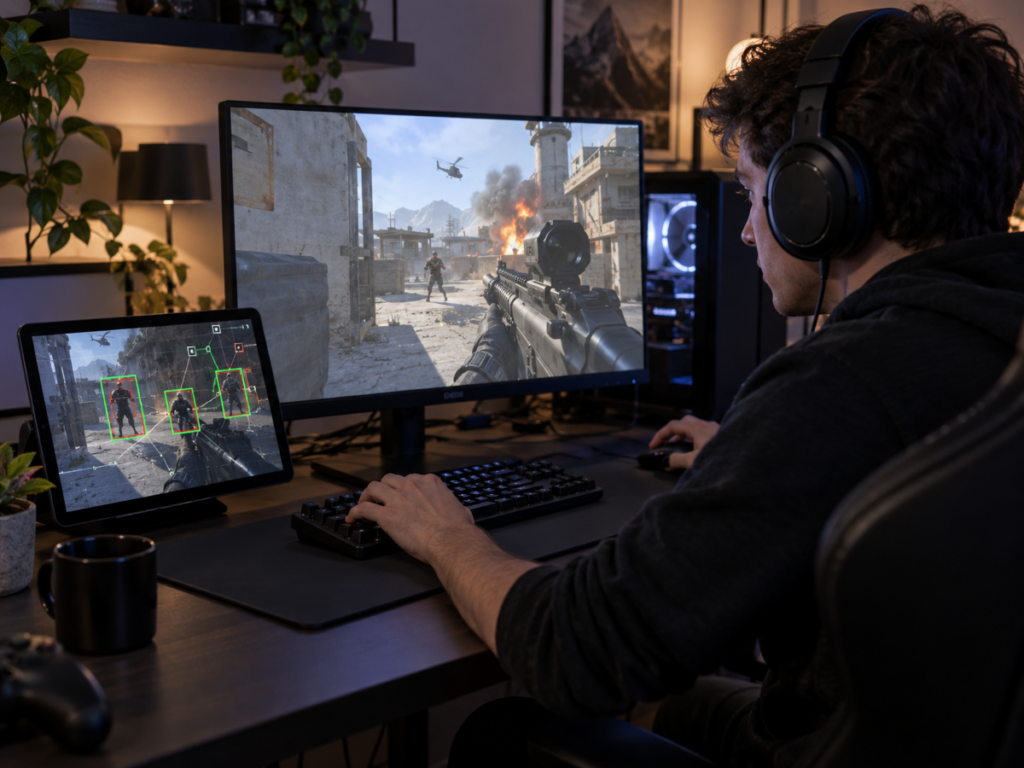
The basic threat is a pixel-bot or visual aimbot that never reads game memory, never injects code into the game process, and may never execute on the machine actually running the game. Instead, computer vision watches the same video frames the player sees, identifies likely targets from pixels, and generates automated aim or firing input. Security researchers have warned that this model fits cloud gaming unusually well because traditional memory cheats lose access to the remote game host while visual cheats still receive exactly what they need: a video stream. A 2024 USENIX Security paper went so far as to describe visual aimbots as a likely major cheating path for cloud gaming because the client receives imagery while remaining separated from the server running the game.
The Old Anti-Cheat Boundary Was the Player’s PC
Modern anti-cheat systems have spent years pushing deeper into the local machine because cheat developers kept doing the same. Riot’s Vanguard architecture, for example, uses a kernel-mode driver to help validate system state and protect the game from software operating at higher privilege levels. Riot has also publicly discussed DMA cheats, where game memory can be transferred to a second computer for processing, as one reason anti-cheat cannot treat ordinary user-mode scanning as a complete defense.
BattlEye describes a similar broad model, with protection and scanning in both user and kernel modes on the protected system. Call of Duty’s RICOCHET Anti-Cheat combines a PC kernel driver with server-side analysis, while newer releases have added Secure Boot, TPM 2.0, attestation, input-device detection, and machine-learning systems intended to identify suspicious aim and behavior. These systems differ in implementation, but they share an assumption that matters here: some part of the defense can observe the computer that is actually executing the game.
Cloud streaming breaks that physical relationship. NVIDIA describes GeForce NOW as a cloud service that provides a virtual gaming PC and streams content to the user’s device. Its developer documentation even provides a cloud-detection API so games can change behavior when running inside GeForce NOW, including altering hardware checks or, in some cases, disabling anti-cheat mechanisms that are unnecessary inside the provider’s controlled environment. That does not mean cloud sessions are unprotected. It means the trust boundary has moved.
Pixel-Bots Need the Picture, Not the Process
Traditional aimbots often depend on privileged information such as player coordinates, bone positions, visibility flags, recoil values, or other state obtained from memory. Visual bots take a different route. They treat the rendered frame as an image-recognition problem, looking for characters, silhouettes, colors, health bars, outlines, or other visible features and then deciding whether an input should be generated.
This approach has become more practical as real-time object detection has improved. Recent academic work describes AI-driven visual cheats that use object detectors in games including Counter-Strike 2, Rust, Marvel Rivals, and Apex, while research on visual aimbots has examined both same-machine and external-machine arrangements. In the external version, the game image can be captured away from the protected system and processed elsewhere, with only resulting input returning to the game machine.
Cloud gaming removes one of the awkward parts of that design because the video is already leaving the game host by design. The player must receive a sequence of decoded frames, and the service must accept keyboard, mouse, controller, or touch input back from the client. A malicious vision system positioned somewhere in that path can work entirely from legitimate output.
From the remote anti-cheat’s point of view, that difference is substantial. There may be no suspicious process beside the game executable, no injected DLL, no modified kernel driver, and no local screen-capture API running on the remote Windows session. The automation can exist on the endpoint receiving the stream, or on another device that observes that endpoint, while the game host sees ordinary control messages arriving through the streaming service.
Why Cloud Streaming Can Act Like a Cheat Cloak
The phrase “cheat cloak” describes an architectural blind spot rather than invisibility. A cloud host can strongly control its own operating system, drivers, files, and virtual hardware, yet still have limited direct visibility into software running on the player’s separate endpoint. That endpoint may be a Windows PC, a handheld, a television device, a phone, a browser, or another supported client.
This flips a long-standing assumption in PC anti-cheat. A publisher can make the remote game environment exceptionally clean and still receive machine-generated input from outside it. The more tightly the cloud provider locks down the game VM, the less useful many traditional cheat techniques become, but visual automation remains because it does not need internal state.
The threat is not theoretical in the broader sense. Public cheat projects and commercial offerings already advertise external computer-vision systems designed to avoid running cheat logic on the protected game machine, and some specifically advertise compatibility with cloud gaming. Those claims should not be treated as independent proof that they defeat every named anti-cheat system, but they demonstrate clear developer interest in the architecture. NVIDIA’s own GeForce NOW terms explicitly prohibit cheating, botting, exploiting, and other unauthorized automated activity, confirming that service rules treat this behavior as abuse rather than an allowed side effect of streaming.
The harder issue for defenders is attribution. A remote session may see aim corrections and firing commands, but it cannot automatically tell whether those commands came directly from a human hand, an accessibility layer, supported remapping software, a controller firmware feature, or a vision model watching the stream. That makes the input itself more important evidence than the presence of a particular executable.
Latency Is a Constraint, but Less of a Shield Than It Used to Be
Cloud gaming already adds an encode, network, decode, display, input, and return path that local rendering does not have. A visual bot adds another decision step. In theory, that extra delay should reduce its value, especially in shooters where a few frames can separate a clean first shot from a lost duel.
In practice, computer vision can operate quickly enough that latency alone cannot be treated as protection. The cheating system does not need perfect semantic understanding of the match. It only needs to recognize a useful target quickly enough to alter aim or fire, and it can be designed around the timing characteristics of the streaming path.
That limitation may still matter in top-level play. A cloud-based visual bot can suffer from compression artifacts, changing bitrate, motion blur, resolution scaling, packet loss, and the ordinary delay of remote rendering. NVIDIA notes that GeForce NOW may lower resolution or bitrate when bandwidth conditions require it, which changes the visual material available to any automated detector as well as to the human player.
Those imperfections are friction, not a reliable defense. Models can be trained against noisy video, and cheats do not need to outperform elite players in every exchange to damage ranked play. A modest automated advantage applied consistently can distort matchmaking, leaderboards, tournament qualification, and player trust.
Detection Has to Move Toward Behavior and Server-Side Evidence
The most promising response is already visible in how major anti-cheat teams are changing their language. RICOCHET has increasingly emphasized behavioral detection, including aim patterns, reaction times, movement, input timing, consistency, and other signals that can indicate machine-driven play even when a specific device or program cannot be identified. Its 2026 updates on unauthorized input devices state that detections focus on how inputs behave rather than simply identifying which hardware is attached.
That approach matters for cloud play because server-side systems do not care where the player endpoint is. If a model can distinguish human aim from automated aim using match telemetry, shot timing, camera movement, target acquisition, and repeated patterns, then moving the cheat outside the streamed game host does not erase the evidence it produces inside the match.
The difficulty is avoiding a crude “too good equals cheating” model. High-level players really do make fast corrections, hold unusual angles, pre-aim correctly, and produce mechanical consistency that would look impossible in average matchmaking. Good behavioral systems therefore need broad context, repeated observations, confidence thresholds, and ways to separate legitimate skill from automation. Activision says its newer models examine more than aim alone, including movement, engagement patterns, reaction behavior, map activity, latency anomalies, and team-level statistics.
For competitive communities, this also strengthens the case for layered evidence. Client integrity still matters for local players. Cloud-provider attestation matters for streamed sessions. Server telemetry, replay analysis, account history, input statistics, and human review can cover areas that endpoint scanning cannot.
The Stream Itself May Become Part of Anti-Cheat
Researchers are also exploring defenses that attack the visual cheat’s perception rather than searching for its code. The 2024 USENIX work on “Invisibility Cloak” tested tiny image perturbations intended to interfere with visual aimbot object detection while remaining hard for human players to perceive. A separate 2026 study proposed adversarial perturbations against AI-driven visual cheats and evaluated them across several current multiplayer games.
For cloud gaming, that line of research is especially interesting because the provider controls the rendered video before it reaches the client. A future defensive system could theoretically alter frames in ways that preserve human play while degrading machine recognition, although deployment would raise hard questions about image quality, accessibility, compression, false positives, and adaptation by cheat developers.
Cloud platforms also possess telemetry that a normal publisher may not. They can know that a session is streamed, measure end-to-end timing, control the host image, and potentially coordinate account, device, session, and input signals with the game operator. NVIDIA’s current terms state that GeForce NOW can collect session, device, software, network, and service-quality data, and that suspected cheating or botting can lead to enforcement or notification to a game publisher.
That coordination is where the next anti-cheat boundary is likely to form. The old model tried to secure the PC. Cloud gaming makes the protected environment cleaner, but it also pushes part of the player’s interaction outside that environment, where a visual bot can watch the same pixels and imitate the same controls as a human. Competitive integrity therefore has to follow the match beyond the operating system, into behavior, telemetry, streaming infrastructure, and the statistical fingerprints left by automated play.