For years, competitive multiplayer gaming appeared to belong almost exclusively to giant publishers. Building a serious online game required matchmaking infrastructure, anti-cheat systems, dedicated servers, constant balancing, live support, and enough marketing money to keep queues full. Small developers could make inventive single-player games, but competing directly with Call of Duty, Battlefield, League of Legends, Counter-Strike, or major fighting franchises seemed financially reckless.
That assumption is breaking down. Small and independent studios are no longer trying to beat AAA publishers through production scale. They are attacking the parts of competitive gaming that large companies have neglected. Faster matches. Cleaner rule sets. Lower hardware requirements. Better community communication. Server browsers. Mod support. Affordable prices. Games designed around one strong competitive idea instead of a giant content schedule.
These releases rarely remove millions of players from one blockbuster overnight. The movement is quieter than that. A squad stops playing its usual shooter twice a week. A fighting game group moves its local bracket to a new title. A clan discovers that a fifteen-dollar game produces better team stories than the franchise it has played for a decade. That is how the migration starts.
Players Are Tired of Carrying the Entire AAA Machine
Modern AAA multiplayer games ask for more than time. They ask players to accept massive downloads, seasonal resets, overlapping currencies, rotating stores, premium bundles, daily challenges, battle passes, limited-time events, and frequent menu redesigns. The basic act of joining a match can feel buried beneath a publishing strategy.
Many players still enjoy these games. Their production quality, animation, audio, licensed content, and matchmaking reach remain difficult to match. The problem is that competitive players do not always need the entire package. They need readable combat. Reliable controls. Fair maps. Stable performance. Strong opponents. A reason to improve.
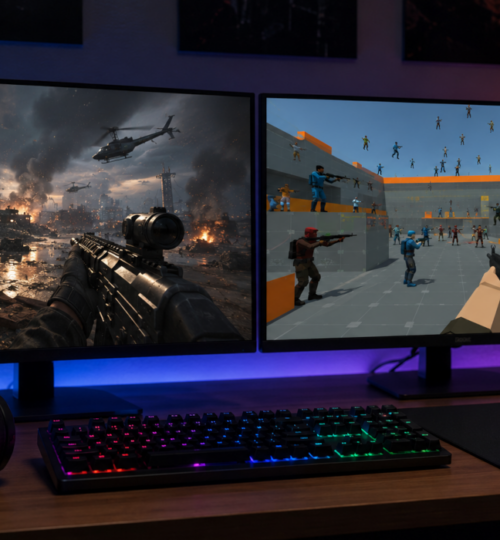
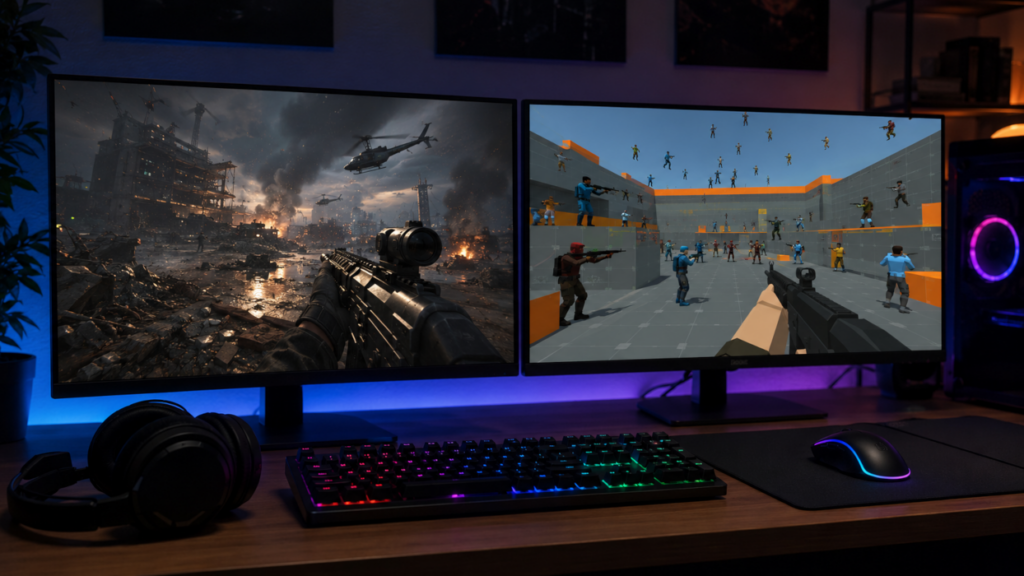
Small studios can build around those needs without supporting thousands of employees or satisfying several layers of corporate management. Their games can look rougher and still feel more focused. A low-poly soldier does not need detailed facial animation when the player controlling it can drag a wounded teammate behind cover, destroy a wall, call for a medic, and coordinate a push through proximity chat. That difference matters. Competitive players forgive plain graphics faster than they forgive poor match design.
BattleBit Remastered Proved That Scale Does Not Require AAA Presentation
BattleBit Remastered remains one of the clearest examples of a small team identifying an abandoned audience. The game was originally built by three developers and launched into Steam Early Access in June 2023. It offered matches with as many as 254 players, destructible environments, vehicles, class roles, squad communication, and the kind of large-scale infantry chaos associated with older Battlefield games. It reportedly sold more than 1.8 million copies during its first two weeks.
Its visual style was deliberately simple. Character models looked closer to block figures than cinematic soldiers. That simplicity became an advantage. BattleBit ran on modest hardware, occupied far less storage than many military shooters, and kept the screen readable even when hundreds of players were fighting across the same map.
The game did not win players because it imitated Battlefield perfectly. It won them because it remembered what Battlefield players liked doing. Squads moved together. Medics mattered. Buildings could be opened, breached, or reduced to rubble. Voice chat produced equal amounts of tactical cooperation and absolute nonsense. Matches felt social, unpredictable, and player-driven.
BattleBit has also shown the danger small multiplayer teams face. Long gaps between major updates and communication frustrations have reduced its momentum, while recent Steam reviews have been more divided than its lifetime rating. Its Steam page still lists more than 78,000 English-language reviews with a strong overall positive percentage, but the current audience is much smaller than the explosive launch crowd.
That decline does not erase the breakthrough. A three-person development team forced the military shooter audience to reconsider how much graphical polish was actually required to create a memorable large-scale battle.
Rivals of Aether II Gives Platform Fighters a Competitive Home
Nintendo’s Super Smash Bros. series holds enormous cultural power, but its competitive relationship with its own community has often been uneasy. Official support, online performance, tournament rules, hardware access, and long-term competitive planning have not always aligned with what dedicated players wanted.
Rivals of Aether II stepped directly into that opening. Developed by Aether Studios and released in October 2024, the sequel expanded the original indie fighter into a full 3D platform fighting game with shields, ledge mechanics, advanced movement, improved online systems, and a roster designed for serious matchup study.
The appeal is not simply that Rivals resembles Smash. It is that the developers openly build for players who enjoy the deeper competitive language of platform fighters. Movement techniques are intentional. Character mechanics support experimentation. Community tournaments are treated as part of the game’s identity rather than an inconvenient side activity.
The commercial model also earned goodwill. Rivals of Aether II launched at a standard purchase price, with future characters and modes promised without separate character fees. Cosmetic purchases support continued development without splitting the competitive roster between players who bought different fighter packs.
The game reached an all-time Steam concurrency peak above 11,000 players and continues to hold a smaller but active audience. That would look modest beside a mainstream shooter, but fighting game health is not measured by battle royale standards. A few hundred simultaneous players can support matchmaking, weekly brackets, training communities, and regional tournament scenes when those players are committed.
Aether Studios has continued adding unusual fighters and competitive mechanics rather than sanding away the game’s personality. A pirate shark who gathers money during combat, shops for upgrades, and can fish in the middle of a match is not the sort of design likely to survive a committee meeting at a risk-averse publisher. In Rivals, that weirdness becomes matchup knowledge.
Small Games Can Serve Competitive Niches That Publishers Ignore
AAA publishers usually want multiplayer concepts capable of reaching several million users. Small teams can survive by serving communities that are too specific for that target. This produces games built around unusual forms of competition. Deception games reward reading behavior rather than aiming. Physics-based fighters turn positioning and momentum into the main skill test. Independent racing games concentrate on time trials, route optimization, and leaderboard chasing without requiring hundreds of licensed cars. Tactical games can target players who enjoy slower communication-heavy matches but no longer feel represented by mainstream shooters.
The audience does not need to be enormous. It needs to care. A small competitive game can become deeply rooted when players know the developers, recognize tournament organizers, contribute strategy guides, create maps, moderate servers, and help newcomers learn. The border between player and contributor becomes thinner.
That connection is difficult for a giant franchise to reproduce. A publisher may collect feedback from millions of matches, but players rarely feel that an individual discussion changed the direction of the game. In a smaller community, one detailed forum thread can influence a balance patch. The result is ownership without legal ownership. Players begin treating the game as something they are helping build.
Price and Hardware Access Are Competitive Features
AAA games have steadily increased their technical demands. High-resolution texture packs, advanced lighting, detailed environments, and cinematic assets create impressive screenshots, but they also limit who can play comfortably. Competitive communities benefit from broad access. Every hardware barrier removes possible teammates, opponents, tournament entrants, and server regulars.
Indie multiplayer games often succeed because they can run on older gaming PCs, budget laptops, handheld systems, or machines without top-tier graphics cards. Their lower purchase prices also make it easier for an entire friend group to move together.
That group effect is powerful. A sixty or seventy-dollar game must convince each player individually. A ten, fifteen, or thirty-dollar game can become an impulse purchase for a whole squad after one person posts it in Discord.
Lower prices do not automatically create healthier communities, but they reduce the cost of experimentation. Players can try a strange arena shooter or platform fighter without feeling that they must commit for the next six months to justify the purchase. AAA games often compete for long-term retention. Indie games can win simply by being easy to start.
Competitive Players Are Following Mechanics, Not Brands
Brand loyalty remains strong in gaming, especially among veterans who have spent years with one series. That loyalty has limits. Players notice when sequels remove favorite systems. They notice when server browsers disappear, custom communities weaken, maps become less readable, matchmaking grows more manipulative, or competitive balance takes second place to seasonal content. Familiar logos cannot permanently cover design decisions that make the game less enjoyable.
Small studios benefit from that frustration. They do not need to create a completely original genre. They can recover ideas that larger publishers discarded. BattleBit revisited massive team warfare with communication and destruction. Rivals of Aether II embraced technical platform fighting. Other independent games have revived arena shooting, extraction competition, tactical dueling, local multiplayer, community servers, and mod-friendly systems.
This is not creative theft. Genres have always advanced through iteration. The difference is that small studios are now moving faster than the companies that once defined those genres.
A large publisher may spend five years deciding how to modernize an old multiplayer formula. A small team may release a playable version, gather community feedback, and discover the answer before the larger project reaches its marketing campaign.
The Failures Matter as Much as the Hits
Competitive multiplayer remains one of the hardest categories for an independent studio. A good game can fail because matchmaking takes too long. Regional populations can collapse. Skilled veterans can overwhelm new players. Cheaters can damage trust faster than a small support team can respond. One unpopular progression update can split the audience. A weak launch week can become permanent because players assume empty queues will remain empty.
SUPERVIVE demonstrated the risk. Theorycraft Games assembled experienced developers and created a polished hero-based battle royale with strong combat ideas. The project moved from open beta into a full 2025 release, yet it still failed to secure the lasting population required for an expensive live multiplayer operation.
That does not mean the design lacked merit. It means competitive games face a brutal population problem. Players create the content for one another. Without enough opponents at comparable skill levels, even excellent mechanics begin to break down.
Deceive Inc. faced a similar long-term struggle after building a distinctive competitive game around espionage, disguises, information gathering, and sudden firefights. Its developer closed, but work later resumed on community-hosted dedicated servers so the game would not vanish with its official backend.
These cases expose a weakness in the live-service model itself. Small studios are encouraged to operate permanent online games, but permanent operation requires recurring revenue, reliable population, backend maintenance, moderation, and technical support.
Community servers can reduce that risk. So can peer hosting, offline modes, bots, local play, mod tools, and private match support. Games that depend entirely on a centralized service may be competitive today and inaccessible tomorrow. Veteran players understand this better than most. They have already watched favorite servers shut down.
Community Tools Are Becoming a Selling Point Again
For much of early online gaming, competitive communities built their own structures. Players rented servers, wrote rules, organized ladders, formed clans, created mods, recorded demos, and handled disputes. The game supplied the battlefield. The community supplied the institution.
Modern matchmaking made online play easier, but it also removed control. Players were placed into temporary groups, completed a match, and disappeared back into the queue. Rivalries became harder to maintain. Server identity faded. Clan culture weakened. Independent developers have an opportunity to restore those missing layers.
A server browser can matter more than a cinematic campaign. Spectator tools can matter more than another cosmetic rarity. Replay files, tournament lobbies, admin controls, custom rule sets, public APIs, clan tags, stat exports, and self-hosted servers can keep a competitive game alive long after its launch campaign ends. These features are rarely glamorous. They do not produce the best trailer footage. They produce communities.
For a revived league with roots reaching back to 2004, that distinction is familiar. Competitive gaming was not originally built around seasonal engagement charts. It grew through repeated matches between recognizable players and teams. Rankings had history. Victories had context. A rival was not a random username generated by matchmaking. It was someone waiting for the rematch. Small studios are rediscovering the value of that structure because they cannot afford to replace their audience every season.
AAA Publishers Are Already Responding
Large publishers are not blind to the shift. Many now borrow the visual simplicity, early-access structure, rapid testing, extraction mechanics, social comedy, creator-friendly systems, and smaller match formats popularized by independent releases. The copying works in both directions. Indie developers adapt familiar AAA systems, while major studios package indie ideas with larger budgets.
The real pressure is not visual. It is philosophical. A small team can release a game that does one thing extremely well. A large publisher often needs every project to support broad monetization, extended retention, multiple audience segments, cross-platform growth, and years of scheduled content. Those business requirements can turn a sharp competitive idea into a crowded product.
Players can feel the difference. They feel it when a game respects the rematch. They feel it when the ranked rules make sense. They feel it when an update fixes a real competitive complaint instead of adding another store tab. They feel it when a developer explains a mistake directly rather than hiding behind corporate language.
The indie breakthrough is not based on defeating AAA studios at their own game. Small teams are winning by refusing to build the same game at all. Their greatest weapon is focus. One mechanic, one community, one clean reason to queue again.