
Disclaimer: The views and opinions expressed in this article are solely those of the author. The mention of any products, services, or methods does not constitute an endorsement.
Portable PC gaming has moved beyond the novelty stage. The Steam Deck proved that players would accept lower resolutions and modest frame rates in exchange for a well-designed handheld experience. Windows manufacturers answered with faster processors, higher-refresh displays, larger batteries, and access to nearly every PC storefront.
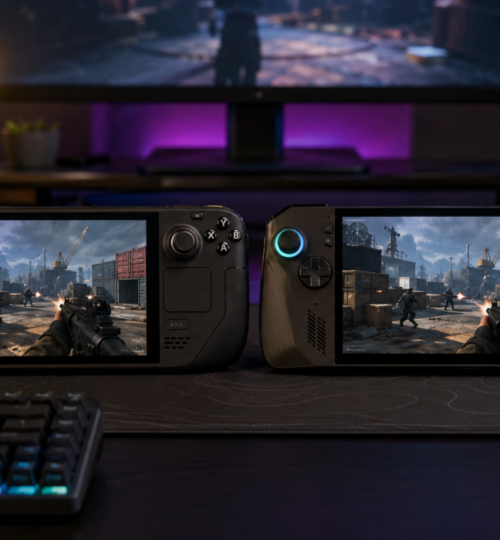
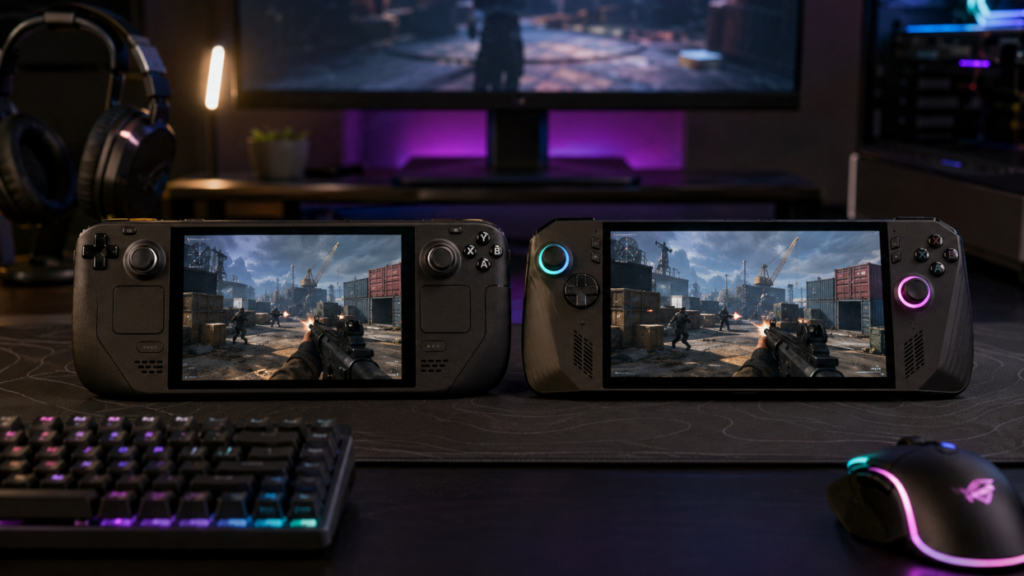
That competition created a strange split. SteamOS often feels more stable as a handheld operating system, while Windows handhelds remain more compatible with the competitive games that many players actually want to play.
For offline games, indie releases, emulation, and single-player Steam libraries, the Steam Deck remains hard to beat. For ranked shooters, live-service games, and titles protected by aggressive anti-cheat software, Windows still holds the stronger position. Driver stability and anti-cheat compatibility are related, but they are not the same thing. That distinction decides this matchup.
SteamOS Controls More of the Experience
Valve has one enormous advantage over most Windows handheld manufacturers. It controls the Steam Deck hardware, SteamOS, the Steam client, Proton, controller profiles, update delivery, and the Deck Verified program.
That level of control reduces fragmentation. Valve can test graphics drivers, kernel changes, firmware, sleep behavior, controller input, and game compatibility against a small number of known hardware configurations. SteamOS updates arrive as part of a coordinated system rather than as separate packages from Microsoft, AMD, a handheld manufacturer, and several support applications.
The result is usually predictable. Games that are already confirmed to work tend to keep working well, and the Steam Deck rarely asks the player to understand which graphics package, chipset installer, BIOS revision, or control-center update is responsible for a new problem.
Valve also gives users a visible compatibility rating through Steam Deck Verified. Games may be marked Verified, Playable, Unsupported, or Unknown, and Steam explains which requirements are not met when a title falls short. Players can also force a different Proton version when testing fixes or dealing with a regression.
That is real stability. It is especially valuable during travel, where a failed update or broken input layer is more than an annoyance. Nobody wants to troubleshoot a handheld in an airport terminal with no keyboard, no dock, and questionable Wi-Fi.
Proton Is Impressive, but Anti-Cheat Support Is Optional
SteamOS does not run most Windows games directly. It relies on Proton, Valve’s compatibility layer, to translate Windows software calls into forms that Linux can handle.
For thousands of games, Proton works remarkably well. Some titles run with little or no visible compromise. Valve has also worked with major anti-cheat providers to create Proton-compatible paths for Easy Anti-Cheat and BattlEye. Valve’s Steamworks documentation states that both systems can support Proton, but developer action is still required. Easy Anti-Cheat support must be enabled for the build, and BattlEye support depends on the developer contacting BattlEye and requesting activation.
That last part matters. The Steam Deck cannot force a publisher to support Linux or Proton. Valve can provide the tools, documentation, and testing environment, but the game publisher still decides whether to enable support. A studio may decline because of security policy, support costs, internal testing requirements, or the design of its anti-cheat system.
Kernel-level anti-cheat creates an even harder wall. Some competitive games expect deep access to Windows components and make assumptions about the operating system, driver signing, boot security, or background services. Proton cannot always reproduce those conditions in a way the publisher considers acceptable.
A SteamOS update may be perfectly stable while a protected game remains completely unavailable. That is not a graphics-driver failure. It is a platform policy and anti-cheat integration problem.
Windows Handhelds Speak the Native Language of Competitive PC Gaming
Windows handhelds avoid the Proton layer. Games install the same Windows executables used on desktop PCs, and anti-cheat systems see the operating system they were originally designed to support.
That gives devices such as the ROG Ally family, Lenovo Legion Go line, and MSI Claw series a basic compatibility advantage. Windows handhelds can access Steam, Xbox, Battle.net, Epic Games Store, EA app, Ubisoft Connect, Riot Client, and other launchers without waiting for Linux support or community workarounds.
Microsoft and ASUS have promoted that broad PC access as a major selling point for the ROG Xbox Ally systems. Microsoft describes them as Windows devices that can run PC storefronts, apps, mods, and games from a controller-focused Xbox interface.
For competitive players, this means fewer hard stops. A multiplayer title may still have performance issues, awkward launcher behavior, or controller problems, but anti-cheat is less likely to reject the operating system itself. Windows wins here. Clearly.
A player who buys a handheld mainly for competitive shooters should start with the game list, not the hardware specifications. If the must-play titles use anti-cheat that blocks Proton, the Steam Deck’s smoother interface and stronger sleep behavior will not compensate for being locked out.
Windows Compatibility Comes With Driver Fragmentation
The Windows advantage is not free. Windows handhelds depend on a chain of updates that can come from several sources.
Microsoft supplies Windows updates. AMD or Intel supplies graphics and chipset components. ASUS, Lenovo, MSI, or another manufacturer supplies BIOS updates, firmware, controller software, power profiles, and device-specific tuning. The handheld’s management application may deliver some updates, while others remain available only from a support page.
ASUS uses Armoury Crate SE for the ROG Ally family and offers device-specific driver and BIOS downloads through its support site. ASUS has also acknowledged that updates delivered through its applications may arrive in batches, with the product support page serving as the safer place to confirm every available driver.
Lenovo uses Legion Space and separate support pages for Legion Go drivers. Lenovo’s documentation explains that driver updating depends on the installed Legion Space version, while its support site also provides manual downloads.
MSI follows a similar model with its Claw software, firmware, and device support structure. The growing Claw family now includes both Intel and AMD models, which increases choice but also means buyers must pay close attention to the exact device and processor before installing graphics packages.
This fragmented update chain can produce strange failures. A Windows update may install correctly while the handheld control software falls behind. A new graphics driver may improve one game and break frame pacing in another. A BIOS update may change power behavior. An anti-cheat service may object to an Insider build, unsigned component, security setting, or software overlay.
Windows gives players wider access, but it also gives them more ways to damage a working setup.
Stable Drivers Do Not Guarantee Stable Anti-Cheat
Anti-cheat compatibility is often discussed as though it were just another driver feature. It is not. Graphics drivers determine how the game communicates with the GPU. Anti-cheat software may inspect processes, services, memory behavior, loaded modules, input tools, virtualization features, and operating-system security conditions. BattlEye’s own support documentation warns that security software can interfere with its service and that unsupported Windows builds may require users to return to a public release.
This creates two different definitions of stability. The Steam Deck offers stronger system consistency. Valve can ship a tested SteamOS image for a narrow hardware target, and the user can recover or reinstall the operating system through official repair tools. Valve has also expanded SteamOS support for other AMD-powered PCs, but the Deck remains the reference device.
Windows handhelds offer stronger software acceptance. Anti-cheat vendors, game publishers, and launcher developers generally test against Windows because that is where the largest PC player base exists. The operating system may feel less elegant on a seven-inch screen, but it is the expected environment. The more competitive the game library becomes, the more valuable that software acceptance becomes.
Microsoft Is Fixing the Handheld Interface Problem
For years, the worst part of a Windows handheld was Windows itself. Tiny controls, desktop pop-ups, competing launchers, login prompts, and touch-unfriendly settings made powerful devices feel unfinished.
Microsoft has spent the last year pushing a controller-first full-screen interface for Windows gaming devices. The feature, now presented as Xbox mode, can boot supported systems into a gaming-focused interface, reduce desktop friction, and provide access to games across major PC storefronts. Microsoft made the full-screen experience broadly available on current Windows handhelds before expanding it further across Windows 11 PCs.
This does not turn Windows into SteamOS. Background services, manufacturer tools, Windows Update, and desktop applications still exist underneath. It does, however, reduce one of the Steam Deck’s biggest usability advantages.
The Windows handheld ecosystem is becoming less chaotic on the surface while keeping its native anti-cheat support. That combination is dangerous for Valve because competitive players care more about launching the game than admiring the operating system.
The Steam Deck Still Wins for Predictable Portable Play
The Steam Deck remains the safer choice for players whose libraries already fit SteamOS. Its hardware profiles are known. Its operating system is designed around a controller. Suspend and resume behavior is usually dependable. Valve manages the graphics stack and compatibility layer as part of one product. The Deck Verified system gives buyers an immediate warning before they install a game that may require extra work.
A Windows handheld can run more software, but running more software also means maintaining more software. SteamOS removes much of that burden.
For a player rotating between indie games, RPGs, strategy titles, older multiplayer releases, and verified co-op games, the Steam Deck provides the more stable day-to-day experience. Its failures are usually easier to identify. A game is supported, partially supported, or blocked. The device itself rarely feels like five vendors arguing inside one case.
The weakness appears when the player’s favorite title changes its anti-cheat policy. A previously functional game can lose compatibility after a publisher adds or modifies protection. SteamOS users remain dependent on decisions made outside Valve’s direct control.
Windows Is the Better Bet for Ranked and Live-Service Games
Competitive players should treat Windows as the default unless every required game has confirmed SteamOS support. That recommendation is not based on benchmark charts. It is based on access. Windows handhelds are more likely to launch games protected by kernel-level anti-cheat, more likely to support publisher-specific launchers, and more likely to receive official troubleshooting steps from the game developer.
The tradeoff is maintenance. Owners should avoid optional preview builds, install drivers from the correct manufacturer page, keep BIOS and control software aligned, and resist the urge to replace validated handheld graphics packages with generic drivers on day one. More freedom creates more responsibility.
For tournament travel, team practice, or ranked grinding, a carefully maintained Windows handheld is the safer machine because it matches the software assumptions used by most competitive PC games. SteamOS is the cleaner system, but Windows is still the accepted system.
That distinction gives Windows handhelds the anti-cheat victory, even though the Steam Deck remains the stronger example of how a handheld PC should behave.