
Disclaimer: The views and opinions expressed in this article are solely those of the author. The mention of any products, services, or methods does not constitute an endorsement.
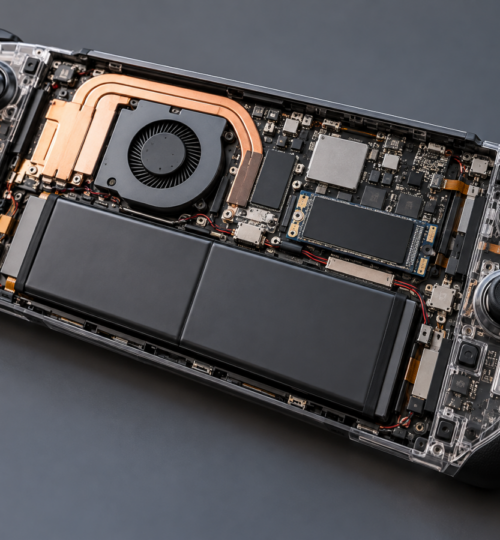
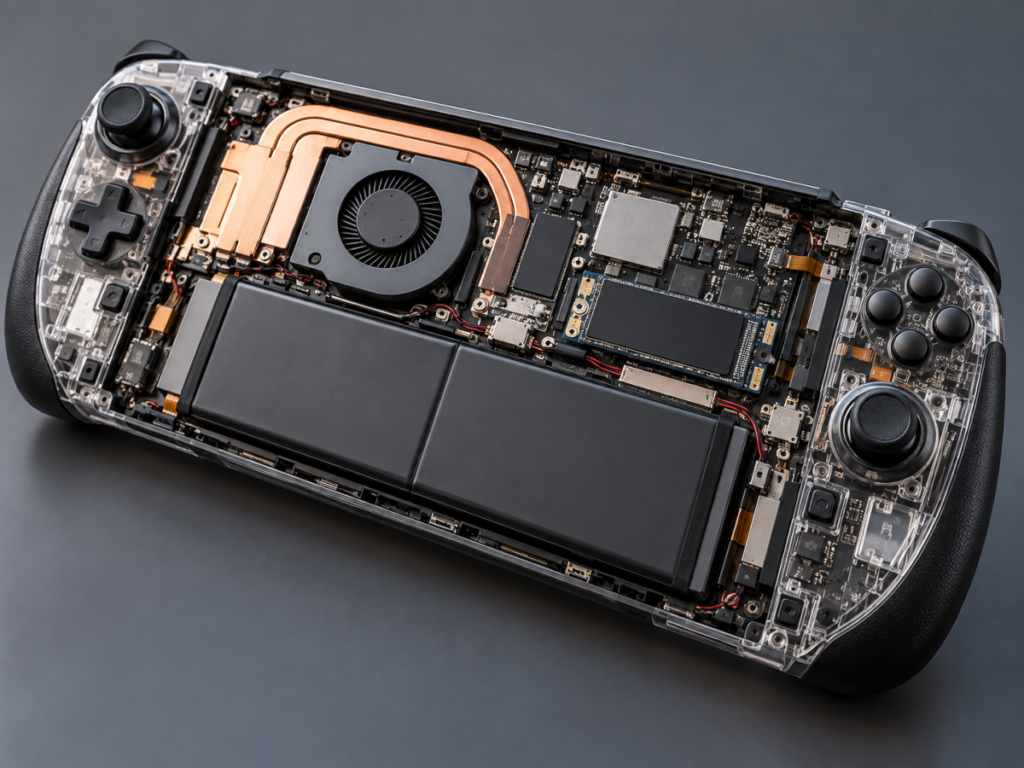
Portable gaming has reached a strange point in its evolution. Handheld PCs can now run games that once required a full desktop rig, but every extra watt of performance still has to come from a battery small enough to sit between two grips without turning the machine into a brick. Faster APUs, brighter high-refresh displays, Wi-Fi, SSDs, memory, cooling fans, and controller electronics are all competing for the same limited supply of stored energy.
That makes battery technology one of the biggest constraints on the next generation of handheld gaming. Manufacturers can keep installing larger lithium-ion packs, and some already have, but there are practical limits involving weight, thickness, heat, charging time, and physical space. Solid-state batteries offer another route, with the possibility of storing more energy in a smaller package while improving safety and charging performance. The technology is moving closer to commercial production, although the road from automotive prototypes to a gaming handheld sitting on a retail shelf remains longer than some headlines suggest.
Handheld Gaming Has Become an Energy Management Problem
The difference between recent handheld generations shows how aggressively manufacturers are already attacking battery life with conventional lithium-ion technology. Valve increased the Steam Deck OLED from the original model’s 40 Wh battery to 50 Wh while also moving to a more efficient 6 nm APU and OLED display. Valve rates the OLED model for roughly three to twelve hours of gameplay depending on workload, compared with two to eight hours for the original LCD configuration.
ASUS went much further with the ROG Ally X, installing an 80 Wh lithium-ion battery. The later ROG Xbox Ally X retained an 80 Wh pack while pairing it with AMD’s Ryzen AI Z2 Extreme, and ASUS claims up to 2.7 hours in a demanding Cyberpunk 2077 test at its specified settings and power mode. Those numbers illustrate the problem clearly: even an 80 Wh battery can disappear quickly when a handheld starts behaving like a small gaming PC.
Nintendo faces the same physics from a different direction. The Switch 2 uses a 5,220 mAh lithium-ion battery, with Nintendo estimating roughly 2 to 6.5 hours depending on the game and operating conditions. Different platforms target different performance levels, but none escapes the trade between computing power and portable runtime.
Increasing battery capacity works, but it also consumes internal volume and adds mass. At some point a manufacturer has to choose between a larger battery, more cooling, a thicker chassis, improved speakers, larger controls, additional ports, or simply making the device easier to hold for several hours. Battery chemistry determines how painful those compromises become.
What Solid-State Batteries Actually Change
A conventional lithium-ion cell generally moves lithium ions through a liquid or gel electrolyte between its electrodes. An all-solid-state battery replaces that liquid component with a solid electrolyte, which can be made from materials such as sulfides, oxides, polymers, or combinations of several approaches. The chemistry matters because different solid electrolytes behave very differently during charging, manufacturing, temperature changes, and repeated cycling.
The biggest attraction for portable electronics is energy density. A battery with higher gravimetric energy density stores more energy for its weight, while higher volumetric energy density stores more energy in the same physical space. Both matter inside a handheld, where designers are fighting for grams and cubic centimeters simultaneously.
Solid electrolytes can also support electrode designs that are difficult to make practical with conventional cells, including lithium-metal approaches. That creates the possibility of significantly increasing energy density rather than simply improving lithium-ion chemistry by another small percentage. Safety is another potential advantage because removing much of the flammable liquid electrolyte can reduce some fire risks, although solid-state does not mean physically indestructible or incapable of failing.
The engineering problems are substantial. Researchers are still working on maintaining reliable contact between solid materials, preventing lithium filaments known as dendrites from producing internal short circuits, handling expansion and contraction during cycling, and achieving high charging currents without damaging the cell. Recent battery research continues to identify solid-solid interfaces and dendrite formation as major barriers to long-term reliability.
Solid-State Has Moved Beyond Laboratory Coin Cells
The solid-state story looks different in 2026 than it did a few years ago because several major programs have advanced into automotive testing, pilot manufacturing, or early production. Samsung SDI has operated an all-solid-state pilot line and says it plans to begin mass production in the second half of 2027. Its development work includes anode-free designs aimed at increasing energy density, and the company has discussed solid-state applications extending beyond automobiles into robots and other mobile machines.
QuantumScape inaugurated its Eagle Line in February 2026, a pilot production system designed to increase output of its QSE-5 lithium-metal cells for customer testing and product development. The company began shipping B1 QSE-5 samples in 2025 and has demonstrated the technology in a Ducati V21L electric motorcycle program with Volkswagen Group. QuantumScape reports more than 800 Wh/L energy density for QSE-5 and a target of less than 15 minutes for charging from 10 to 80 percent, although those specifications should still be treated as cell-level development figures rather than promises for future consumer devices.
Factorial Energy has also moved into vehicle testing. In June 2026, Stellantis announced that Factorial FEST solid-state cells had been installed in a Dodge Charger Daytona development vehicle for road testing. Factorial previously reported 375 Wh/kg cells and charging from 15 to 90 percent in 18 minutes under test conditions.
Solid Power’s technology has reached BMW test vehicles as well. BMW began operating an i7 equipped with large-format all-solid-state cells in 2025, while Solid Power has continued work with Samsung SDI, BMW, and SK On on electrolyte production and cell development.
There has even been movement on actual production. In September 2026, ProLogium announced mass production of its Gen 3.5 lithium-ceramic solid-state cell in Taiwan, reporting third-party-tested figures of 381 Wh/kg and 903 Wh/L for a 185.4 Ah large-format cell. Those figures come from ProLogium’s production announcement and do not mean the same technology is ready to drop into a gaming handheld, but they provide evidence that high-energy solid-state designs are beginning to cross the line from development equipment into industrial manufacturing.
A Handheld Could Spend the Energy-Density Gain Two Ways
A major increase in battery energy density would give handheld designers an unusually valuable choice. They could maintain roughly the same physical battery size and increase runtime, or preserve today’s runtime while making the device lighter and creating internal space for other components.
Consider a future machine built around the general dimensions of today’s 50 to 80 Wh handhelds. If a new battery technology eventually delivered a meaningful cell-level density improvement without requiring substantially more packaging, pressure hardware, cooling, or protection circuitry, manufacturers could potentially fit more stored energy into roughly the same internal volume. A machine that currently needs a large portion of its chassis for an 80 Wh battery might gain longer play sessions without becoming thicker.
The alternative may be more interesting for competitive players. Instead of turning every density improvement into maximum runtime, a designer could install a smaller battery while preserving acceptable endurance, then spend the saved space and weight on cooling capacity, larger analog sticks, stronger structural components, better speakers, additional ports, or improved ergonomics. Portable competitive gaming benefits from consistency as much as endurance, and a system that can sustain its intended power level without excessive heat or throttling may be more useful than one advertising the largest possible battery.
This is also why comparing cell energy-density numbers directly with finished handheld batteries can be misleading. A commercial battery pack includes electrical connections, monitoring systems, protective structures, insulation, adhesives, and other hardware. A 40 percent improvement at the cell level does not automatically produce a 40 percent improvement in finished-device runtime.
Faster Charging Could Matter Almost as Much as Runtime
Handheld players already compensate for limited battery life by carrying USB-C chargers and power banks. A battery capable of safely accepting much higher charging rates could change that routine even if runtime itself increased only moderately.
A handheld that could recover most of its battery during a meal, airport stop, tournament break, or short session away from the screen would spend much less time tethered to an outlet. High charging performance also fits gaming’s uneven power pattern, where a system may spend one session running a lightweight indie title and the next pushing a demanding game close to the APU’s power limit.
Solid-state developers regularly cite fast charging as one of the technology’s potential strengths, but this is an area where prototype numbers require restraint. Fast charging creates heat, stresses interfaces, and can accelerate degradation if the chemistry and battery-management system are not designed around it. A manufacturer building a $700 handheld needs thousands of reliable charging cycles and predictable behavior across years of ownership, not a spectacular laboratory charging demonstration that shortens battery life.
Safety Gains Could Change Internal Packaging
Battery safety rarely becomes part of a gaming hardware discussion until something goes wrong. Handheld manufacturers still have to design around puncture damage, thermal events, cell swelling, manufacturing defects, charging faults, and the heat generated by processors located only centimeters from the battery.
Removing flammable liquid electrolyte can reduce some failure risks and may eventually allow engineers to reconsider how aggressively batteries need to be isolated from other components. That could have secondary effects on chassis construction and cooling layouts. The benefit would be especially relevant as handheld APUs climb toward laptop-like performance levels while remaining packed inside enclosures that players hold directly in their hands.
Solid-state batteries still require protection systems, quality control, and careful thermal engineering. Research has shown that lithium dendrites can still penetrate solid electrolytes, while poor contact between solid layers can increase resistance or cause degradation. The chemistry changes the failure problem, but it does not delete it.
Manufacturing Cost Is the Barrier Gamers Will Actually Feel
A battery technology can work brilliantly and still fail as a consumer product if manufacturers cannot produce it cheaply, consistently, and at enormous scale. Gaming handhelds occupy a difficult price range because buyers compare them with consoles, laptops, tablets, and desktop upgrades. Adding an expensive battery that pushes a device several hundred dollars higher would erase much of its mass-market appeal.
Solid-state production can require new materials, specialized manufacturing steps, extremely consistent interfaces, and tight control of defects. Some designs also need pressure applied to maintain contact between layers, which is much easier to tolerate inside an experimental battery fixture than inside a thin consumer handheld being dropped into a backpack.
Yield may prove just as important as raw material cost. If a factory produces excellent cells but rejects too many during manufacturing, those discarded cells become part of the price of every successful one. The battery industry has spent decades refining conventional lithium-ion production, so a replacement technology has to compete against manufacturing systems that are already fast, highly automated, and deployed around the world.
Conventional Lithium-Ion Still Has Room to Fight Back
Solid-state batteries are racing against a moving target. Today’s lithium-ion cells will continue improving while solid-state manufacturers work through production problems, and handheld makers are finding substantial runtime gains elsewhere in the system.
Valve’s Steam Deck OLED demonstrated the combined approach. Its battery became larger, but the 6 nm APU and other efficiency changes also reduced consumption. ASUS followed the same general logic with the Xbox Ally X, pairing an 80 Wh battery with a newer processor designed to deliver more performance at lower power settings. Battery capacity gets the easy headline, but system efficiency determines how quickly those watt-hours disappear.
That means the first dramatic improvements in handheld endurance may continue coming from better chips, smarter power management, display efficiency, operating-system tuning, and refined lithium-ion cells rather than a sudden industry-wide switch to solid-state. A handheld drawing 12 watts instead of 18 watts gains an enormous runtime advantage without changing battery chemistry at all.
The First Solid-State Handheld May Arrive Quietly
Consumer electronics already contain small solid-state batteries, although nowhere near the scale required for a high-performance gaming handheld. TDK commercially produces its tiny CeraCharge solid-state rechargeable cells for devices such as sensors and wearables, and it has developed newer solid-state material aimed at much higher volumetric energy density for products such as wireless earphones and smartwatches. The existing CeraCharge parts are measured in microamp-hours, which shows how wide the gap remains between putting solid-state technology into electronics and powering a 20-watt gaming computer with it.
That progression suggests gaming may receive solid-state batteries only after higher-volume industries have absorbed much of the early development cost. Automobiles are currently driving large-cell research, while wearables and small electronics are proving other forms of the technology at the opposite end of the scale. Handheld PCs sit awkwardly between those markets, requiring far more energy than a smartwatch but far less than an EV.
The first gaming device using the technology may therefore come from a premium or experimental handheld manufacturer willing to absorb higher battery costs before the largest platform holders make the same move. Once production volume rises and engineers can buy proven cells in the capacities, shapes, and discharge rates needed for gaming hardware, solid-state becomes far more attractive.
For handheld gaming, the real breakthrough will arrive when battery improvements stop forcing designers to choose quite so aggressively between runtime, weight, cooling, and performance. A thinner 80 Wh-class machine, a lighter device that still lasts through a long multiplayer session, or a high-performance handheld that can recharge most of its battery during a short break would change portable gaming in ways another small increase in GPU performance cannot. Solid-state technology is finally getting close enough to industrial production that those possibilities can be discussed as engineering targets rather than science-fiction features, but the next few generations of handhelds will still be shaped as much by manufacturing economics and processor efficiency as by what happens inside the battery cell.