
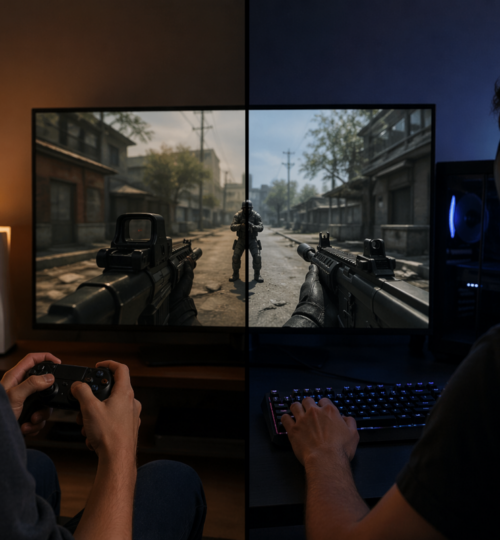
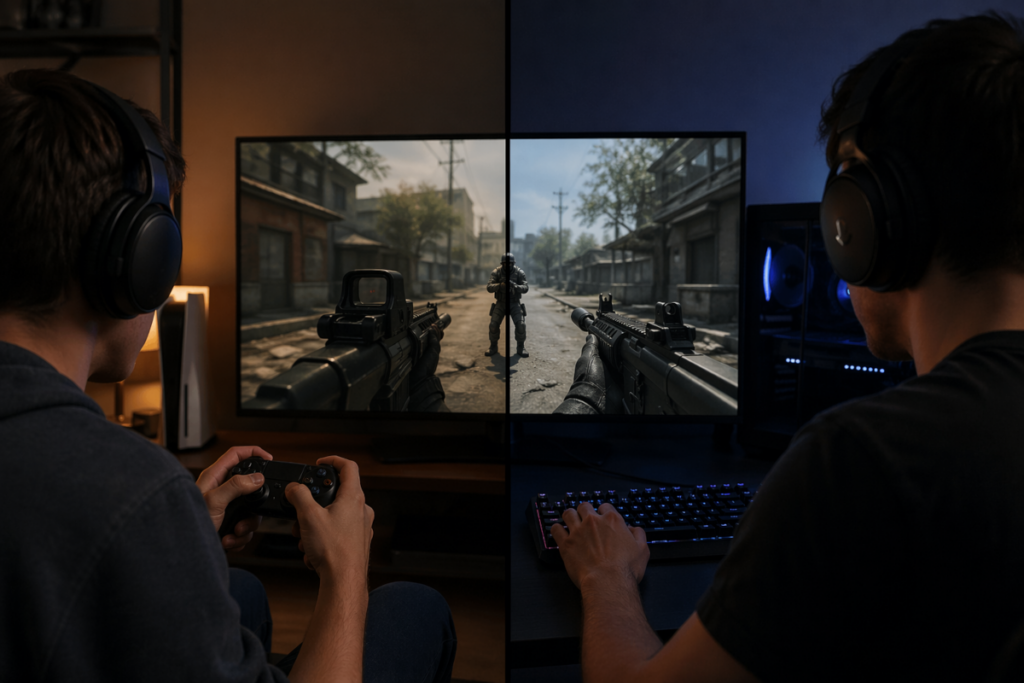
For most of competitive multiplayer history, your platform defined your battlefield. PC players faced PC players. Console players stayed within their own ecosystems. Communities formed around hardware as much as they did around games. That separation helped build identity, but it also fractured player bases and limited matchmaking pools.
Today, cross-play has broken down those walls. First-person shooters in particular have embraced it, bringing together players from consoles and PC into shared lobbies. On paper, this sounds like a universal win. Bigger populations, faster matchmaking, and friends finally able to play together regardless of platform.
But for a community rooted in competitive integrity, the question runs deeper. Does cross-play actually improve the experience in first-person shooters, or does it introduce new imbalances that redefine competition itself?
Let’s dig into the reality behind the feature, from matchmaking advantages to the ongoing auto-aim debate that continues to divide players.
The Original Divide: Why Platforms Were Separated
Before cross-play became technically and commercially viable, platform separation was not just a limitation. It was a design choice shaped by hardware realities.
PC players benefited from:
- Mouse and keyboard precision
- Higher frame rates and refresh rates
- Customizable graphics and input settings
Console players operated within:
- Fixed hardware constraints
- Controller-based aiming
- Standardized performance across users
These differences created fundamentally different skill environments. A high-level PC player relied on raw mechanical precision, while a top console player mastered controller movement and aim assist systems.
Keeping these ecosystems separate ensured that competition remained internally consistent. Everyone in a match was playing under roughly the same conditions.
Cross-play disrupted that balance.
The Promise of Cross-Play: Bigger Communities, Better Matchmaking
The most obvious advantage of cross-play is population size. When all platforms are combined into a single matchmaking pool, several benefits emerge immediately.
Faster Matchmaking – Legacy competitive communities understand the frustration of waiting for a match, especially in niche modes or aging titles. Cross-play dramatically reduces queue times by pulling from a unified player base.
Longer Game Lifespans – Games that support cross-play tend to retain active communities longer. Instead of fragmenting players across platforms, the ecosystem consolidates them. This is especially important for competitive shooters that rely on sustained engagement.
Social Connectivity – Perhaps the most universally appreciated benefit is the ability to play with friends regardless of platform. In an era where friend groups are spread across consoles and PC, cross-play removes a major barrier.
From a community-building standpoint, this is huge. It aligns with the philosophy of player-driven ecosystems, where participation matters more than hardware.
The Competitive Reality: Are All Inputs Equal?
While cross-play expands the player pool, it also introduces a central issue. Not all input methods are equal in a first-person shooter.
Mouse and keyboard allow for:
- Pixel-precise aiming
- Faster target acquisition
- Greater control over recoil patterns
Controllers, by contrast, rely on analog sticks, which are inherently less precise. To compensate, developers implement aim assist systems.
This is where the debate begins.
The Auto-Aim Debate: Assistance or Advantage?
In modern shooters, aim assist is not a minor feature. It is a core system that enables controller players to compete at a high level. Without it, the gap between mouse and controller would be overwhelming.
However, in cross-play environments, aim assist becomes controversial.
What Aim Assist Actually Does
Aim assist typically includes:
- Slowdown when the reticle passes over a target
- Rotational assistance that subtly tracks moving enemies
- Magnetism that helps keep shots aligned
These systems are designed to compensate for the limitations of analog input. But when placed in a shared environment with mouse users, the perception shifts.
The PC Perspective
Many mouse and keyboard players argue that aim assist can feel like artificial tracking. In close-range engagements, especially, controller players can maintain consistent accuracy that rivals or exceeds human tracking ability.
From this perspective, aim assist is not just compensation. It becomes a form of assistance that reduces the mechanical skill gap.
The Console Perspective
Controller players counter that aim assist is necessary, not optional. Without it, they would be at a severe disadvantage in every engagement.
They also point out that:
- Mouse users have superior flick accuracy
- Long-range engagements favor precision input
- Movement and camera control are more fluid on mouse and keyboard
From this angle, aim assist is not overpowered. It is the only reason cross-play is even viable.
Data vs Perception: What the Numbers Suggest
Developers have access to extensive telemetry data across platforms. In many cases, this data shows that performance between controller and mouse players is closer than expected.
Some findings from recent shooter ecosystems include:
- Controller players often perform better at close range
- Mouse players dominate at long range and in high-skill lobbies
- Overall win rates tend to balance out across input types
This suggests that aim assist is doing its intended job. It equalizes performance across different input methods.
However, perception matters as much as reality in competitive communities. If players feel that outcomes are influenced by system assistance rather than pure skill, frustration grows.
Skill Expression in a Cross-Play Environment
One of the more subtle impacts of cross-play is how it reshapes skill expression.
In a platform-separated environment, skill is defined within a consistent input framework. When cross-play is introduced, skill becomes relative to both input and system design.
For example:
- A controller player mastering aim assist mechanics is demonstrating skill within that system
- A mouse player relying on raw precision is demonstrating a different type of skill
The problem arises when these skill expressions intersect. Players are no longer just competing against opponents. They are competing against different input philosophies.
This can blur the definition of what it means to be “better” in a competitive sense.
Competitive Integrity: Should Cross-Play Be Optional?
Many modern shooters address this issue by offering cross-play toggles or input-based matchmaking.
Cross-Play Toggle – Players can choose to play only within their platform ecosystem. This restores the traditional competitive environment but comes at the cost of longer queue times and smaller populations.
Input-Based Matchmaking – Some games group players based on input method rather than platform. Controller users face controller users, and mouse users face mouse users.
This approach preserves competitive balance while still enabling cross-platform connectivity. However, it is not always perfect, especially when players switch inputs or use hybrid setups.
The Esports Angle: Where Cross-Play Stands
At the professional level, cross-play is still limited. Most esports tournaments standardize hardware and input methods to ensure fairness.
This highlights an important point. When stakes are highest, consistency is prioritized over inclusivity.
That does not mean cross-play has no place in competitive gaming. It simply means that its role is different. It is more about accessibility and community growth than pure competitive purity.
The Community Impact: A Net Positive?
For legacy communities that value participation and longevity, cross-play offers clear advantages.
It:
- Revives older titles by expanding the player base
- Encourages new players to join without platform barriers
- Strengthens social connections across ecosystems
However, it also introduces ongoing debates about fairness, skill, and system design.
For a revived competitive hub, this creates an interesting dynamic. Cross-play can fuel growth, but it also requires thoughtful structure to maintain competitive integrity.
Myth or Reality: The Final Verdict
So, are the advantages of console cross-play in first-person shooters a myth or a reality?
The answer depends on what you value.
If your focus is:
- Community size
- Accessibility
- Social play
Then cross-play is undeniably a reality-driven advantage. It strengthens the ecosystem and keeps games alive.
If your focus is:
- Pure competitive fairness
- Input consistency
- Mechanical skill expression
Then cross-play introduces complications that cannot be ignored.
The truth is that cross-play does not level the playing field. It reshapes it. It creates a new kind of competition where different inputs, systems, and player expectations coexist.
For some, that is the future of multiplayer gaming. For others, it is a departure from the purity of platform-defined competition.
Where It Goes Next
As developers continue refining matchmaking systems and aim assist tuning, the gap between perception and reality may narrow.
We are already seeing:
- More advanced input detection systems
- Dynamic aim assist balancing
- Increased transparency in matchmaking design
The long-term success of cross-play will depend on how well these systems evolve. If developers can maintain both accessibility and competitive integrity, cross-play could become the standard rather than the exception.
For communities built on competition and identity, the challenge is clear. Embrace the expanded battlefield, but never lose sight of what makes competition meaningful.
Because at the end of the day, it is not just about who you play against. It is about how the game defines the fight.