
Disclaimer: The views and opinions expressed in this article are solely those of the author. The mention of any products, services, or methods does not constitute an endorsement.
The Game Developers Conference has always been a place where the future of gaming quietly takes shape. Developers share technology, platform holders discuss direction, and industry insiders begin piecing together the next wave of hardware and software. At the 2026 GDC event, one topic repeatedly surfaced in conversations around the show floor and developer panels: Microsoft’s evolving Xbox strategy and the mysterious project known internally as Project Helix.
While Microsoft has not formally unveiled a next-generation Xbox console yet, several reports, developer comments, and industry rumors point toward a significant shift in how the company thinks about gaming hardware. The conversation is no longer just about a box under your television. Instead, the future may revolve around a unified ecosystem that blends consoles, Windows PCs, and cloud gaming into a single platform.
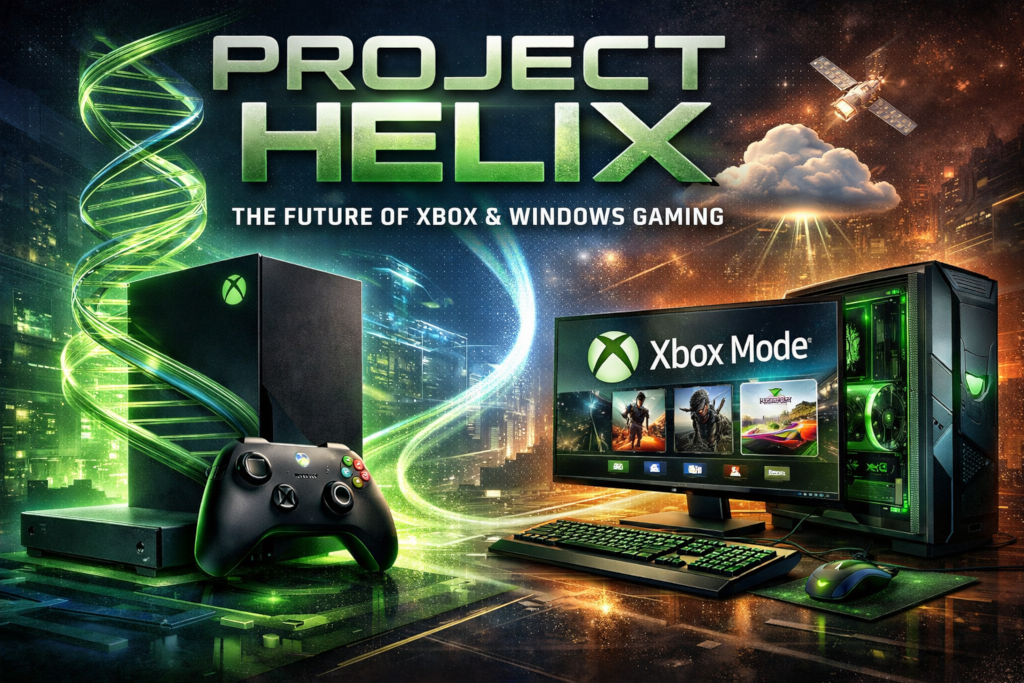
Two terms have become central to these discussions: Project Helix and Xbox Mode for Windows. Together, they hint at a future where the line between console gaming and PC gaming continues to blur.
The Long Arc of the Xbox Strategy
To understand why Project Helix matters, it helps to look at how Microsoft has been reshaping its gaming strategy over the past decade.
The traditional console model used to be straightforward. A company released a console every six or seven years. Games were built specifically for that hardware. Players bought discs or digital copies tied to that system. Microsoft began breaking away from that model during the Xbox One era.
Several key changes defined the transition:
- Xbox Play Anywhere allowed players to buy a game once and play it on both Xbox and Windows.
- Xbox Game Pass shifted attention toward subscription access instead of individual game purchases.
- Cross-platform multiplayer became more common.
- Cloud gaming introduced the possibility of playing console titles on devices that were never designed as consoles.
Each of these changes moved Xbox closer to something different from its competitors. Instead of focusing only on console sales, Microsoft began focusing on a gaming ecosystem. Project Helix appears to be the next step in that evolution.
What We Know About Project Helix
At the time of writing, Microsoft has not officially revealed a device called Project Helix. The name appears to be an internal codename that surfaced in developer discussions and industry reports around GDC.
Based on the information circulating among developers and analysts, Project Helix may represent one of two things.
The first possibility is a next generation Xbox console architecture designed around tighter integration with Windows. The second possibility is a broader platform initiative that connects Xbox hardware, Windows gaming PCs, and cloud infrastructure.
Many observers believe the truth may involve both. Rather than a single traditional console launch, Project Helix could describe the technological framework behind Microsoft’s next generation gaming platform.
Several elements rumored to be associated with the project include:
- deeper integration between Xbox and Windows gaming systems
- a new developer environment designed to simplify cross-platform releases
- hardware that resembles a hybrid between a console and a gaming PC
- expanded support for cloud streaming and remote gaming
If these rumors are accurate, Microsoft may be positioning its next Xbox generation as less of a fixed device and more of a flexible platform architecture.
The Concept of “Xbox Mode” for Windows
One of the most interesting rumors coming out of GDC is the idea of Xbox Mode for Windows.
Windows has long been the most popular operating system for PC gaming, yet it has always carried the overhead of a full desktop environment. Background services, update systems, and productivity tools all compete for resources with games.
Console operating systems avoid that problem by being designed almost entirely for gaming tasks. Xbox Mode appears to be an attempt to bring that console-style efficiency to Windows PCs.
In practical terms, Xbox Mode could function as a specialized system configuration that prioritizes gaming performance and reduces unnecessary processes. Instead of launching into the full Windows desktop environment, a PC could boot into a streamlined gaming interface similar to the Xbox dashboard.
This approach could offer several advantages:
- reduced system overhead
- faster game launch times
- a console-like interface for living room gaming
- tighter controller support
- deeper integration with Xbox services such as Game Pass and cloud saves
For players who already use their PCs primarily for gaming, this type of mode could provide a console-like experience without requiring separate hardware.
Why Microsoft Might Be Moving in This Direction
Microsoft occupies a unique position in the gaming industry because it controls both a major console platform and the dominant PC operating system.
For years those two worlds existed side by side but were not fully unified. Console gaming and PC gaming followed different development pipelines, different storefronts, and different performance expectations.
Project Helix and Xbox Mode suggest Microsoft may finally be attempting to merge those environments more completely.
From a business perspective, the advantages are obvious. If developers can build games once and deploy them across Xbox consoles, Windows PCs, and cloud streaming systems, development becomes more efficient. A unified platform also increases the potential player base for each game.
From a player perspective, the benefits could be just as significant. A gamer might buy a title once and play it across multiple devices without worrying about compatibility issues or separate versions.
Your progress could follow you between:
- a living room console
- a gaming laptop
- a desktop PC
- a handheld device capable of streaming from the cloud
This kind of ecosystem approach aligns closely with the direction Microsoft has already taken with Game Pass and Xbox Cloud Gaming.
Hardware Possibilities for the Next Xbox
Even if Microsoft is building a broader ecosystem, dedicated console hardware will almost certainly remain part of the equation.
Industry rumors suggest the next Xbox hardware generation could pursue several different strategies.
A High-End Console
One possibility is a powerful traditional console designed to compete directly with the next generation of Sony hardware. This system would focus on cutting-edge graphics performance, high frame rates, and support for modern rendering technologies.
Such a device could include:
- next generation AMD GPU architecture
- advanced ray tracing capabilities
- improved AI-driven graphics features
- faster SSD storage systems
A PC-Like Console Platform
Another possibility is a console built around architecture that resembles a simplified gaming PC.
Instead of running a completely separate console operating system, the hardware might operate on a heavily customized Windows-based platform.
This design would make it easier for developers to port PC games directly to Xbox systems without major redesign work.
Multiple Device Tiers
Microsoft may also pursue a multi-tier strategy similar to the current Series S and Series X approach.
Under this model, the next generation could include:
- a high-end performance console
- a smaller, more affordable digital console
- streaming-focused devices designed for cloud gaming
All of these systems would connect to the same Xbox platform ecosystem.
The Growing Importance of Game Pass
Any discussion about the future of Xbox inevitably returns to one central element: Game Pass.
Microsoft has invested heavily in its subscription model, turning it into one of the most recognizable services in gaming. Instead of purchasing individual titles at full price, players gain access to a rotating catalog of games through a monthly subscription.
If Project Helix represents a unified gaming ecosystem, Game Pass could function as the center of that ecosystem.
Players might access the same library of titles across:
- console hardware
- Windows PCs
- cloud streaming devices
The success of this model depends on maintaining a steady flow of compelling games. Microsoft has addressed that challenge through a series of major studio acquisitions over the past decade.
Large publishing groups and internal development studios now feed content into the Game Pass pipeline, ensuring that new titles regularly appear on the service.
For many players, the platform they choose becomes less important than the library they can access.
What Developers Might Gain from a Unified Platform
One of the most important audiences for Project Helix is not gamers but game developers. Modern game development has become increasingly complex. Studios often have to build multiple versions of a game for different platforms. Each version may require different optimization strategies and testing processes.
If Microsoft successfully creates a unified Xbox and Windows architecture, developers could potentially streamline much of that work. Instead of treating console and PC as completely separate platforms, they might operate as variations of the same environment.
This could result in:
- faster development cycles
- easier cross-platform updates
- improved modding support
- more consistent performance across devices
Such changes would also benefit smaller independent studios that do not have the resources of major publishers.
How This Could Affect the Console Landscape
If Microsoft moves forward with a unified Xbox ecosystem, it may influence how the broader gaming industry approaches future hardware.
For decades, console manufacturers relied on clearly defined hardware generations. Each new system launched with a dramatic technological leap over its predecessor. That model still exists, but the lines between generations have become less rigid.
PC gaming already evolves continuously as graphics cards and processors improve. A unified Xbox platform could introduce a similar idea to the console world.
Rather than waiting years for entirely new hardware generations, players might see a more gradual evolution of devices that all operate within the same gaming ecosystem. This shift could make platform transitions smoother for both developers and players.
What Players Should Watch in the Coming Months
While Project Helix remains unofficial for now, several upcoming events may reveal more about Microsoft’s plans.
The gaming industry calendar includes major showcases where platform holders traditionally reveal hardware and platform updates.
Announcements to watch for include:
- updates during major summer gaming showcases
- developer conference presentations
- announcements tied to new Game Pass initiatives
If the rumors circulating at GDC are accurate, Microsoft may begin introducing elements of Xbox Mode or related platform features before the next console hardware officially launches.
That approach would allow players to experience pieces of the new ecosystem early.
The Future of Xbox May Be Bigger Than a Console
The most important takeaway from the Project Helix rumors is that Microsoft may be redefining what an Xbox actually is.
Instead of a single piece of hardware, the next phase of Xbox could become a network of devices connected by shared services, shared libraries, and shared technology.
A player might interact with that platform through:
- a traditional console
- a gaming PC running Xbox Mode
- a handheld streaming device
- a smart television with cloud gaming support
All of those experiences would still belong to the same Xbox environment.
If this vision becomes reality, the next generation of Xbox might not just be about launching a new console. It may represent the expansion of an entire gaming ecosystem designed to reach players wherever they choose to play.
For longtime fans of the platform and for developers watching closely from the sidelines, the next few years could define one of the most significant transitions in Xbox history.