
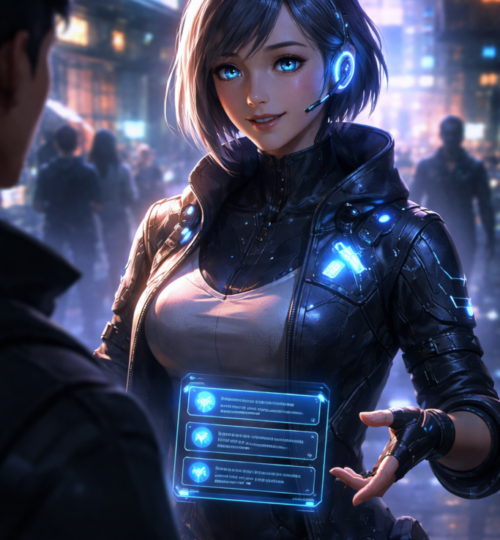
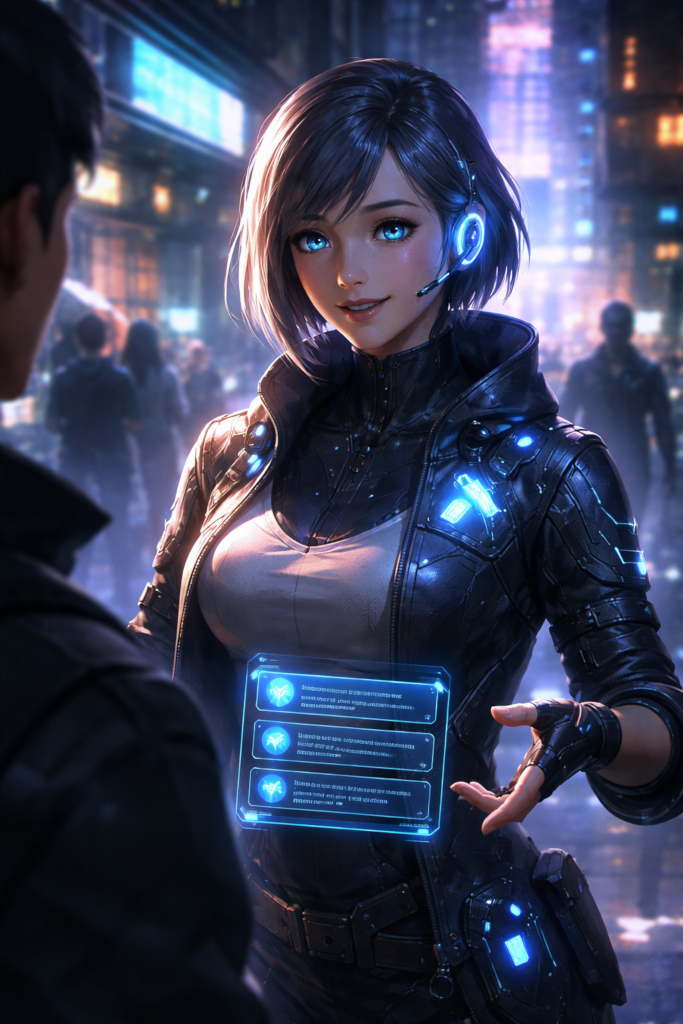
For most of gaming history, non-player characters have lived inside carefully written boundaries. Their lines were typed into scripts. Their responses were triggered by specific player actions. Their personalities were defined by a limited set of dialogue trees that developers designed months or even years before a player ever picked up a controller. This approach shaped everything from early role-playing games to massive open worlds. It worked well for decades, but it always came with a limitation: once a player had exhausted the available dialogue options, the illusion of life disappeared.
Now that limitation is beginning to change.
At the 2026 edition of the Game Developers Conference (GDC), one theme appeared repeatedly across panels and demonstrations: dynamic AI-driven storytelling. Developers are increasingly exploring systems that allow NPCs to react in ways that are not fully scripted ahead of time. Instead of selecting from a finite list of responses, characters can generate dialogue, react to context, remember past interactions, and adapt their behavior based on player choices.
If these systems mature, they could fundamentally reshape how games tell stories and how players interact with virtual worlds.
The Traditional NPC Problem
To understand why developers are exploring AI NPCs, it helps to look at the limitations of traditional dialogue systems.
Most games rely on what developers call branching dialogue trees. A player chooses from a set of responses. Each response leads to a different scripted branch of conversation. This design can create the illusion of choice, but it is ultimately constrained by the number of lines that writers and voice actors produce.
In smaller games this limitation is manageable. In massive open worlds, it becomes more noticeable.
Players eventually recognize patterns. NPCs repeat the same lines. Townsfolk cycle through predictable responses. Quest givers repeat identical instructions every time a player approaches them. Even games praised for narrative depth still rely on pre-written dialogue that cannot meaningfully adapt once the scripted content runs out.
This is not a failure of creativity. It is a technical and logistical constraint. Writing, recording, animating, and implementing dialogue at scale is expensive. Voice acting alone can require thousands of hours of recording sessions.
AI-driven dialogue systems promise a different approach. Instead of relying entirely on prewritten responses, developers can design systems that generate dialogue dynamically based on context, world state, and player behavior.
What Dynamic AI NPCs Actually Mean
When people hear “AI NPCs,” they often imagine characters powered by fully autonomous artificial intelligence. In reality, most systems being discussed at GDC 2026 are more structured.
Developers are not handing control of their entire narrative to an unpredictable AI model. Instead, they are combining several layers of technology.
First, there is the narrative framework. Designers still define the world, the characters, and the major story arcs. These act as boundaries that prevent the AI from generating dialogue that contradicts the game’s lore or tone.
Second, there is contextual awareness. AI systems can track information such as:
- The player’s previous choices
- Current location
- Active quests
- Relationships with characters
- Time of day or world events
This context allows NPCs to produce dialogue that feels responsive to what is happening around them.
Third, there is natural language generation. AI models can generate new sentences that fit within the established personality of a character. This means two players might have slightly different conversations with the same NPC depending on how they approach the interaction.
Finally, developers add guardrails. Dialogue filters, narrative constraints, and moderation systems ensure the generated responses remain appropriate and consistent with the game’s design.
The result is not infinite storytelling, but it is far more flexible than traditional dialogue trees.
A Look at Emerging Examples
While many AI NPC systems are still experimental, several high-profile games are already exploring the idea in different ways.
One of the most discussed projects is Pragmata, an upcoming science fiction title from Capcom. Although the game has remained somewhat mysterious since its announcement, developer presentations have hinted at adaptive AI systems that shape how characters respond to the player and the world around them.
In science fiction settings like Pragmata, dynamic dialogue can enhance immersion. Characters reacting naturally to the environment, missions, and player actions can make the world feel less like a scripted sequence and more like a living system.
Another title drawing attention is Grand Theft Auto VI, currently in development at Rockstar Games. Rockstar has always focused heavily on believable open worlds, from pedestrians who react to chaos in the streets to background characters who carry on conversations as players walk past.
While Rockstar has not publicly detailed its AI plans, industry speculation suggests that large-scale NPC behavior systems will play a significant role in the game’s world simulation. Even small improvements in how pedestrians talk, react, and interact could dramatically increase the sense of realism in cities populated by thousands of characters.
Imagine walking into a bar in a future open world game. Instead of overhearing a short loop of repeated lines, NPCs might discuss events that recently occurred in the game world. They could react to the player’s reputation or even comment on specific missions the player completed hours earlier.
That level of contextual storytelling is exactly what many developers are chasing.
Why Developers Are Interested Now
The idea of dynamic NPC dialogue is not new. Researchers and developers have experimented with procedural dialogue systems for years. What has changed recently is the rapid advancement of machine learning and natural language processing.
Modern language models can generate coherent text quickly enough to support interactive conversations. At the same time, game engines have become powerful enough to track complex world states and feed that information into AI systems.
Another major factor is player expectation. Open world games have grown dramatically in scale. Players explore massive environments filled with hundreds or thousands of NPCs. As worlds become larger, static dialogue becomes more noticeable.
When a city contains thousands of residents but only a handful of voice lines, the illusion begins to break. Dynamic AI dialogue could help developers scale interactions without needing to manually script every possible conversation.
The Technical Challenges
Despite the excitement surrounding AI NPCs, developers face several serious challenges before the technology becomes widespread. The first challenge is consistency.
Characters need to maintain their personalities, motivations, and relationships throughout the game. An AI system that generates inconsistent dialogue can break immersion just as quickly as repetitive scripted lines. The second challenge is narrative control.
Game writers carefully craft emotional beats, plot twists, and character arcs. If AI systems generate dialogue freely, they might accidentally reveal information too early or contradict the intended story structure. The third challenge is voice acting.
Many modern games rely on fully voiced characters. Generating dynamic dialogue means either recording enormous libraries of voice lines or using real-time voice synthesis technology. Both approaches come with technical and ethical considerations.
The fourth challenge is moderation and safety. Games with open AI dialogue systems must ensure that generated content remains appropriate and aligned with the game’s tone and rating. Developers must also prevent systems from generating offensive or harmful responses.
These concerns explain why many studios are approaching the technology cautiously.
A New Role for Writers
One of the most interesting consequences of AI NPC systems is how they may reshape the role of game writers. Instead of writing every individual line of dialogue, writers may focus on defining character personalities, motivations, and conversational rules. These guidelines act as a framework that AI systems use to generate dialogue.
Think of it as writing the DNA of a character rather than every word they might speak. Writers could define how a character reacts to stress, how they talk about specific topics, what slang they use, and how their personality changes over time. The AI system then uses these traits to produce dialogue that fits the character.
This approach could actually expand narrative possibilities rather than reduce them. Instead of repeating a limited set of scripted lines, NPCs might hold longer and more natural conversations with players. Side characters could become more memorable because they react uniquely to each player’s journey.
The Risk of Overpromising
As with many emerging technologies, AI NPC systems are surrounded by a great deal of hype. It is important to remember that dynamic dialogue does not automatically create better storytelling. Great stories still depend on strong writing, thoughtful design, and meaningful player choices. AI systems can support these goals, but they cannot replace them.
There is also a risk that some developers may promise fully conversational NPCs long before the technology is ready. If expectations grow too quickly, players could become disappointed when early implementations feel limited.
For now, most studios are experimenting with hybrid approaches. Traditional scripting remains the backbone of major story moments, while AI systems enhance background conversations and minor interactions.
The Future of Game Worlds
Even with the challenges ahead, it is difficult to ignore the potential impact of dynamic AI NPCs. If the technology continues to improve, open world games could begin to feel dramatically different. Cities might become more reactive environments. Characters could develop evolving relationships with players. Conversations might feel less like menu selections and more like natural interactions.
For long-time gamers, the shift could be comparable to the transition from static environments to fully explorable 3D worlds in the late 1990s. NPCs would no longer exist solely to deliver quests or repeat scripted lines. Instead, they could become active participants in the world around the player.
And while the technology is still evolving, the conversations happening at events like GDC 2026 suggest that developers are taking this future seriously.
The era of fully scripted NPC dialogue may not be ending tomorrow. But for the first time in gaming history, developers are beginning to imagine worlds where characters can truly talk back.
If that vision becomes reality, the way we experience stories in games could change just as dramatically as the worlds themselves.