
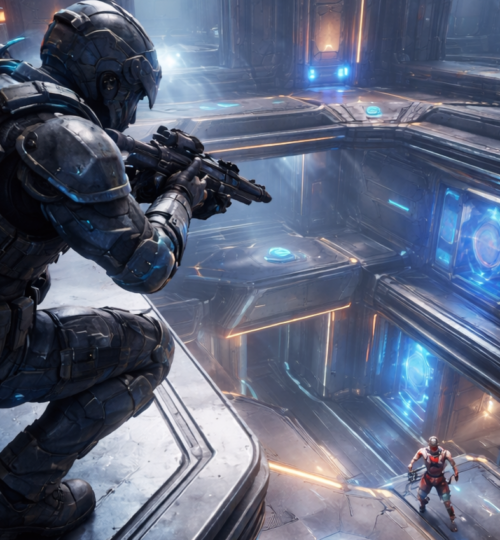
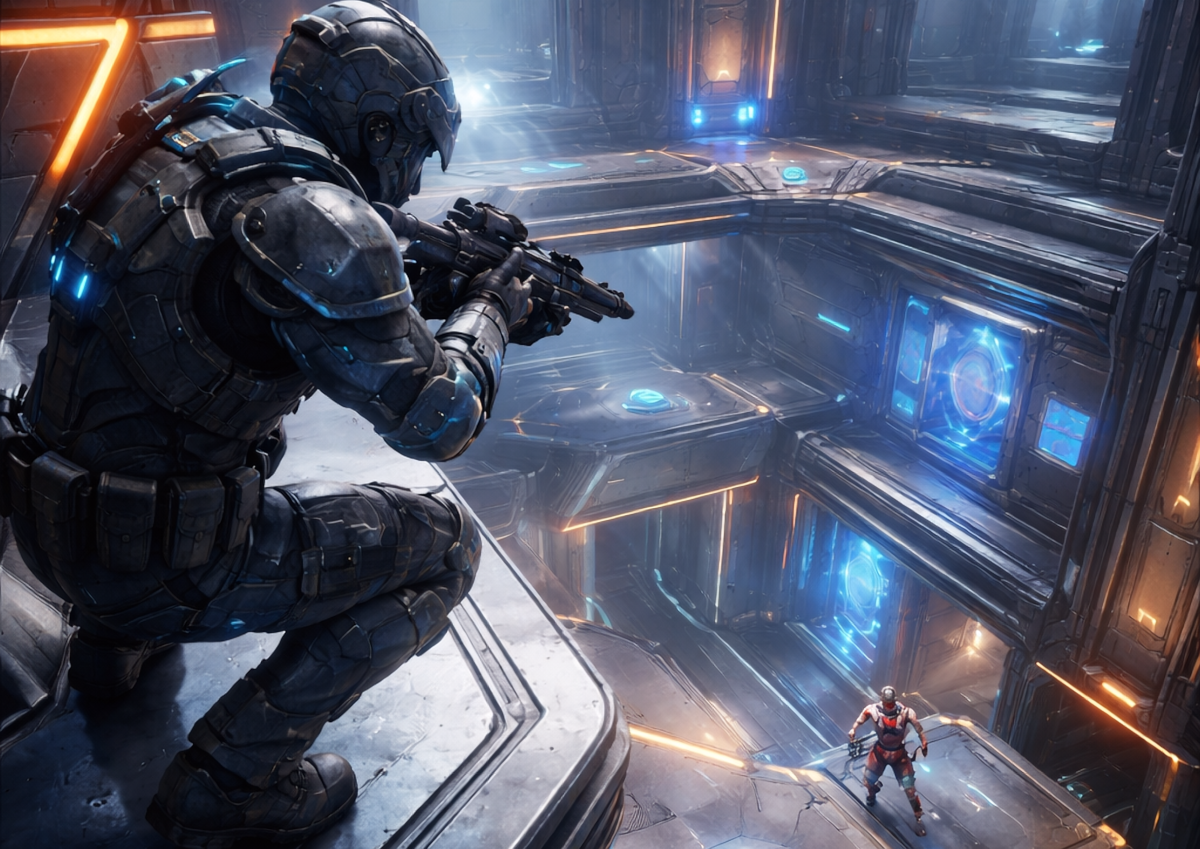
For many veteran players, the phrase “arena shooter” is not just a genre label. It is a memory. It calls back to late nights on servers where speed meant survival, where knowing a map was only half the battle, and where mastering movement separated the good from the untouchable. Titles like Quake, Unreal Tournament, and Tribes were not simply games. They were proving grounds. Every jump, every strafe, every route across a map was a test of precision and control.
For a long time, that style of play felt like it had been left behind. Modern shooters rose to dominance with a different philosophy. They focused on accessibility, consistency, and predictability. Movement became standardized. Sprint forward, take cover, aim, fire. It worked, and it worked well. Massive player bases formed, esports ecosystems expanded, and competitive play became more structured than ever before.
But something subtle began to fade. The sense of mechanical expression that once defined competitive shooters started to narrow. Engagements became cleaner, more controlled, but also more predictable. For players who thrived on pushing systems to their limits, there was a growing feeling that something essential had been lost. Now, that feeling is beginning to reverse.
When Movement Was the Meta
To understand why this revival matters, it helps to remember what movement once meant in competitive shooters.
In classic arena titles, movement was not just about getting from one point to another. It was the foundation of the entire game. Players learned how to build speed through strafing, how to chain jumps to maintain momentum, how to use the environment itself as a tool. Mastery was not handed to you through tutorials. It was discovered, practiced, and refined over time.
You could watch two players with identical aim and instantly tell who had the edge based on how they moved. One player would glide across the map, hitting angles before the opponent even expected contact. The other would arrive just a fraction too late.
That fraction was everything. As the industry shifted toward more grounded and accessible mechanics, that layer of depth became less central. Movement still mattered, but it was no longer the defining factor in most engagements. For a while, that trade-off made sense. It opened the door for millions of new players.
But competitive communities never stopped chasing depth.
A Shift in Design Philosophy
What we are seeing now is not a sudden return to the past, but a gradual evolution. Developers are reintroducing movement mechanics with a modern perspective. They are not simply copying older systems. They are rebuilding them in ways that fit today’s players and expectations.
Movement is becoming a skill layer again, sitting alongside aim and game knowledge rather than beneath them. You feel it when a slide carries just enough momentum into a jump to give you an edge. You notice it when strafing subtly changes your speed in a way that rewards precision. These mechanics are not always obvious at first. That is part of their appeal. They invite discovery.
The difference now is that these systems are often designed with intention. In the past, some movement techniques emerged almost accidentally from physics systems. Today, they are being crafted to offer depth without completely overwhelming new players. That balance is what defines this revival.
The Competitive Player’s Influence
At the center of this shift is the competitive community itself. Players who spend hundreds or thousands of hours in a game are always searching for something deeper. When mechanics are too rigid, the ceiling becomes visible. Once you can see that ceiling, it becomes harder to stay engaged.
Movement changes that dynamic completely. It creates a skill curve that is almost endless. There is always a faster route, a cleaner execution, a more efficient way to move through space. Improvement becomes tangible in a way that goes beyond rank or statistics. You can feel it in your hands.
That feeling is addictive. In modern ranked environments, players are rediscovering what it means to invest in mechanics that are not explicitly explained. There is a quiet satisfaction in learning something through repetition and experimentation, then applying it in a real match and seeing the difference immediately.
For communities that remember the early days of competitive shooters, this is a familiar rhythm. Practice, refine, compete, repeat.
The Quiet Push from Indie Developers
While major studios are beginning to embrace these ideas again, much of the early momentum has come from smaller developers. Indie teams have the freedom to take risks that larger studios often avoid. They can build games around high-speed movement and trust that a dedicated audience will find them. Without the pressure to appeal to everyone, they can focus on creating something that feels mechanically rich.
These games often start small. A niche audience forms around them, drawn in by the promise of depth and mastery. Over time, their influence begins to spread. Players bring what they learn into other games. Developers take notice of the engagement these systems create. It is a familiar pattern in the industry. Innovation rarely starts at the center. It builds on the edges, gaining strength before it becomes impossible to ignore.
Movement in the Age of Content
There is another force amplifying this revival, and it comes from outside the games themselves. Modern gaming exists in a content-driven ecosystem. Highlights, clips, and streams shape how games are perceived and shared. Movement-heavy gameplay naturally fits into this environment.
Watching a player outmaneuver an opponent through sheer mechanical skill is compelling. It creates moments that stand out. A perfectly timed jump, a rapid sequence of directional changes, a fluid escape that should not have been possible. These are the moments that get clipped, shared, and replayed.
They tell a story instantly. Static engagements rarely create the same impact. Movement introduces unpredictability, and unpredictability creates excitement. In a landscape where attention is valuable, that matters.
A New Generation of Players
The players entering competitive shooters today are not the same as those from a decade ago. Many have grown up with competitive gaming as a constant presence. They are used to learning systems, optimizing performance, and investing time into improvement. They expect depth. They want mechanics that reward effort.
Complex movement meets those expectations. It gives players a sense of control over their progression. Improvement is not just about better aim or smarter decisions. It is about refining how you interact with the game at a fundamental level. Every small gain in efficiency translates into real advantages.
This creates a kind of personal expression that is difficult to replicate through simpler systems. Two players can approach the same situation in completely different ways, shaped by how they move rather than just how they shoot. That individuality keeps the experience fresh.
The Challenge of Balance
Reintroducing complex movement is not without its challenges. Classic arena shooters were notoriously difficult for new players to break into. Veterans who had spent years mastering the mechanics could dominate lobbies in ways that felt insurmountable. That kind of barrier is difficult to sustain in modern gaming, where player retention is critical.
Developers are approaching this differently now. Basic movement is designed to feel intuitive and effective from the start. A new player can jump into a match and function without needing to understand advanced techniques. At the same time, deeper mechanics exist beneath the surface, offering advantages to those willing to learn them.
The goal is not to eliminate the skill gap, but to make it feel climbable. When done correctly, this creates a system where players are constantly aware that they can improve, but never feel completely locked out.
Maps That Reward Motion
As movement evolves, so does the environment in which it exists. Arena shooters were defined by their maps as much as their mechanics. Verticality, hidden routes, and carefully designed sightlines created spaces where movement could shine. Every part of a map had a purpose, even if that purpose was not immediately obvious.
Modern games are beginning to revisit these ideas. Maps are becoming more layered. Vertical space is being used more intentionally. Routes are designed not just for traversal, but for mastery. A player who understands how to move efficiently can navigate these spaces in ways that others cannot. This changes how matches unfold.
Positioning is no longer static. Control of the map becomes fluid, shifting based on who can move through it most effectively. It adds a strategic dimension that goes beyond holding angles or controlling choke points. Movement becomes a form of map control.
The Psychological Impact
There is also a mental aspect to movement that often goes unnoticed. Players who move unpredictably are difficult to read. They disrupt expectations. They force opponents to react rather than anticipate. In competitive environments, that kind of pressure can lead to mistakes.
A player who consistently outmaneuvers their opponents gains more than just positional advantages. They gain confidence. They set the pace of the match. Over time, that control can become overwhelming.
At high levels of play, these small edges add up quickly. The difference between winning and losing is often measured in moments. Movement has a way of creating those moments.
Esports and the Spectacle of Skill
From a spectator perspective, the return of movement-heavy gameplay brings a different kind of energy. Matches become faster, more dynamic, and less predictable. Individual skill stands out in a way that is immediately visible, even to casual viewers. A player’s movement can tell a story without needing explanation.
At the same time, it introduces new challenges for esports presentation. Complex mechanics can be difficult to follow, especially for viewers who are not familiar with them. Production teams are adapting by improving camera work, refining overlays, and relying on commentary to break down what is happening in real time.
As these tools improve, the gap between high-level play and viewer understanding begins to close. The result is a more engaging experience for everyone involved.
A Return to Identity
For long-standing competitive communities, this revival carries a deeper meaning. There was a time when players were known not just for their results, but for how they played. Their movement, their routes, their style. That identity was built through mechanical mastery and personal expression.
As complex movement returns, so does that sense of individuality. Players are once again carving out distinct playstyles. They are finding ways to stand out that go beyond statistics. In communities built around competition, that matters. It creates stories, rivalries, and a sense of history.
It brings back a piece of what made these games special in the first place.
Looking Forward
The revival of the arena shooter is not a full return to the past. It is something new, shaped by modern expectations and technology.
Not every game will embrace complex movement, and not every player will seek it out. But the influence is clear. Movement is becoming a defining factor again. It is raising the skill ceiling and giving players new ways to improve.
For veterans, it feels like a familiar challenge returning. For newer players, it offers a deeper layer of gameplay waiting to be explored. And for competitive communities, it signals something important.
The ceiling is rising again. In a space that once leaned heavily toward accessibility, depth is finding its way back. Not as a barrier, but as an opportunity. An opportunity to master something that cannot be simplified. An opportunity to stand out in ways that feel earned.
Movement is no longer just a tool. It is once again a language of competition.