Where Digital Loot Became Real Value
Every long-running online gaming community eventually learns the same lesson: players do not just compete inside games. They build cultures, reputations, markets, rivalries, and entire social economies around them.
For veteran multiplayer gamers, this is nothing new. Anyone who lived through the early MMO years remembers trade chat, auction houses, rare item farming, player-run markets, guild banks, black-market gold sellers, and the strange feeling of watching a digital sword become more valuable than something sitting on your real-world desk. What began as a side activity inside online games has grown into one of the most important parts of modern gaming.
Virtual economies are no longer background systems. They influence how players spend time, how developers design progression, how esports ecosystems are funded, and how communities decide what has status. Whether it is a Counter-Strike skin, an MMO crafting material, a Roblox item, a battle pass reward, a FIFA-style card, or a player-to-player marketplace, in-game trading has become a mirror of real-world economics. The wild part is that games often teach these lessons faster and more brutally than textbooks do.
Scarcity Is Still King
At the center of every working game economy is scarcity. Players may call it rarity, drop rate, grind time, exclusivity, or limited availability, but the principle is the same. If everyone has an item, it usually loses prestige. If only a few players can get it, the item gains symbolic value.
This is why a rare cosmetic skin can become a status symbol even when it has no gameplay advantage. It is not just about what the item does. It is about what the item says. It may say, “I was there during that season.” It may say, “I played during the early days.” It may say, “I won this tournament,” “I completed this challenge,” or “I had the money and timing to buy this before it disappeared.”
That is the same psychological force that drives sneaker collecting, trading cards, classic cars, limited vinyl releases, and vintage tech. The item itself matters, but the story attached to the item matters more.
Games compress that entire process. A developer can create scarcity overnight by limiting supply, changing drop rates, retiring an item, or attaching rewards to an event. Players react almost instantly. Prices move. Trade behavior changes. Communities debate whether the item is worth it. Speculators jump in. Casual players wonder why something that was “just a skin” is suddenly being discussed like a stock.
In other words, virtual economies show us that value is not always tied to utility. Sometimes value is tied to rarity, memory, identity, and social proof.
Time Becomes Currency
One of the oldest forms of in-game trading is simple: some players have time, others have money, and many games sit directly between those two groups. In MMOs, farming gold, gathering materials, leveling professions, crafting rare gear, or running dungeons for drops all transform time into value. A player who spends six hours gathering resources has created something another player might want but does not want to spend six hours earning. That creates a market.
This is where games reveal a real economic truth: labor is not only physical. Digital effort counts inside a system where other people recognize the result. That recognition is what makes a player economy function. If players trust that an item took time, skill, luck, or coordination to obtain, they treat it as valuable. If the same item can be duplicated, botted, bought cheaply, or flooded into the market, value collapses.
This is why bots and exploits are so damaging. They do not merely cheat individual players. They distort the entire meaning of effort. When automated farming floods a market with currency or items, real players feel the damage immediately. Prices inflate. Normal gameplay feels less rewarding. Honest players may feel pressured to cheat just to keep up.
That is a real-world lesson too. Economies depend on trust in production, fairness, enforcement, and scarcity. When people believe the system is rigged, they stop respecting the market.
Auction Houses Are Economics Class With Better Graphics
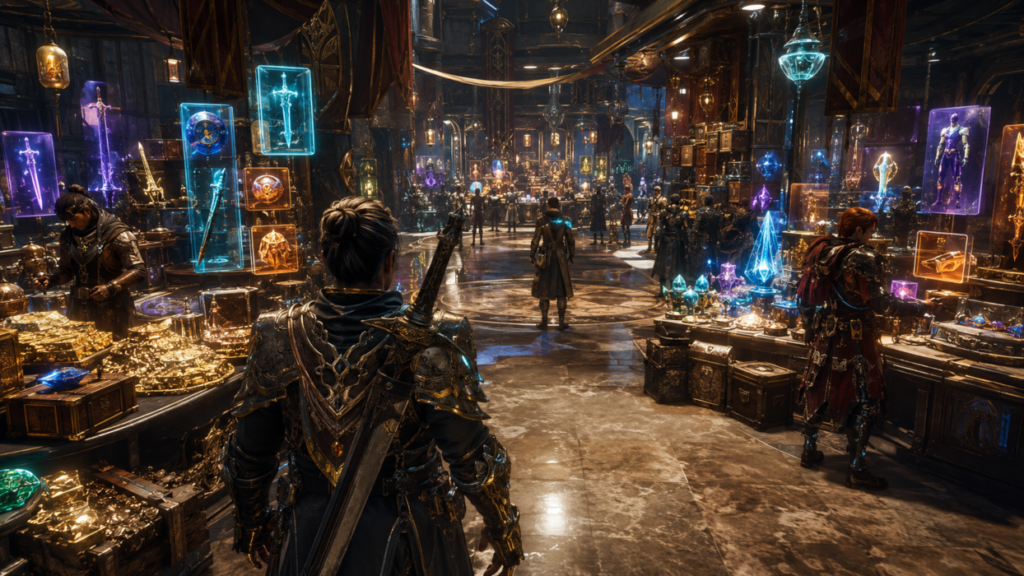
Some of the best lessons in supply and demand have happened inside MMO auction houses. Players learn quickly that price is not fixed. It changes depending on patch notes, class balance, raid releases, crafting requirements, server population, and even the day of the week. A material that seems worthless during one phase of a game can become essential after a new recipe appears. A weapon enchantment can spike in price after a popular build spreads through the community. Consumables may rise before major raid nights and fall after the weekend.
Veteran players know the game within the game. They buy low, sell high, watch trends, anticipate updates, and understand player behavior. Some players barely care about combat at all. They become merchants, crafters, market watchers, and logistics specialists.
That matters because it proves something important about online worlds. Competition is not always measured in kills, wins, or rankings. Sometimes the sharpest player on the server is the one who understands the economy better than everyone else.
This is also why player markets can build community identity. A server may become known for expensive materials, aggressive traders, generous crafters, or a few dominant guilds controlling key resources. Those stories become part of the game’s living history. For a legacy gaming community, that matters. Leaderboards tell us who won. Economies tell us how people lived between matches.
The Skin Market Changed the Conversation
Few examples show the power and risk of virtual economies better than Counter-Strike skins. Counter-Strike cosmetics began as visual customization, but over time, skins became collectibles, trade goods, status symbols, esports culture markers, and speculative assets. Some rare skins have been treated by players almost like luxury goods. They are displayed, traded, priced, discussed, and watched by third-party market communities.
This changed how many players think about cosmetics. A skin is no longer always “just cosmetic.” In some ecosystems, it can represent money, identity, risk, and reputation.
That is where things become complicated. Once in-game items can be traded, sold, or connected to third-party markets, developers lose some control over how players interpret those items. A cosmetic may begin as a harmless personalization feature, but if players can attach real-world value to it, the system can attract speculation, scams, gambling concerns, and regulatory attention.
Valve’s Counter-Strike ecosystem has faced recurring controversy around skins, trading, case openings, and gambling-adjacent third-party activity. In late 2025, reporting around Valve’s tournament rules highlighted restrictions on skin gambling, case-opening, and trading-related promotions in Counter-Strike esports contexts. The lesson is clear: once an item can carry real-world value, the rules around that item matter far beyond the game client.
Loot Boxes, Gacha, and the Trust Problem
Randomized rewards are one of the most controversial parts of modern virtual economies. Loot boxes and gacha systems create excitement through uncertainty, but they also raise questions about transparency, odds, spending behavior, and younger players.
The Federal Trade Commission has treated gaming monetization as a consumer protection issue, including actions involving unwanted purchases and concerns around in-game transactions. In December 2024, the FTC announced more than $72 million in refunds related to Epic Games and unlawful billing practices.
In 2025, the developer behind Genshin Impact agreed to a $20 million settlement with the FTC over allegations involving loot box odds, virtual currency costs, children’s data, and marketing to minors. Reports on the settlement noted requirements around clearer pricing, odds disclosures, and protections for younger users.
For players, the lesson is not simply “loot boxes bad.” The better lesson is that virtual economies need clarity. Players should understand what they are buying, what the odds are, how currency converts, and whether the system is designed around fair enjoyment or psychological pressure.
A healthy economy can include rarity and excitement. A toxic one hides costs, manipulates urgency, or makes players feel trapped in a spending loop.
Real-Money Trading Never Really Goes Away
Many developers prohibit real-money trading, but the demand for it has existed for decades. If a game has valuable items, tradable currency, or time-intensive progression, someone will try to sell shortcuts. That creates a constant tension. Developers want to preserve fair play and control the economy. Players want flexibility, convenience, or profit. Third-party sellers exploit the gap.
Real-money trading can damage games in several ways. It can encourage account theft, botting, spam, phishing, chargeback fraud, and pay-to-win behavior. It can also create resentment among players who feel that effort no longer matters. If someone can buy their way past the grind, the grind starts to feel less meaningful for everyone else.
But developers also know that demand for convenience is real. That is why many games have introduced official systems that convert money into controlled forms of value, such as premium currency, bonds, tokens, battle passes, or marketplace fees. These systems attempt to bring gray-market behavior into a safer, more regulated environment.
The tradeoff is delicate. Too much restriction pushes players toward black markets. Too much monetization makes the game feel like a storefront. The healthiest economies usually find a middle ground where players can trade, earn, craft, customize, and progress without feeling exploited.
Esports Adds Another Layer
Esports makes virtual economies more powerful because competition creates visibility. If a pro player uses a skin, a weapon charm, a character, a loadout, or a cosmetic style, it can influence demand. If a tournament drops exclusive items, viewers may tune in not only for the matches but for the rewards. If teams partner with marketplaces, betting brands, or skin-related sponsors, the economy becomes connected to the public face of competition.
That can help fund esports ecosystems, but it also creates risk. Competitive integrity depends on trust. When monetization, gambling-adjacent systems, or speculative markets get too close to competition, communities start asking hard questions.
Are players being marketed to responsibly? Are younger viewers being exposed to gambling-like systems? Are teams depending on sponsors that create reputational problems? Are tournament organizers protecting the game’s long-term health? These questions are not side issues anymore. They are part of modern esports management.
For a revived legacy league community, this is especially relevant. Competitive gaming is not just brackets and match results. It is governance, fairness, transparency, and player confidence. If players do not trust the surrounding economy, they eventually stop trusting the competition connected to it.
Reputation Is a Currency Too
Not every virtual economy is about items. Some of the most important economies in gaming are social. A player’s name, clan tag, match history, tournament record, trade reputation, forum presence, and community behavior all create value. In older online communities, reputation was often worth more than any item. People knew who kept their word, who rage quit, who disputed losses, who ran fair tournaments, who helped new players, and who made every lobby worse just by joining it.
That kind of reputation economy still exists. It just looks different now. Today it may show up through Discord roles, Steam profiles, ranked badges, verified marketplaces, creator codes, platform achievements, or site-based player profiles.
This is one reason legacy leaderboard restoration matters. Old records are more than data. They are identity. They preserve proof that players existed, competed, won, lost, improved, and contributed to a scene. In a gaming world where platforms shut down and histories vanish, preserving those records gives value back to the community. A virtual economy can be built around skins and currency, but a community economy is built around memory.
What Players Can Learn From Game Markets
The biggest real-world lesson from in-game trading is that markets are emotional. Players like to imagine they make purely rational decisions, but game economies prove otherwise.
People overpay for nostalgia. They panic sell after updates. They chase rare drops. They follow influencers. They hoard items because they believe prices will rise. They buy cosmetics because friends have them. They grind for rewards because limited-time events create pressure. They value items more when those items are connected to personal achievement. That sounds like gaming, but it also sounds like the real world.
Virtual economies teach supply and demand, inflation, speculation, scarcity, arbitrage, consumer psychology, risk management, labor value, fraud prevention, and regulation. They also teach something more human: people assign value based on stories.
The rare mount matters because of the grind. The tournament badge matters because of the win. The old clan profile matters because of the era it represents. The skin matters because of the player who used it, the match where it dropped, or the community that recognizes it. Games make economics personal.
The Future of Virtual Economies
The next phase of virtual economies will likely be shaped by three forces: player ownership, platform control, and regulation. Players want more meaningful digital ownership. They want items, profiles, achievements, and histories that do not vanish when a server shuts down. Developers want control because uncontrolled markets can create fraud, gambling concerns, legal exposure, and balance problems. Regulators want transparency when real money, children, randomized rewards, and unclear pricing are involved.
Some companies will respond with stricter marketplaces. Some will reduce trading. Some will lean harder into creator economies, user-generated content, and platform currencies. Others will experiment with more transparent item shops, limited cosmetics, direct purchases, and safer trading systems.
The strongest communities will be the ones that understand the difference between economy and exploitation. Trading can deepen a game. Crafting can create identity. Rare rewards can build history. Player markets can make worlds feel alive. But when every system is tuned to extract money, players eventually notice. And gamers have long memories.
Why This Matters to Multiplayer Communities
For a legacy multiplayer community, virtual economies are not just industry trivia. They are part of why online gaming became so powerful in the first place. Players did not gather only to play matches. They gathered to build teams, trade knowledge, earn status, test themselves, collect memories, and become known. Every ladder, tournament, profile, forum thread, and scoreboard contributed to a larger economy of recognition.
That is the real bridge between old-school competitive gaming and modern virtual economies. The tools have changed, but the human behavior has not. Players still want value. Sometimes that value is a rare item. Sometimes it is a rank. Sometimes it is a restored profile from 2006. Sometimes it is the respect of people who know what the grind meant.
In-game trading teaches us that digital spaces are never “just digital.” When people invest time, skill, money, and identity into them, those spaces become real in every way that matters.