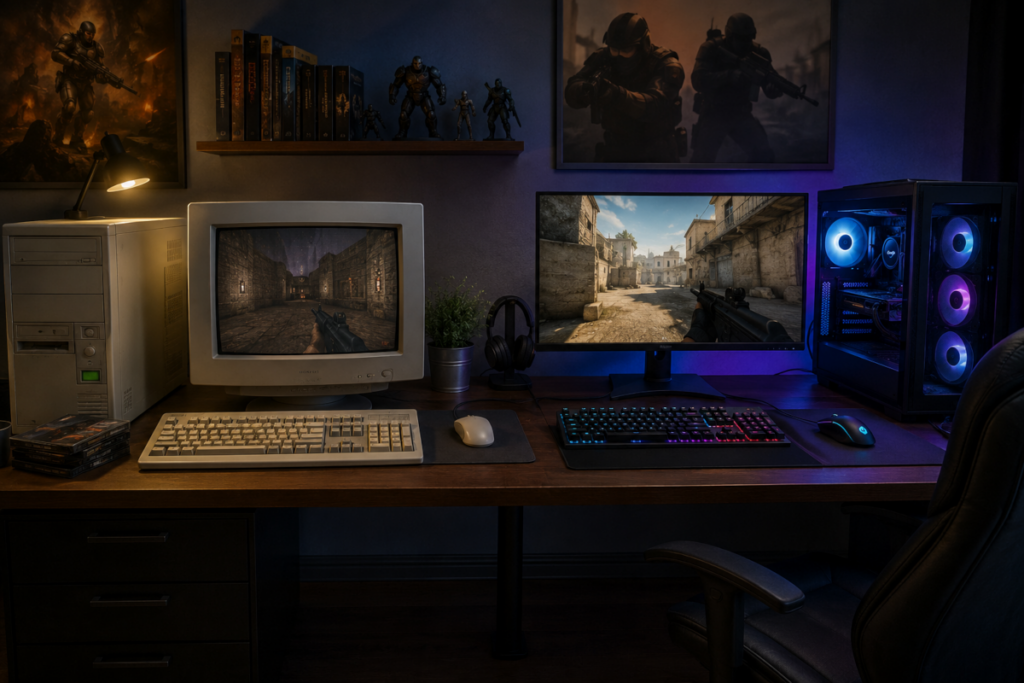
Modern shooters look nothing like the games that built online competitive play. Today’s multiplayer landscape is packed with seasonal content, ranked resets, hero abilities, weapon attachments, live-service economies, cross-platform matchmaking, controller aim assist debates, skill-based matchmaking, and esports ecosystems that run year-round. On the surface, it can feel like the old arena and tactical shooters belong to another era.
But dig under the graphics, battle passes, and cinematic trailers, and the truth is still sitting there with a rocket launcher in one hand and a stopwatch in the other: classic shooter mechanics still matter.
The players who learned how to strafe jump, control recoil, pre-aim angles, manage spawn timings, listen for audio cues, conserve armor, predict rotations, and win duels without hand-holding were not just learning old games. They were learning competitive fundamentals. Those fundamentals still transfer into modern shooters because the core language of multiplayer combat has not disappeared. It has evolved.
Counter-Strike 2 remains one of the most played games on Steam, and Valve’s own Steam stats continue to show tactical shooters near the top of PC activity. Quake is still officially described as a game that helped define fast, skill-based arena competition, and its influence remains obvious across movement shooters, arena revivals, aim trainers, and high-speed indie FPS design. Classic mechanics are not dead. They are the skeleton under the armor.
Classic Shooters Were Built Around Mechanical Truth
Classic shooters did not have as many layers as modern games. That was the point. When you loaded into Quake, Unreal Tournament, Counter-Strike, Medal of Honor, Return to Castle Wolfenstein, Halo 2, Call of Duty 1, or Star Wars Battlefront II Classic, you were often facing a more exposed version of competition.
There were fewer distractions. Fewer progression systems. Fewer unlock trees. Fewer cosmetic rewards. The match itself was the reward.
Because of that, mechanics mattered brutally. Movement was not just movement. It was survival, positioning, timing, and pressure. Aim was not just crosshair placement. It was prediction, tracking, flicking, burst control, and knowing when not to shoot. Map control was not just knowing where enemies might be. It was understanding where they had to go next.
Classic shooters forced players to answer hard questions every few seconds:
- Can I take this duel?
- Do I have the better angle?
- Can I hear the rotation?
- Is the power weapon about to respawn?
- Do I chase the weak player or hold position?
- Should I reload now or bait the push?
- Can I survive long enough for support?
Those questions are still alive in modern shooters. Whether the game is Counter-Strike 2, Valorant, Apex Legends, Fortnite, Rainbow Six Siege, Call of Duty, The Finals, XDefiant, Overwatch, Halo Infinite, or a newer competitive FPS, the same decision-making DNA shows up again and again. The interface changed. The fundamentals stayed.
Movement Is Still a Skill Gap
Movement has always separated average players from dangerous players. In classic shooters, movement was often the first real wall players hit. You could have decent aim and still get destroyed by someone who knew how to move.
Quake players mastered strafe jumping, bunny hopping, air control, rocket jumps, circle jumps, and momentum management. Unreal Tournament players learned dodging, lift jumps, wall movement, shock combos, and evasive routes. Counter-Strike players learned counter-strafing, shoulder peeking, silent walking, jiggle peeking, ladder movement, and jump-spotting. Halo players learned strafing patterns, crouch timing, map jumps, and grenade-assisted pressure.
These skills still matter because movement is not only about speed. It is about making yourself harder to hit while making your own shots easier.
In modern shooters, movement may be expressed through slides, mantles, ziplines, wall climbs, tactical sprints, air strafes, ledge grabs, hero abilities, or mobility gadgets. But the mental discipline is the same. Good movement is controlled chaos. Bad movement is panic with a keyboard.
Players who understand classic movement tend to adapt faster because they already know the principle behind it: every movement decision changes the fight before a shot is fired.
That is why old-school movement training still has value. It teaches rhythm. It teaches momentum. It teaches spacing. It teaches how to enter and exit danger without becoming predictable.
Aim Is More Than Raw Reflex
A lot of players talk about aim like it is purely a reflex contest. Faster hand wins. Better mouse wins. Higher refresh rate wins. That is only part of the picture.
Classic shooters taught a more complete version of aim. In arena shooters, players had to switch between hitscan, projectile, splash damage, tracking weapons, and prediction weapons. The lightning gun rewarded smooth tracking. The railgun rewarded precision and timing. Rockets rewarded prediction and spatial awareness. The shotgun rewarded distance control. The plasma gun rewarded pressure and denial.
That kind of weapon variety created flexible aimers. In tactical shooters, aim became more about restraint. Counter-Strike players learned crosshair placement, recoil discipline, first-bullet accuracy, angle isolation, and pre-fire timing. The goal was not always to move the mouse faster. The goal was to need less movement in the first place.
That lesson is still extremely relevant. Modern players can spend hundreds of hours in aim trainers, but the best in-game aim still comes from positioning, anticipation, and clean decision-making. A player who knows where the fight will happen has an advantage over a player who only reacts after the fight begins. Classic shooters teach that aim is not just mechanical execution. It is preparation.
Map Control Is the Original Meta
Before modern games had live pings, minimap clutter, UAV spam, ability reveals, and spectator-friendly overlays, players had to understand maps the hard way.
They learned timings. They memorized routes. They knew where spawns could flip. They knew where armor, health, ammo, flags, bombsites, power weapons, and choke points shaped the match. They learned which doors made noise, which jumps saved time, which angles were bait, and which routes were only safe if your team had pressure elsewhere. That is classic map control, and it is still one of the most valuable skills in gaming.
In battle royale games, map control becomes rotation planning. In tactical shooters, it becomes site control and lane denial. In arena shooters, it becomes item timing and territory. In hero shooters, it becomes high-ground pressure and cooldown trading. In extraction shooters, it becomes risk mapping and escape planning.
Different names. Same lesson. A player who understands map control does not just ask, “Where is the enemy?” They ask, “Where can the enemy be, where do they want to go, and what do they need next?” That is the difference between reacting and controlling.
Timing Separates Good Players From Veterans
Classic shooters rewarded players who could feel the clock. In arena shooters, timing armor, mega health, and power-ups could decide a match. In Counter-Strike, knowing when to rotate, when to fake, when to save, and when to execute was often more important than winning one flashy duel. In objective shooters, timing respawns and pushes was the difference between feeding and breaking a defense.
Modern games still revolve around timing, even when the systems look different. Cooldowns are timers. Zone closures are timers. Economy rounds are timers. Respawn waves are timers. Ultimate abilities are timers. Weapon spawns are timers. Loadout drops, crafting stations, buy phases, cashouts, overtime rounds, and objective unlocks all create timing windows.
Classic shooters train players to think in windows. They teach that a fight is not only about who is alive right now. It is about what becomes available in five seconds, ten seconds, thirty seconds, or the next round. That mindset is timeless.
Audio Awareness Is Still a Competitive Weapon
Veteran shooter players know that sound wins matches. Footsteps, reloads, weapon swaps, jump pads, doors, grenades, armor pickups, healing, bomb plants, defuses, and distant gunfire all give information. Classic shooters often had less visual assistance, so players developed strong audio discipline. They learned when to make noise, when to stay quiet, and when to bait sound to force a reaction.
Modern shooters are louder and more complex, but audio remains one of the biggest separators between casual and competitive play. A player who hears one footstep and understands what it means can rotate early, hold the correct angle, pre-aim the entry, warn teammates, or avoid a trap. That is not nostalgia. That is competitive literacy.
Classic games made players listen because they had no choice. That habit still pays off.
Classic Mechanics Teach Accountability
One reason classic shooters still matter is that they expose mistakes. In many older games, there was less cushioning. No panic button. No ultimate to erase a bad position. No forgiving spawn protection that lasted forever. No loadout advantage to blame. No elaborate ability kit to cover poor fundamentals. If you missed, overpeeked, wasted ammo, ignored sound, lost track of timing, or took a bad route, you usually paid for it immediately.
That kind of punishment can be frustrating, but it builds accountability. Modern games sometimes hide weaknesses behind systems. A player can rely on abilities, matchmaking quirks, equipment advantages, overpowered seasonal weapons, or team compositions. Classic shooters strip much of that away. They ask a simple question: can you play?
That does not mean classic shooters are automatically better. Modern games have their own depth. But classic mechanics are excellent teachers because the feedback loop is clean. You know when you messed up. You know why you lost the duel. You know when your route was wrong. You know when your timing failed. That clarity creates growth.
Why These Skills Transfer Into Modern Competitive Games
The modern esports ecosystem is not a museum. It is constantly changing. Games update, metas shift, movement systems get patched, weapons get rebalanced, maps rotate, and entire competitive scenes rise or fall. That is exactly why fundamentals matter.
A player who only knows one meta can become lost when the patch changes. A player with strong fundamentals can adapt. Classic shooter mechanics create that foundation.
They teach:
- How to win clean duels.
- How to move under pressure.
- How to control space.
- How to read enemy habits.
- How to manage timing.
- How to use sound.
- How to value positioning over ego.
- How to stay calm when the fight gets messy.
These skills travel from game to game because they are not tied to one weapon skin, one battle pass, or one season. They belong to the player.
That is why veterans from older shooters often show up in newer games with an unusual advantage. They may need time to learn the interface, abilities, recoil patterns, and maps, but the underlying instincts are already there. They know how competitive pressure feels.
The Legacy Player Still Has a Place
For a revived legacy gaming community, this topic matters for more than nostalgia. It speaks directly to identity.
A lot of veteran players came from an era where communities were built around servers, ladders, clans, rivalries, forums, scrims, and match reports. Skill was not only measured by ranked icons. It was remembered through names, teams, match histories, and moments people still talk about years later.
Those players learned games before modern onboarding softened the first hundred hours. They learned by getting wrecked, asking questions, watching better players, joining teams, studying routes, and grinding mechanics until the game finally slowed down in their mind.
That experience still has value. Modern players can learn from it. Veteran players can return with it. Communities can preserve it. Classic shooter mechanics are not relics. They are a training ground for competitive thinking.
The New Generation Still Needs the Old Lessons
The funniest thing about modern shooters is that many new players are rediscovering old lessons under new names. Crosshair placement is still king. Movement tech still becomes a community obsession. Map knowledge still beats random aggression. Aim trainers still chase skills arena shooters demanded decades ago.
Ranked players still argue about economy, rotations, timing, and team discipline. Developers still build games around the same tension between mechanical skill, strategy, and readable counterplay.
Even games with advanced abilities still need clean shooting. Even games with high mobility still reward smart positioning. Even games with complex metas still punish bad timing. The old lessons never left. They just got new UI.
Mastery Is a Mindset, Not a Time Period
Mastering classic shooter mechanics is not about pretending every old game was perfect. Some had brutal learning curves. Some had balance issues. Some had netcode problems. Some had hardware barriers. Some had communities that were not always welcoming to new blood. But the mechanical lessons were real.
The best classic shooters demanded precision, patience, awareness, discipline, and adaptation. Those qualities are still required today. The player who masters them becomes harder to shake, no matter what game they load next. That is the real relevance of classic shooters in 2026 and beyond. They remind us that competition is not only about content. It is about craft. Graphics age. Seasons end. Servers shut down. Metas change.
But the feeling of hitting the perfect shot, reading the perfect rotation, timing the perfect push, or outplaying someone through pure understanding still hits the same. Classic shooter mechanics still matter because they teach players how to compete at the root level. Not just how to play a game, but how to think inside one. And for any serious multiplayer community, that skill never goes out of style.