
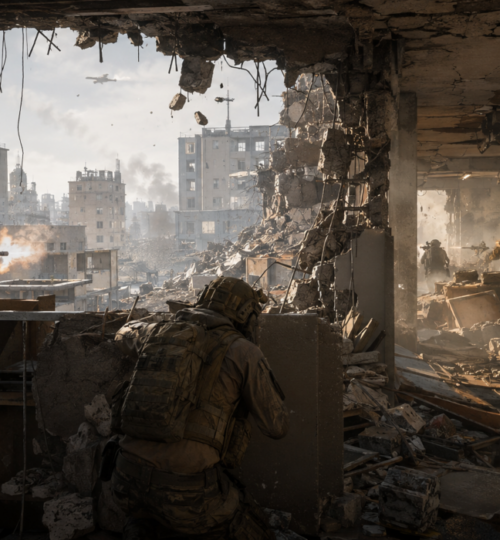
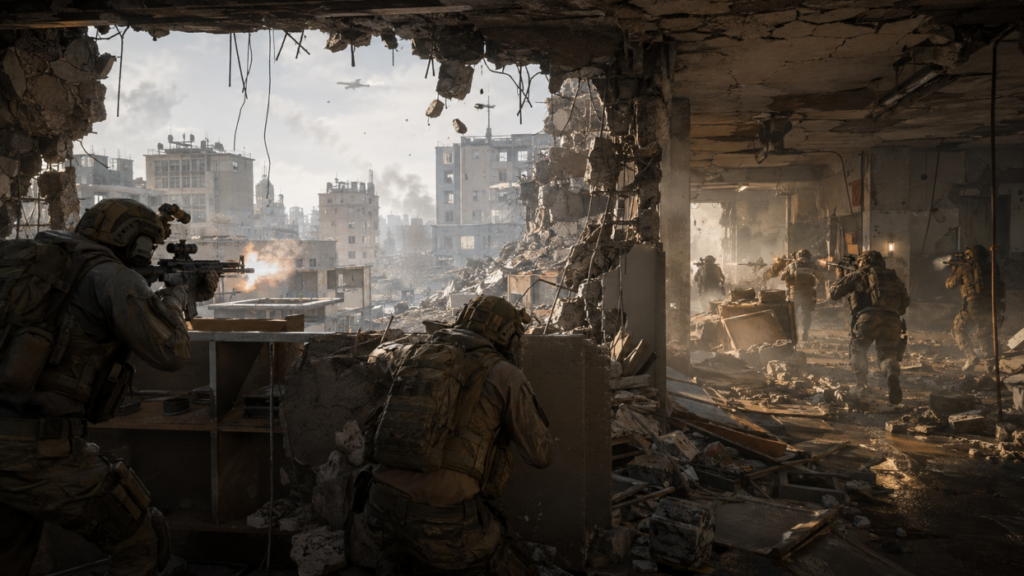
For years, competitive map knowledge meant learning a fixed object. Teams memorized sightlines, timings, grenade spots, rotations, power positions, spawn tendencies, and the exact geometry of every doorway and piece of cover. The better a player knew the map, the less mental effort had to be spent interpreting it. That model is not disappearing, but a growing group of multiplayer shooters is making the map itself an active participant in the match.
Destructible walls are only the beginning. Modern dynamic maps can lose entire sections of cover, open fresh attack lanes, move objectives through space, alter visibility, change vertical access, or introduce hazards that force both teams to abandon a plan that was sound thirty seconds earlier. Battlefield 6 and THE FINALS are two of the clearest current examples, but the idea has roots stretching back through Battlefield: Bad Company 2, Battlefield 4, and Rainbow Six Siege. The competitive consequence is bigger than spectacle. Map control is becoming temporary.
Destruction Has Moved Beyond Set Dressing
Environmental destruction in multiplayer shooters is not new. Battlefield: Bad Company 2 was already advertising its Frostbite-powered “Destruction 2.0” in 2010, including the ability to chip away cover or collapse entire buildings. Battlefield 4 later pushed large map-changing events through systems such as Flood Zone, where destroying a levee flooded the play space, increased the value of light naval vehicles, and let infantry reach rooftops by swimming through newly raised water.
Rainbow Six Siege took a tighter and more competitive approach. Instead of treating destruction mainly as a large-scale event, Siege built tactical rounds around procedural destruction, breaching, fortification, and the ability to create firing lines through walls, floors, and ceilings. Ubisoft still describes destructible environments as a central part of Siege, and the game’s long life has shown how destruction can become learned competitive structure rather than pure chaos.
That distinction matters. Destruction becomes strategically meaningful when players can predict what an action will do, understand who caused it, and exploit the result. A wall disappearing is not interesting merely because fragments fly across the screen. It becomes interesting when the missing wall changes a defense, exposes a rotation, removes safe cover, or creates a new angle that the opposing team now has to account for.
THE FINALS Treats the Arena as a Consumable Resource
THE FINALS pushes this concept harder than most shooters because its arenas are designed to be dismantled during ordinary play. Embark describes the game around fully destructible virtual arenas, and its current Game Show Events can add meteor showers, low gravity, intensified destruction through Mega Damage, or even hostile arcade-style invaders whose attacks damage players and structures. Arena variants can also place objectives on moving platforms, suspend them high above the map, alter central structures, or reduce visibility with a sandstorm.
That changes what “holding” an objective means. In a static shooter, a strong defensive setup often depends on controlling entrances and establishing crossfires around geometry that everyone knows will remain in place. In THE FINALS, the building containing the objective may stop being a building in any useful sense. Floors can disappear, stair access can be broken, exterior walls can be opened, and a defended room can become exposed from several directions.
The result is a different form of resource management. Players are not only spending ammunition, health, gadgets, cooldowns, and lives. They are spending the map. Destroying a floor to drop a cashout station can solve an immediate problem, but it may also eliminate a defensive position the team would have preferred to use thirty seconds later. Blowing open a wall may create the fastest entry route while simultaneously giving another squad a clean line of sight from outside.
That creates a competitive skill that older shooters rarely demanded at this scale: evaluating future geometry. Good players have to think about what the room will look like after the explosives go off, not simply what it looks like now.
Battlefield 6 Is Turning Routes Into Player Decisions
Battlefield 6 is moving in a related direction, although at a larger scale and with a different pace. EA has said its destruction design is intended to clearly communicate what can be destroyed, altered, or transformed. On Cairo Bazaar, expanded destruction can create new pathways and shortcuts, specifically opening alternatives around pressure points and allowing squads to create unexpected pushes.
That is more competitively interesting than destruction that merely removes cover. A destroyed wall can function almost like a player-created map rework during the match. The team that opens it has changed the rotation network for everybody, including the opponent.
Railway to Golmud adds another layer. EA describes the moving railway as a defining feature that creates a shifting frontline while squads fight for control of it. The concept is simple, but the implications are not. An objective or combat focus that physically changes position alters reinforcement timing, vehicle approach angles, nearby cover value, and the distance between contested areas without requiring a round reset or server-side map change.
Battlefield 6 has also experimented with hazards that affect player decision-making without relying on direct damage. Season 2’s VL-7 modes introduced psychoactive smoke zones that cause disorienting effects, while masks and filters become resources that squads must manage. In those modes, moving through contaminated space can still be tactically correct, but the cost and preparation required to do it are different from a normal flank through open terrain.
These systems point toward a broader design shift. Instead of asking players only to master a map, developers can ask them to master the rules by which the map changes.
Mid-Match Adaptation Becomes a Mechanical Skill
Traditional competitive preparation rewards repetition. Teams scrim the same positions until entries, trades, utility sequences, and rotations become fast enough to execute almost automatically. Dynamic environments do not erase that preparation, but they place a ceiling on how much of the match can be pre-scripted.
A destroyed route can invalidate a rotation that worked in practice. A moving objective can turn yesterday’s timing into the wrong timing. A visibility event can reduce the value of a long-range loadout, while a collapsed structure can suddenly make vertical mobility much more valuable. Teams that recognize the change first gain a window before the opponent reorganizes.
That window is where dynamic-map skill lives. The strongest adaptation is not random improvisation. It is rapid reassessment based on a shared understanding of the game’s physical systems.
For organized teams, that puts more weight on communication quality. Calling “building weak” is different from calling an enemy location because it predicts a future state rather than reporting a current one. The same is true of warnings that a floor is about to collapse, an objective is moving out of a favorable zone, or a hazard is about to make a route unreliable. A team can know exactly where every opponent is and still lose because it misunderstood what the environment was about to become.
Dynamic Maps Can Punish Memorization Without Replacing Knowledge
There is a temptation to frame dynamic maps as the opposite of map knowledge, but that misses the competitive depth. In a well-designed system, experienced players still know more than new players. They simply know a different category of information.
A veteran Siege player does not merely know where a wall starts the round. The player knows whether it can be breached, what sits behind it, what lines appear after partial destruction, which floors permit vertical pressure, and how sound or utility behavior changes once those surfaces are opened. The map is still being memorized, but the memorized object includes several possible states instead of one.
THE FINALS pushes that idea into more extreme territory. Players learn structural relationships, likely collapse patterns, movement tools, objective manipulation, and which parts of an arena can be removed to create access. Battlefield’s larger spaces apply similar thinking to vehicle lanes, buildings, choke points, and moving combat zones.
The next competitive map guide may therefore look less like a blueprint and more like a decision tree. The useful question is not just “Where is the best position?” It is “Under which version of this map is that position still good?”
Competitive Integrity Depends on Readability, Not Static Geometry
Dynamic environments also create a hard problem for serious competition. Unpredictability can generate memorable matches, but competitive players need to understand why something happened. If a building collapses because of accumulated damage, players need enough visual, audio, or systemic feedback to judge the risk before it becomes fatal. If a hazard changes movement or visibility, teams need a fair opportunity to detect and respond to it.
That is why randomness and dynamism are not the same thing. A dynamic system can still be consistent. A wall that always responds to the same damage rules is learnable even if players choose when to destroy it. A moving platform can create different fights every round while remaining mechanically predictable. A hazard can force adaptation without becoming arbitrary if its timing, boundaries, counters, or warnings are readable.
This is also where esports rule sets may have to become selective. Some environmental systems reward planning and mechanical awareness. Others may introduce enough variance that tournament organizers or ranked designers prefer to disable them, constrain them, or standardize which variants can appear. THE FINALS itself separates pre-match Arena Variants from mid-match Game Show Events, showing how several forms of environmental change can coexist inside one game while producing very different levels of uncertainty.
The best competitive version of dynamic mapping will not be the one with the most destruction. It will be the one where changing the map creates decisions that skilled teams can intentionally cause, anticipate, counter, and exploit.
Map Control Is Becoming Temporary by Design
Older multiplayer strategy often treated strong geometry as a possession. Secure the power position, lock the lane, hold the building, control the choke. Dynamic maps weaken that assumption because geometry itself can now have an expiration date.
That pushes teams toward layered plans. A squad may defend a room while also preparing a fallback if the outer wall is destroyed. A vehicle crew may control a road while watching for destruction that opens another approach. A team chasing a moving objective may need to value mobility over the strongest static firing position. The environment becomes another clock in the match, even when no timer is visible.
There is a strange competitive elegance in that shift. Fixed maps reward players for solving space before the match begins, then executing that knowledge under pressure. Dynamic maps reward players for doing part of that solving live, while opponents are actively changing the problem.
The technology is now strong enough that collapsing structures, moving objectives, changing visibility, physical hazards, and player-created routes can exist as gameplay systems rather than occasional scripted tricks. Battlefield 6 is using destruction to open shortcuts and move frontlines, while THE FINALS is comfortable letting an arena partially disintegrate under players who still have an objective to complete.
That makes the map less like a board and more like equipment shared by both teams. It can be damaged, manipulated, denied, repurposed, and sometimes ruined. Competitive players have spent decades learning where to stand. More games are now asking whether they also know when to make that place disappear.