
Disclaimer: The views and opinions expressed in this article are solely those of the author. The mention of any products, services, or methods does not constitute an endorsement.
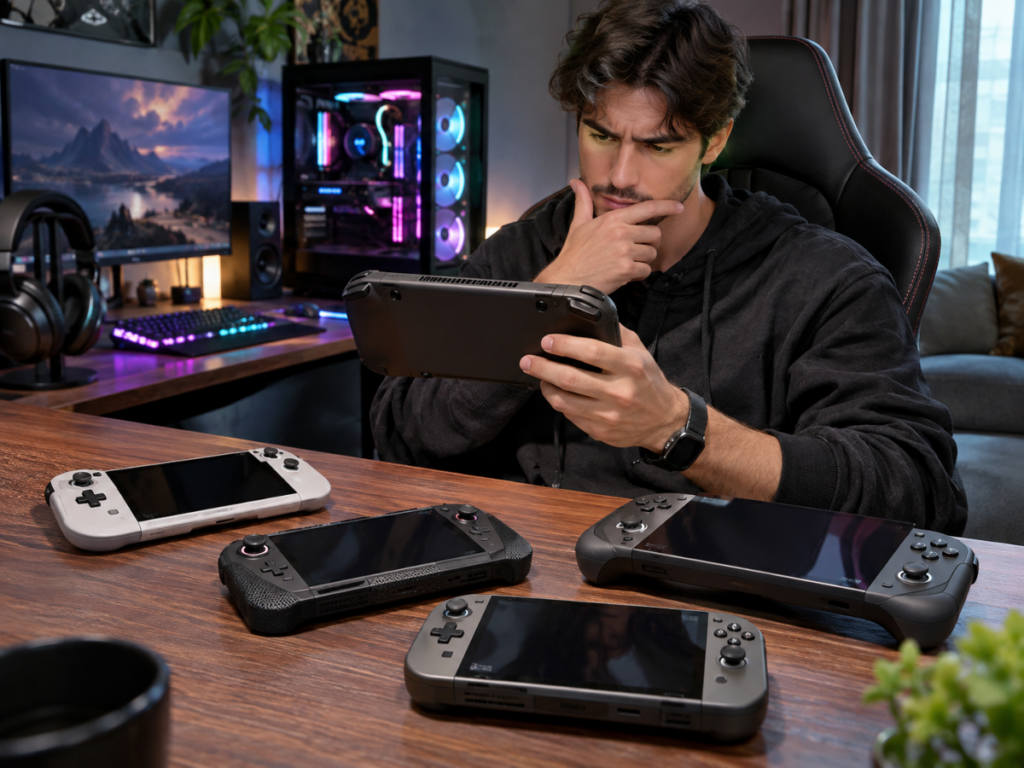
The handheld gaming PC market has reached an unusual point in 2026. Consumers can choose between compact Linux-based systems, powerful Windows handhelds, oversized portable computers with detachable controllers, and premium machines approaching the price of a capable gaming laptop. Manufacturers continue introducing new models, but the differences between them are becoming harder to evaluate from specifications alone.
Valve, ASUS, Lenovo, MSI, and smaller manufacturers such as GPD and AYANEO are competing for gamers who want access to their PC libraries without being tied to a desk. Their products offer different combinations of processing power, screen technology, battery capacity, and operating systems. Several devices use closely related hardware, making differences in cooling, ergonomics, and software more meaningful than their processor names might suggest.
For prospective buyers, the expanding selection creates a difficult comparison. A handheld costing twice as much as another model will not necessarily deliver twice the gaming performance, and a device with a superior processor may provide a less satisfying experience once battery life, weight, or game compatibility enters the equation. With prices climbing throughout 2026, understanding those trade-offs has become essential.
The Handheld PC Market Is Getting Crowded
The modern handheld PC category gained considerable attention following the Steam Deck’s arrival in 2022. Valve demonstrated that an integrated controller, compact AMD processor, and gaming-focused operating system could make a large PC game library practical on portable hardware. Competitors subsequently entered the market with Windows-based alternatives, faster processors, higher-resolution screens, and different control layouts.
By 2026, manufacturers are competing across several overlapping product categories. The Steam Deck OLED remains an established SteamOS option, while the ASUS ROG Xbox Ally family targets players who want Windows compatibility with a console-style interface. Lenovo’s Legion Go systems emphasize larger displays and flexible controls, and MSI continues developing Intel-powered alternatives.
ASUS expanded its premium lineup with the ROG Xbox Ally X20, a 2026 model featuring a 7.4-inch OLED display, 120Hz refresh rate, AMD Ryzen AI Z2 Extreme processor, and 24GB of memory. Its $1,299.99 U.S. list price places it above the standard ROG Xbox Ally X, which also uses the Ryzen AI Z2 Extreme. The additional expense buys improvements such as the OLED display and revised controls rather than a fundamentally different processor.
MSI pushed further into premium hardware with the Claw 8 EX AI+, announced at Computex 2026. Powered by Intel’s Arc G3 Extreme platform, the device represents another attempt to raise integrated graphics performance within a handheld form factor. Its approximately $1,800 launch pricing illustrates how far the category has moved beyond the relatively affordable hardware that helped establish its popularity.
The number of available models creates the appearance of market saturation, although crowded product catalogs do not establish that consumer demand has peaked. Reliable, comparable shipment figures for individual handheld PC families remain limited, making it difficult to determine how effectively the expanding selection translates into sales. Manufacturers are nevertheless introducing more hardware variations while competing for buyers whose existing portable systems may still meet their needs.
Processor Specifications Are Only Part of the Performance Equation
Processor comparisons have become particularly confusing because manufacturers advertise several generations of AMD and Intel hardware under similar gaming-oriented branding. AMD’s Ryzen Z2 family includes products with substantially different CPU and GPU architectures. A device advertised as having a Ryzen Z2 processor should never be assumed to perform like one carrying the Z2 Extreme designation.
AMD’s published Ryzen Z-series specifications demonstrate these differences. The entry-level Ryzen Z2 A, used in the standard ROG Xbox Ally, relies on older Zen 2 CPU and RDNA 2 graphics technology. The Ryzen Z2 Extreme instead combines Zen 5 and Zen 5c CPU cores with RDNA 3.5 integrated graphics, providing a more capable foundation for demanding games.
The Ryzen AI Z2 Extreme adds a dedicated neural processing unit for supported AI workloads. Its advertised AI processing capability does not directly translate into higher conventional gaming frame rates, particularly when applications do not make use of that hardware. Buyers interested primarily in gaming should place greater weight on demonstrated GPU performance, memory bandwidth, and sustained frame rates than on neural processing figures measured in TOPS.
Intel has developed its own approach to handheld graphics. Earlier MSI Claw models employed Intel Core Ultra processors with integrated Arc graphics, while the Claw 8 EX AI+ introduced the Arc G3 Extreme platform with Arc B390 graphics. Independent testing by Tom’s Hardware found substantial performance advantages for the newer MSI handheld across several gaming benchmarks, although the results varied with resolution and power configuration.
Those results also demonstrate why processor comparisons must account for operating conditions. A handheld running at 30 watts may outperform another operating at 15 watts while consuming considerably more energy. Cooling capacity, firmware settings, and power restrictions can further influence how closely a device approaches the performance suggested by its processor specifications.
Memory deserves equal attention because most handheld PCs use unified memory shared between the CPU and integrated GPU. An advertised 16GB, 24GB, or 32GB must accommodate both system operations and graphics workloads, while memory bandwidth influences how quickly the GPU can access game data. Since RAM is usually soldered to the motherboard, buyers generally cannot increase its capacity later.
Higher memory configurations provide additional breathing room for demanding games and multitasking, although their benefits depend on the workload. Storage is more commonly replaceable, but SSD dimensions, internal accessibility, and manufacturer warranty conditions vary between devices. These limitations make the original hardware configuration more consequential than it would be on a conventional desktop PC.
Higher-Resolution Displays Create New Performance Demands
Display technology has become one of the clearest ways manufacturers distinguish competing handhelds. The Steam Deck OLED uses a 7.4-inch, 1280 × 800 HDR OLED panel with a refresh rate reaching 90Hz. Meanwhile, the ROG Xbox Ally X offers a 7-inch, 1920 × 1080 IPS display operating at up to 120Hz with variable refresh rate support.
Lenovo has taken a different approach with the Legion Go Gen 2, which features an 8.8-inch, 1920 × 1200 OLED touchscreen capable of 144Hz operation. Its larger display makes small interface elements easier to see and provides additional screen space for games with detailed inventories or extensive menus. The larger panel also contributes to the device’s substantial physical dimensions, making portability a consideration.
Resolution has a measurable effect on graphics workloads. A 1920 × 1200 display contains 2.25 times as many pixels as a 1280 × 800 panel, requiring considerably more rendering work at native resolution. A handheld capable of maintaining 60 frames per second at 800p may struggle to approach that result at 1200p using otherwise identical settings.
Modern upscaling technologies help reduce that burden by rendering games at lower internal resolutions and reconstructing the image. AMD FSR and Intel XeSS can make higher-resolution displays more practical, although image quality varies by game, upscaling mode, and implementation. Aggressive upscaling can introduce softness, shimmering, or reconstruction artifacts that become noticeable during movement, particularly when the internal rendering resolution is already low.
Refresh rates require similar perspective. A 144Hz display can present more frames than a 90Hz panel, but the benefit depends on the game consistently producing those frames. Variable refresh rate technology helps reduce visible tearing and uneven presentation when performance fluctuates, which can be particularly useful on devices operating within tight power limits.
For competitive multiplayer gaming, stable frame delivery and low input latency often matter more than maximum display specifications. A consistent 60 FPS experience with predictable frame times can feel better than a higher average interrupted by frequent stutters. Frame generation can improve visual smoothness in supported games, but generated frames do not increase the underlying simulation rate or provide the same responsiveness as additional frames rendered directly by the game.
Battery Capacity Does Not Guarantee Longer Gaming Sessions
Battery life remains one of the most significant practical limitations of handheld PC gaming. Modern devices carry batteries considerably larger than those found in earlier portable systems, yet demanding games can still drain them within a relatively short session. Increasing battery capacity also adds physical weight, creating another trade-off for manufacturers designing equipment intended to be held for extended periods.
The Steam Deck OLED includes a 50Wh battery, while the ROG Xbox Ally X and MSI Claw 8 EX AI+ use 80Wh batteries. Lenovo’s Legion Go Gen 2 includes a 74Wh battery. These figures describe stored energy rather than gaming endurance, and comparing them without considering power consumption can produce misleading expectations.
A simplified calculation illustrates the difference. A device averaging 25 watts of total power consumption would theoretically operate for approximately two hours on a 50Wh battery or 3.2 hours on an 80Wh battery. Actual results vary because display brightness, processor activity, wireless connections, cooling fans, conversion losses, and other components all affect power consumption.
Manufacturers also configure their processors with different power limits. Increasing an APU’s power allowance may improve gaming performance, but those gains often become less efficient as power consumption rises. Pushing a handheld from a moderate operating profile into its highest performance mode can produce a relatively small frame-rate improvement at the expense of battery life and additional heat.
Cooling design becomes especially relevant during sustained gameplay. Compact fans and heat pipes must remove heat from components operating inside enclosures much smaller than conventional gaming laptops. When a system cannot maintain its desired operating temperature or power target, it may reduce clock speeds, affecting performance during longer sessions.
Independent reviews that measure frame rates at several power settings are therefore more useful than peak performance claims. Battery testing should identify the game, rendering resolution, graphics settings, refresh rate, and operating profile. Without those details, published endurance figures provide little basis for meaningful comparison.
SteamOS and Windows Remain a Major Dividing Line
Operating-system compatibility is another factor that processor specifications cannot resolve. SteamOS offers a controller-focused environment designed around launching, suspending, and managing games with relatively little desktop interaction. Its Linux foundation also gives Valve greater control over the software environment and system-level gaming features.
Windows offers broader native compatibility with PC gaming services, launchers, and applications. Gamers using Xbox PC Game Pass, multiple storefronts, specialized utilities, or Windows-only multiplayer titles may find a Windows handheld more practical. Windows also introduces additional background services, interface complexity, and maintenance requirements that can feel awkward on a touchscreen with controller inputs.
Microsoft has responded by expanding its handheld-focused interface. In April 2026, the company began a broader rollout of Xbox mode for Windows 11 PCs, extending a controller-oriented experience originally developed for handheld hardware. The interface provides access to games from multiple storefronts through a consolidated library while retaining the option to return to the Windows desktop.
For competitive multiplayer players, the choice requires additional investigation. Some games using kernel-level anti-cheat systems or unsupported middleware remain incompatible with SteamOS and other Linux-based gaming environments. The operating system may successfully launch a game’s executable while its anti-cheat implementation prevents participation in online matches.
Valve’s Steam Deck compatibility program provides useful information about verified, playable, and unsupported games. However, compatibility can change following game updates, launcher modifications, or anti-cheat revisions, and a general compatibility rating does not necessarily establish that every multiplayer feature works. Players purchasing a handheld specifically for one competitive title should confirm that game’s current online functionality before choosing a Linux-based device.
This distinction also affects users who play on private servers, run community modifications, or depend on older multiplayer utilities. Windows generally offers a more familiar environment for legacy PC software, although older programs can still encounter compatibility problems. SteamOS may require additional configuration or compatibility layers, and certain specialized tools will remain unavailable.
Controls and Ergonomics Can Matter More Than Benchmarks
Handheld manufacturers have experimented with considerably different physical designs. Some favor familiar console-style controls, while others add trackpads, detachable controllers, kickstands, or alternative input modes. These differences become apparent during prolonged sessions, particularly when playing games originally developed for a keyboard and mouse.
The Steam Deck’s dual trackpads provide useful control options for strategy games, older PC titles, and interfaces that do not translate comfortably to analog sticks. Lenovo’s Legion Go design offers detachable controllers and a mouse-oriented FPS mode, giving users additional flexibility when playing at a desk or using the built-in kickstand. These features can reduce dependence on external peripherals when a game requires more precise cursor control.
Those capabilities come with trade-offs in size and portability. According to Lenovo’s published hardware specifications, the Legion Go Gen 2 weighs approximately 920 grams with its controllers attached, compared with roughly 640 grams for the Steam Deck OLED and 715 grams for the ROG Xbox Ally X. Weight distribution and grip design influence comfort, but holding a heavier device for extended periods can become tiring regardless of its performance.
Controller technology deserves attention as well. Hall-effect and TMR thumbsticks use magnetic sensing approaches that avoid certain wear mechanisms associated with conventional potentiometer-based sticks. Their inclusion can reduce susceptibility to particular forms of stick drift, although mechanical durability, calibration, firmware behavior, and overall controller construction still matter.
Competitive players should also evaluate trigger response, button placement, rear paddle accessibility, and the availability of external input devices. A built-in gamepad may work well for racing games or action titles while remaining less suitable for precision mouse aiming. USB connectivity, docking support, and Bluetooth peripherals can make handheld PCs more versatile, but an external keyboard and mouse also reduce the convenience of playing entirely in hand.
Rising Prices Are Changing the Value Proposition
Hardware pricing has become a defining issue for the category in 2026. Rising memory and storage costs have affected manufacturers across the broader PC market, making portable gaming systems more expensive even when their underlying technology remains unchanged. That pressure has reached established products as well as newly introduced hardware.
Valve provided a particularly clear example when it raised Steam Deck OLED prices on May 27, 2026. The 512GB model increased to $789 in the United States, while the 1TB version reached $949. Valve attributed the changes to rising memory and storage costs alongside broader logistical pressures, explaining that the device’s hardware itself had not changed.
Those increases altered the Steam Deck’s original value argument. At $789, the entry OLED model competes with Windows handhelds offering newer processor architectures and potentially greater performance in demanding games. SteamOS integration, control flexibility, repair support, and operating efficiency remain relevant advantages, but the price difference is no longer as favorable as it once was.
At the premium end, the ROG Xbox Ally X carries a U.S. list price of approximately $1,000, while its OLED-equipped X20 counterpart reaches approximately $1,300. MSI’s Claw 8 EX AI+ launched at roughly $1,800, making it an expensive option even within an increasingly premium market. Retail discounts and regional pricing can change these comparisons, but the official prices demonstrate how widely the category now extends.
The comparison becomes more difficult when gaming laptops enter the discussion. At prices exceeding $1,000, consumers can find laptops equipped with dedicated graphics processors, larger displays, conventional keyboards, and more flexible cooling systems. These machines sacrifice handheld convenience but may provide substantially greater performance for demanding games, particularly when operating at higher power levels.
The appropriate comparison depends on where the device will be used. A laptop is poorly suited to playing while standing in a line or relaxing on a couch without a desk, while a handheld PC cannot match the comfort of a full keyboard and larger screen during extended productivity sessions. For gamers who spend most of their time near an electrical outlet, the premium for handheld portability deserves serious consideration.
Choosing Hardware Around the Games Being Played
Different gaming libraries create different hardware requirements. Players spending most of their time with indie games, emulators, older PC releases, and lightweight multiplayer titles may find little benefit in purchasing a high-end handheld. Lower-power processors can provide adequate performance while reducing heat and power consumption.
Modern AAA games place much greater demands on integrated graphics. A premium handheld with a newer GPU may deliver more consistent frame rates, stronger upscaling results, or higher graphics settings, especially when connected to external power. Even then, matching a contemporary gaming desktop often requires compromises in resolution, visual quality, or frame rate.
Competitive multiplayer creates another set of priorities. A player focused on esports titles needs to consider anti-cheat compatibility, stable frame times, input response, network reliability, and support for the game’s preferred control method. Maximum GPU specifications become less meaningful if the system cannot run the required multiplayer client or maintain consistent performance during a match.
Remote play and cloud gaming can change these calculations. Streaming from a local gaming PC or supported cloud service reduces the handheld’s need to render demanding graphics locally, although the experience depends heavily on network quality and latency. For players who primarily stream games, screen quality, wireless performance, and ergonomics may justify a purchase more readily than an expensive processor upgrade.
The Growing Importance of Long-Term Hardware Support
As more manufacturers enter the handheld category, software maintenance and repairability become increasingly relevant. A handheld gaming PC depends on firmware, graphics drivers, controller software, and operating-system updates to remain useful. The quality and duration of manufacturer support can affect the device long after its original specifications have stopped looking competitive.
Storage upgrades and battery replacement are also worth investigating before purchase. Many handhelds support replaceable SSDs, although accessing the drive may require removing covers, disconnecting internal components, or working with unfamiliar hardware. Battery replacement can be more difficult, and parts availability varies between manufacturers.
Some smaller handheld manufacturers introduce new configurations at a rapid pace. That approach can bring newer components to market quickly, but it also raises questions about replacement parts and ongoing firmware development for previous models. Buyers considering expensive niche hardware should examine support policies and documented repair options rather than assuming a premium price guarantees long-term service.
The crowded 2026 market may eventually encourage manufacturers to offer fewer, more clearly differentiated models. There is no dependable evidence yet that this outcome is inevitable, and new processor generations continue providing reasons for additional product launches. For existing owners, increasingly expensive upgrades create an obvious incentive to keep capable hardware running longer.
That economic pressure could make battery availability, repair documentation, firmware stability, and replacement controls more valuable selling points. A handheld that remains comfortable, compatible, and serviceable after several years may deliver greater practical value than a faster model requiring replacement when a relatively minor component fails. As prices approach those of gaming laptops, manufacturers have stronger reasons to demonstrate that their portable PCs can remain useful well beyond their initial release cycle.