
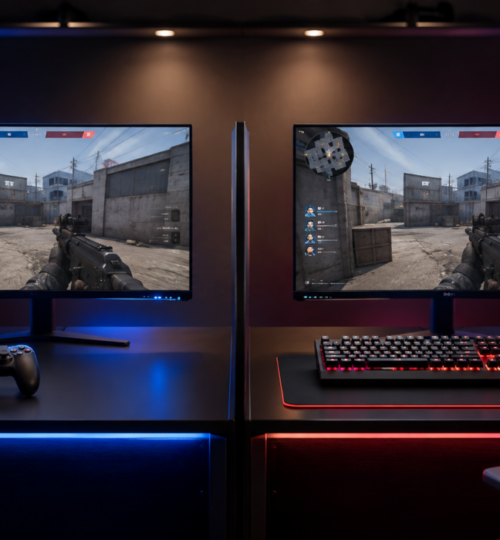
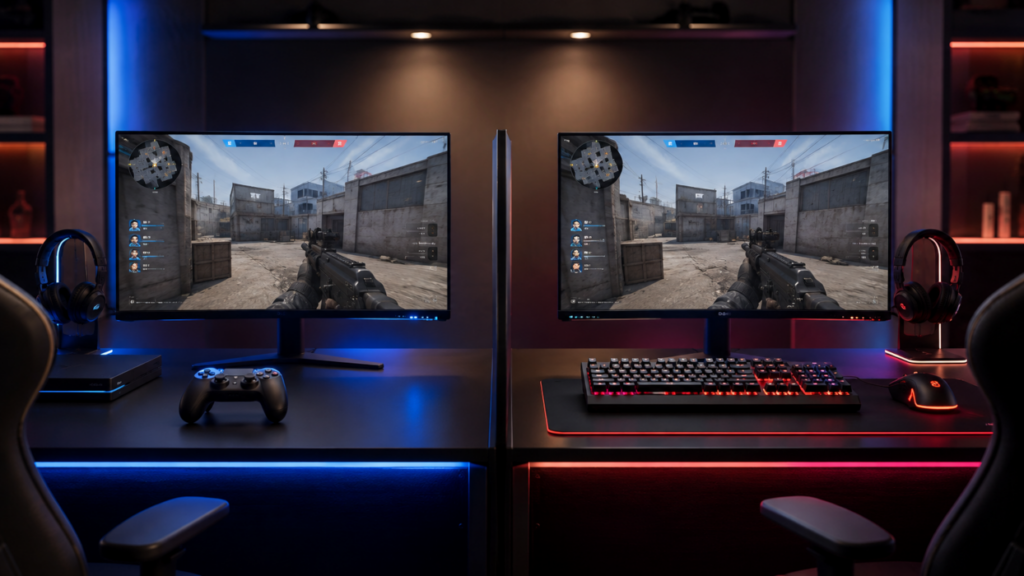
Crossplay solved one of multiplayer gaming’s oldest problems: friends on different hardware no longer have to live in separate matchmaking pools. It also created a harder competitive problem, because a controller thumbstick and a mouse are fundamentally different aiming devices, yet modern shooters increasingly ask them to compete in the same fights. The argument over aim assist has therefore moved beyond the old console-versus-PC tribal fight. It has become a live balance problem involving input mechanics, frame rate, matchmaking, recoil design, player skill, and the question of how much software assistance is acceptable before two inputs stop feeling meaningfully comparable.
Developers are no longer treating aim assist as a fixed console feature that ships once and remains unchanged. Recent changes in Apex Legends, Fortnite, Call of Duty, and other shooters show a move toward finer tuning, where assistance can vary by range, platform, lobby type, player input, and even the way the player moves the right stick. That shift matters because competitive crossplay is entering a stage where input balance is being handled more like weapon balance: measured, adjusted, tested, and sometimes rolled back when the numbers or player experience point in the wrong direction.
Why Controller Aim Assist Exists in the First Place
A mouse gives the player a large physical surface for aiming, direct positional movement, fast flicks, and the ability to stop almost instantly. A controller stick has limited travel, recenters itself, and translates stick deflection into camera rotation rather than mapping hand movement directly to a point on the screen. Without assistance, those two control methods place very different mechanical demands on the player, especially in shooters built around rapid target changes and sustained tracking.
Modern controller aim assist usually combines more than one behavior. Reticle slowdown, sometimes called friction, reduces sensitivity when the crosshair passes near a target. Rotational assistance can help the camera follow lateral target movement while the player is also providing controller input. Different games tune these systems differently, which is why two shooters can both claim to have “aim assist” while feeling completely different in close-range fights.
The competitive argument begins when assistance does more than make a thumbstick usable. Strong rotational help can react to sudden direction changes faster than a human hand can fully process them, especially during strafing duels where both players are moving. Mouse players see that as software participating in the tracking task, while controller players point out that mouse input retains major advantages in precision, fast target acquisition, inventory control, and certain movement techniques. Both observations can be true at the same time, which is exactly why a single global aim-assist value is such a poor solution for a mixed-input game.
Apex Legends Made the Crossplay Difference Explicit
Respawn provided one of the clearest examples of input-specific balancing with Apex Legends: Shockwave. The developer reduced controller aim assist by 25 percent for controller players on PC, by 18 percent for console players entering PC crossplay lobbies, and by 22 percent for console performance-mode players entering those PC lobbies. Console-only lobbies were left unchanged. Respawn said its player experience reports lined up with encounter win-rate data and stated directly that aim assist was too strong in the game’s PC competitive environment.
That design choice is more interesting than the raw percentages. Respawn did not decide that controller assistance was universally overpowered. It decided that the amount of help considered reasonable depended on the environment in which the controller was competing, including whether the lobby contained PC players and whether the console was running a higher-performance mode.
The same game also demonstrates why the subject cannot be separated cleanly from anti-cheat. In July 2026, Respawn classified jitter aim and RC-filter manipulation used to exploit controller aim-assist behavior and reduce recoil as cheating. In August, the studio said it had restricted unintended manipulation of RC filters and other aim-assist exploits, showing that competitive input balance now overlaps with device spoofing and automation rather than existing only inside ordinary controller settings.
That boundary matters. A developer can balance legitimate controller assistance around normal thumbstick behavior, but the calculation changes once hardware or scripts can feed the game artificial inputs designed to keep rotational assistance active or suppress recoil. The same mechanic intended to make controller aiming competitive can become a target for exploitation if the game cannot distinguish a human control pattern from manufactured input.
Call of Duty Is Moving Toward Conditional Rotational Assistance
Call of Duty has spent years at the center of controller-versus-mouse arguments because its fast time-to-kill, close-range fights, large crossplay population, and strong controller presence make small aiming changes immediately visible. Treyarch’s direction with Black Ops 7 shows how developers are beginning to change the conditions under which rotational assistance reaches full strength rather than merely raising or lowering a universal number.
According to the Black Ops 7 preseason notes, Black Ops 6 had already changed close-range rotational aim assist so that strength scaled across a short distance. Black Ops 7 extended the range required before full rotational strength is reached, slightly increased rotational strength at very long range, and added a right-stick tracking requirement. Full rotational help now depends on the player moving the right stick in a way that tracks the enemy; relying only on left-stick movement produces reduced assistance.
That is a major design idea even if individual players disagree with the exact tuning. Rotational assistance has long been controversial because skilled players can learn how movement input interacts with the assist system. Requiring more active right-stick tracking pushes the design toward “help the player perform the action” instead of “perform part of the action because the target moved.”
Range-based scaling attacks another long-running problem. The relative value of mouse and controller is not constant at five meters, 30 meters, and 100 meters. Close-range strafing places a premium on rapid directional tracking, while long-range engagements reward tiny corrections and recoil control. A system that changes assistance by distance has a better chance of addressing those different mechanical problems than one fixed value applied everywhere.
Fortnite Tried to Model Human Reaction Time
Epic took a different route in Fortnite’s v31.20 update by introducing what it called “human-like aim assist” for controller players across console, PC, and mobile. Epic said the system models human reaction time while trying to more closely match the tracking behavior of unassisted mouse players, with further tuning expected based on results.
The idea gets directly at the most controversial part of rotational assistance: reaction speed. A human player must see a target change direction, recognize it, then move a hand or thumb. A purely reactive assist system can begin responding as soon as the game knows the target has changed velocity. Adding delay or reaction modeling is one way to preserve controller support without giving the assistance an unrealistically immediate response to every strafe.
Fortnite is also a useful reminder that controller aiming has several paths besides conventional stick assistance. The game supports gyro aiming and flick stick, and Epic disables aim assist while gyro aiming is active. Gyro gives controller players a motion-based precision option that behaves more like direct physical aiming, which may reduce the need for strong traditional assistance for players willing to learn it.
That does not mean gyro will replace sticks across competitive shooters. Controller layouts, platform support, player habits, accessibility needs, and tournament rules all affect adoption. It does show that the future of console aiming does not have to be a permanent fight between raw mouse input and ever-stronger rotational correction.
Mouse Input Can Be Tuned Too
Crossplay discussions often assume controller is the only side receiving software help, but developers have also experimented with assistance on mouse input. Halo Infinite’s December 2022 update increased mouse friction while firing at an opponent in a weapon’s functional range. 343 Industries described the feature as sensitivity reduction rather than reticle movement, with the goal of improving sustained tracking and fine control.
That approach is worth paying attention to because it changes the framing. If developers decide mixed-input competition is desirable, balance does not have to mean repeatedly weakening controllers until they feel poor. A studio can also adjust recoil, bullet magnetism, target friction, movement, weapon handling, and mouse behavior to reduce specific disadvantages without making either input feel artificial.
There is a danger here, of course. Too much input-specific correction can make a shooter feel less like one coherent competitive ruleset and more like two separate games sharing a server. The more hidden modifiers depend on platform, frame rate, distance, input device, or target behavior, the harder it becomes for players to understand why a fight felt the way it did.
Input Balance Is Also a Matchmaking Problem
Aim-assist tuning carries more weight when ranked modes and tournaments combine inputs by default. A small statistical edge that barely matters in casual play can become dominant after thousands of high-skill matches, because competitive players naturally move toward whatever produces the most consistent results. If one input becomes clearly better in the most common engagement range, team composition and player hardware choices will eventually reflect it.
That is why input-based matchmaking remains attractive even when full crossplay is technically possible. It preserves cross-platform populations while separating mouse and controller competition where fairness matters most. The tradeoff is obvious: narrower matchmaking pools can mean longer queues, worse skill matching, or difficulty keeping less-populated regions and modes healthy.
Riot chose the harder separation with VALORANT. The company does not allow console-to-PC crossplay and does not permit mouse and keyboard for normal console play, explicitly citing the competitive problems created by combining console aim assist with mouse precision. Riot’s anti-cheat team has also treated input-spoofing devices as a major console threat because they can make mouse input appear to the game as controller input and receive controller assistance.
That decision proves there is no industry requirement that every multiplayer shooter merge every platform into one ranked population. Crossplay is a product choice. A studio can prioritize friend groups and large matchmaking pools, or it can keep inputs separated when the competitive cost of combining them becomes too high.
Frame Rate and Hardware Complicate the Console-versus-PC Label
The older argument assumed console meant a 60 Hz television, fixed hardware, and a stock controller, while PC meant high frame rates, low latency, and mouse and keyboard. That picture is outdated. Current consoles can run competitive shooters at 120 fps, high-refresh displays are common, controllers can use rear paddles and high polling rates, and many PC players use controllers.
Apex’s separate adjustment for console performance mode in PC lobbies is a good example of developers recognizing that “console” is no longer one performance class. A controller player at 120 fps with low display latency is operating under different conditions from a player at 60 fps on an older television, even if both are technically on the same console family.
PC has the same spread in the other direction. A high-end system at very high frame rates is not equivalent to a budget PC struggling near 60 fps, yet both may be placed in the same mouse-and-keyboard population. Input balance can compensate for device mechanics, but it cannot erase every hardware difference without turning the competitive model into an endless stack of hidden corrections.
Competitive Players Care About Predictability as Much as Parity
Perfect mathematical equality between mouse and controller may be impossible because the inputs solve aiming in different physical ways. A more realistic target is competitive predictability: players should understand what assistance exists, when it activates, and which behaviors are expected from their own input.
That is one reason conditional systems are promising. Distance scaling, right-stick requirements, reaction-time modeling, and lobby-specific values all attempt to target the situations where assistance creates the biggest advantage rather than weakening controller aiming everywhere. The risk is opacity. If those systems are not documented clearly, every missed shot or sudden death becomes fuel for suspicion.
Developers can reduce that suspicion by publishing more than vague statements about “tuning.” Respawn’s percentage changes and Treyarch’s explanation of the Black Ops 7 right-stick requirement are useful because players can connect the patch to the behavior they feel in a match. Competitive communities will still argue over the result, but an argument over visible rules is healthier than one built around guesswork.
The Next Fight Is Over How Much Assistance Counts as Player Skill
Crossplay has forced shooter developers to define something they could mostly avoid when platforms were separated: how much of aiming should come from the player, and how much correction can come from the game before the competitive meaning of accuracy changes. The answer will vary by title. A fast battle royale, a tactical shooter, an arena shooter, and an arcade military shooter do not need identical solutions.
The direction is becoming clearer, though. Aim assist is moving away from a simple controller on-or-off feature and toward a set of conditions that can be tuned around range, input behavior, lobby composition, frame rate, and abuse prevention. That gives developers better tools, but it also raises the standard for transparency and testing.
For competitive players, the healthiest version of crossplay may be the one that stops treating console and PC as the main dividing line. The real variables are input method, performance conditions, assistance behavior, and whether the rules reward genuine player control. As those systems become more selective, the best balancing work will be the kind players barely notice because a close fight feels decided by timing, positioning, recoil control, and aim rather than by which device was plugged in.