
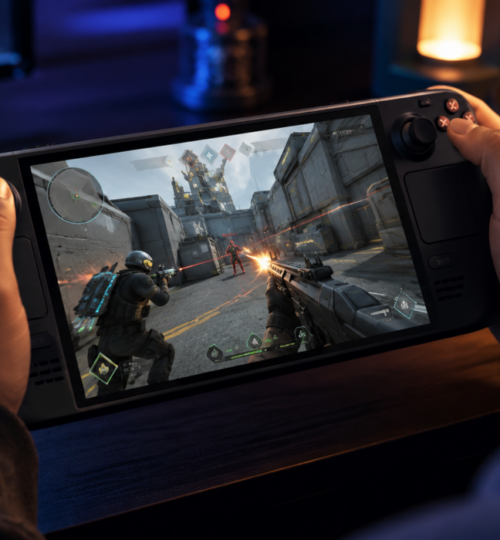
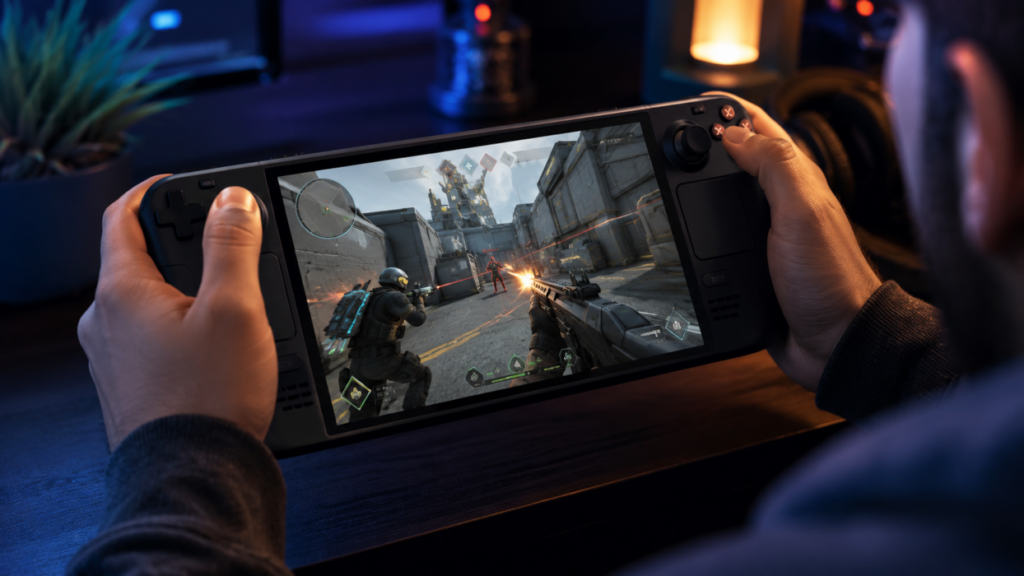
Portable gaming PCs have reached the point where raw performance is no longer their biggest problem. Modern handhelds can run demanding multiplayer games at frame rates that would have seemed absurd for an integrated GPU a few years ago, but the faster these machines become, the more obvious their next limitation gets: battery capacity has not kept pace with sustained CPU and GPU demand.
That matters more in multiplayer than many benchmark charts suggest. A handheld running a large online shooter, extraction game, battle royale, or effects-heavy Unreal Engine title may be processing player activity, physics, destruction, AI, streaming assets, networking, anti-cheat software, voice communications, and graphics simultaneously. The difference between a handheld that looks impressive during a five-minute benchmark and one that can survive a two-hour multiplayer session increasingly comes down to efficiency, cooling, display choices, and power management.
Battery Capacity Only Tells Half the Story
The current handheld market makes battery specifications look straightforward. Valve’s Steam Deck OLED carries a 50 Wh battery, while machines such as the ASUS ROG Xbox Ally X and MSI Claw 8 AI+ move up to 80 Wh. Lenovo’s Legion Go Gen 2 sits between them with a 74 Wh battery. Those differences are substantial, but dividing battery capacity by processor wattage still does not tell you how long a device will actually last.
The advertised processor power limit covers only part of the system. The screen, memory, SSD, Wi-Fi radio, audio hardware, cooling fans, USB controllers, voltage regulation, and the rest of the motherboard also consume energy. A handheld running an APU at 17 watts can therefore be drawing considerably more than 17 watts from its battery, while higher brightness and refresh rates can further widen the gap.
This is why an 80 Wh handheld running aggressively at 25 or 30 watts does not automatically dominate a 50 Wh Steam Deck operating closer to 10 or 15 watts. Bigger batteries allow manufacturers to raise performance ceilings, but those extra watts can disappear surprisingly quickly once a modern game keeps the hardware continuously busy.
Steam Deck OLED Still Owns the Low-Power Argument
Valve’s Steam Deck OLED remains an unusual machine because its hardware was designed around a fairly strict power envelope. Its AMD APU operates between 4 and 15 watts, driving a 1280 x 800 OLED display that tops out at 90 Hz. The processor is older than the chips in the newest Windows handhelds, but Valve’s decision to stay at a modest native resolution and relatively low APU power gives the Deck a strong efficiency position.
Notebookcheck measured roughly 4 hours and 12 minutes in its general gaming battery test, while a particularly demanding Cyberpunk 2077 run with high settings, maximum brightness, and HDR pushed the machine down toward two hours. During heavy load, the Deck OLED also remained relatively restrained thermally, with surface temperatures around 40 degrees Celsius in the review’s stress testing and gaming fan noise generally below its maximum.
That efficiency comes with a clear performance ceiling. Games that comfortably run at 50 or 60 FPS on newer Ryzen Z2 Extreme hardware may require 30 or 40 FPS targets on the Deck, lower settings, or more aggressive upscaling. In a multiplayer title where stable frame time and input response matter more than visual detail, that can still be a reasonable trade, but the Deck cannot simply increase its wattage until the frame rate problem disappears.
There is another multiplayer-specific limitation that has nothing to do with batteries. SteamOS depends heavily on Proton for Windows games, and Valve’s compatibility rules explicitly require middleware such as anti-cheat systems to work under Proton. Some publishers still block Linux completely. EA, for example, specifically ended Linux access to Apex Legends because of its anti-cheat policy, so the Deck’s efficiency advantage means little if the game a player wants to compete in will not run.
ROG Xbox Ally X Pushes Harder Without Giving Up Endurance
ASUS took a different approach with the ROG Xbox Ally X. Its Ryzen AI Z2 Extreme provides substantially more modern CPU and graphics hardware, while an 80 Wh battery gives ASUS enough capacity to operate at higher power without returning to the short runtimes that plagued some early Windows handhelds. The machine offers a 7-inch 1080p 120 Hz VRR display and power profiles that include 13-watt Silent, 17-watt Performance, and up to 35-watt Turbo operation while connected to external power, with 25 watts available for Turbo use on battery.
The important figure for portable multiplayer gaming is probably 17 watts rather than the headline maximum. PC Gamer found the Radeon 890M graphics particularly effective at this lower setting, which is exactly where handheld efficiency begins to matter more than peak benchmark position. Running a mobile processor at 30 or 35 watts can produce more frames, but the last several frames frequently cost far more energy than the first several.
Notebookcheck recorded 3 hours and 12 minutes of gaming in Performance mode and just over two hours in Turbo mode, while Silent mode stretched toward four hours. Surface temperatures during gaming reached roughly 41 degrees Celsius at the hottest measured points, which is warm but still controlled considering the performance available.
For multiplayer players, that creates an attractive middle ground. A 17-watt profile paired with a 45, 60, or VRR-managed frame target can preserve much of the machine’s responsiveness without paying the battery penalty of forcing the APU toward its maximum operating range. The Xbox Ally X is powerful enough that lowering power does not automatically mean dropping into an unpleasant performance tier.
Legion Go Gen 2 Pays for Its Bigger Screen
Lenovo’s Legion Go Gen 2 approaches portable gaming from another direction. Its Ryzen Z2 Extreme can operate across a 15 to 35 watt configurable range, and the machine carries a 74 Wh battery, but it also drives an 8.8-inch 1920 x 1200 OLED panel capable of 144 Hz. That screen is one of the device’s defining features, yet it also gives the battery another component to feed.
Tom’s Hardware found roughly half the battery remaining after about 90 minutes of Marvel’s Midnight Suns at reduced brightness, Balanced thermals, a 60 FPS cap, and modest rendering settings. Another session with Tony Hawk’s Pro Skater 3 + 4 consumed almost half the battery within an hour while the display was operating at 144 Hz. The exact runtime varies dramatically by game, but the tests illustrate how quickly display and performance settings can change the equation.
Thermally, the Legion’s detachable controllers create an interesting physical advantage. Tom’s Hardware measured the controllers themselves at only about 84 degrees Fahrenheit during its stress workload, while the upper exhaust reached roughly 106 degrees Fahrenheit. Notebookcheck observed considerably warmer areas around the main chassis, including readings above 42 degrees Celsius, reinforcing the point that Lenovo moves heat toward the central tablet rather than directly into the player’s grip.
The Legion therefore works best when its 144 Hz display is treated as a capability rather than a permanent requirement. Feeding 144 refreshes per second while a demanding multiplayer engine struggles around 50 FPS wastes energy with little competitive benefit. VRR, lower resolution, moderate brightness, and a sensible frame cap can turn the same hardware into a much more efficient machine.
MSI Shows What Strong Cooling Can Do
MSI’s Claw 8 AI+ demonstrated how much processor architecture can change handheld efficiency. Its Core Ultra 7 258V and Arc 140V graphics sit behind an 8-inch 1200p VRR display and an 80 Wh battery. Notebookcheck measured very low exterior temperatures, with its heaviest surface reading around 36.6 degrees Celsius, while the grips remained comparatively cool.
Battery behavior changed substantially with performance mode. Cyberpunk 2077 lasted about 1 hour and 45 minutes in the fastest mode, while MSI’s adaptive AI profile extended the run to just under three and a half hours at reduced performance. That gap is almost the whole handheld argument compressed into one test. Peak speed and energy efficiency are different targets, even when they come from the same silicon and battery.
MSI’s newer Claw 8 EX AI+, introduced in 2026 with Intel’s Arc G3 Extreme and B390 graphics, pushes that idea further. It retains an 80 Wh battery and uses a redesigned cooling system, while Notebookcheck measured Cyberpunk runtimes of roughly 1 hour and 39 minutes at a 35-watt manual setting, 2 hours and 21 minutes under its adaptive profile, and 3 hours and 19 minutes in its lower-power endurance mode. MSI’s U.S. product page was still listing the model as coming soon or available for preorder at the time of writing, so it is better viewed as the next step in the comparison than as the default machine already sitting in every retailer.
The thermal results are encouraging. Notebookcheck recorded a maximum exterior temperature around 39.4 degrees Celsius and reported that the grips remained cool while most heat stayed around the center of the device. More performance is clearly becoming possible without turning the handheld itself into an uncomfortable heat source, although the battery cost of running near 35 watts remains severe.
Multiplayer Workloads Punish the Wrong Settings
Heavy multiplayer games create a sustained workload that handheld benchmark averages can hide. A large match can keep CPU threads active through player simulation, physics, animation, destruction, audio, decompression, anti-cheat processes, and background services while the GPU simultaneously renders effects and high-frequency movement. Wi-Fi and voice communications add additional consumption, although the APU and display remain the major power users during serious gameplay.
The worst portable configuration is therefore easy to create: native 1080p or 1200p rendering, maximum screen brightness, an uncapped frame rate, a 120 or 144 Hz panel, an aggressive APU profile, frame generation, background launchers, voice chat, and a game engine already struggling to hold its target. A handheld in that state may be producing noticeably more heat and consuming dramatically more battery for a visual difference that is difficult to appreciate on a seven or eight-inch display.
Competitive players already understand the value of stable frame times. Handheld gaming adds another reason to pursue them. Locking a fluctuating 48 to 73 FPS workload to a stable 45 or 60 FPS can reduce unnecessary GPU work, while VRR prevents the lower target from feeling as rough as a fixed-refresh display would.
Resolution is another powerful control. Rendering at 720p or 800p and upscaling to a 1080p or 1200p handheld panel can cut GPU demand significantly, especially in games where the screen’s physical size hides much of the difference. Lowering shadows, volumetrics, reflections, ambient effects, and ray-traced features usually saves more power than reducing texture quality because those effects continuously consume GPU time.
The Real Competition Is Performance Per Watt
Handheld gaming is entering a phase where another five FPS at maximum power matters less than keeping acceptable performance after the charger has been unplugged. Steam Deck OLED remains remarkably efficient inside its lower performance envelope. The ROG Xbox Ally X provides one of the stronger balances between modern performance and battery capacity, while the Legion Go Gen 2 spends more of its energy budget supporting a much larger high-refresh OLED experience. MSI’s recent Claw designs demonstrate how much cooling and processor efficiency can improve without requiring the grips themselves to become heat sinks.
For heavy multiplayer play, the best power profile is rarely the fastest profile printed in the control software. The useful target sits lower, where the processor is still operating efficiently, the cooling system is not fighting a constant thermal load, VRR can smooth modest frame-rate changes, and the battery can survive more than a handful of matches. That sweet spot is becoming the real benchmark for portable competitive gaming, because a handheld capable of 80 FPS for ninety minutes is solving a different problem than one that can hold 55 or 60 FPS through an entire evening away from the wall.