
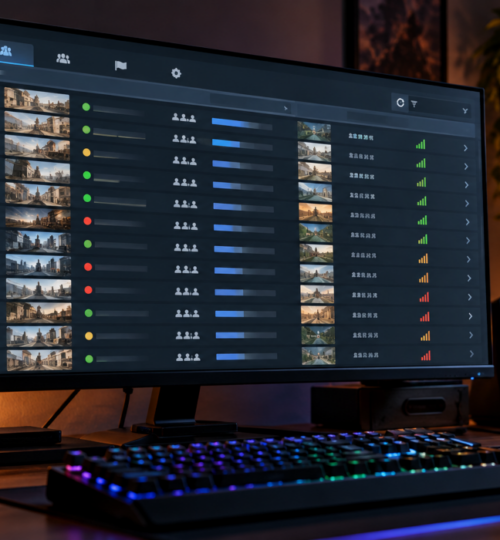
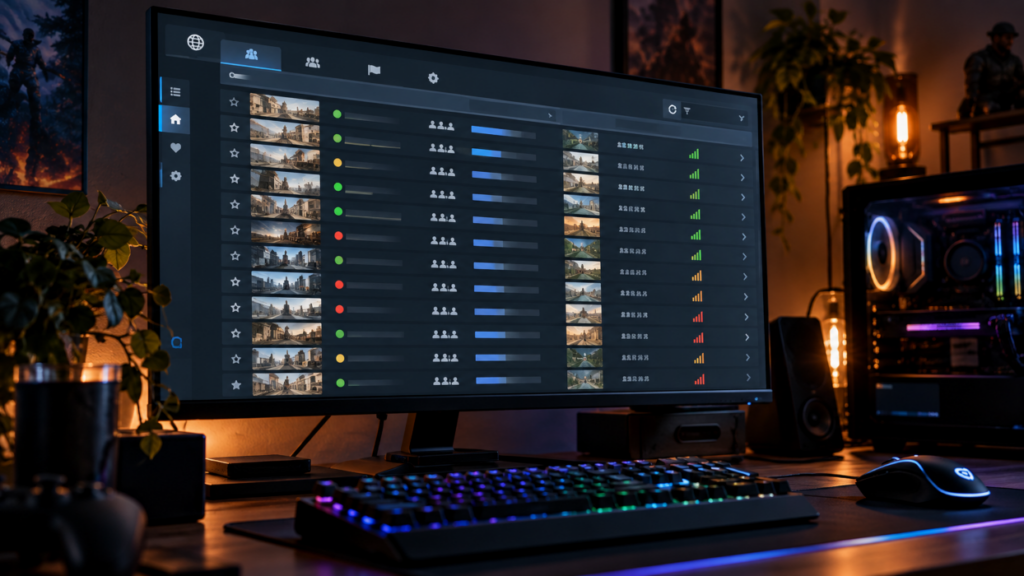
For much of multiplayer gaming history, finding a match meant choosing where you wanted to play. A server browser showed the map, mode, player count, ping, server name, and sometimes enough information to tell whether the people running it had created something worth returning to. Modern matchmaking replaced much of that process with a button. Press Play, enter a queue, and let software decide everything else.
That trade was sold largely on convenience, and convenience remains automated matchmaking’s strongest argument. Yet server browsers are appearing again in discussions around major shooters, new multiplayer projects, and community-focused games. Battlefield 6 is preparing a broader server browser with persistent match flow, while newer releases such as WARDOGS have made community servers part of their identity. Even projects outside traditional military shooters are revisiting in-game server discovery. The common thread is growing demand for something matchmaking often struggles to provide: player choice.
Matchmaking Solved a Real Problem
Automated matchmaking did not take over multiplayer gaming by accident. Server browsers could be messy, especially for new players. Lists might contain hundreds of servers with cryptic names, strange rules, password protection, incompatible mods, or wildly different skill levels. Finding a good match could take longer than playing one.
A matchmaking system can hide almost all of that complexity. The player chooses a playlist, the game considers available players and connection conditions, then assembles a lobby without asking the player to understand server infrastructure. Cross-platform multiplayer made that convenience even more valuable because games increasingly needed to coordinate players across different hardware, input methods, regions, parties, and playlists.
Call of Duty’s own published matchmaking research illustrates how many variables modern systems may consider. Activision has said connection is the most heavily weighted factor in its core multiplayer matchmaking, followed by time to match, while player performance, platform, input device, recent maps, playlists, and other variables also influence how lobbies are assembled. The company has also said its testing found that severe skill mismatches can cause lower-skilled players to leave matches or multiplayer altogether, reducing the available population for everyone.
There is a legitimate design problem being solved here. Developers need matches to start quickly, connections to remain acceptable, teams to avoid extreme imbalance, and new or less experienced players to have some chance of participating before getting erased by veterans who have spent thousands of hours mastering the game. The frustration begins when the system that solves those problems also becomes the only way to play.
Players Lost Control Over the Lobby
A traditional server browser exposes information that automated matchmaking often keeps behind the curtain. Players can see that one server has a 24 ms ping while another has 83 ms. They can choose a nearly full server rather than being dropped into an empty lobby waiting for backfill. They can avoid a map they have played four times that evening or deliberately join a server running it repeatedly because that happens to be their favorite map.
That control becomes especially valuable when a game’s automatic system behaves strangely. Battlefield 6 players, for example, have raised concerns about high-ping matches, excessive bot backfill, uneven ticket situations, and inconsistent match quality. EA has acknowledged those issues while saying its planned Season 5 server browser is intended to complement matchmaking rather than replace it. The company is also testing ways to keep groups together between rounds instead of rebuilding the experience after every match.
That distinction matters. The strongest case for server browsers is not that every multiplayer gamer should manually search through a spreadsheet of dedicated servers before playing. Quick Play should remain quick. The problem comes from removing the alternative.
If a player wants the algorithm to locate a match, the algorithm can do that. If another player wants a specific server, region, map rotation, ruleset, population level, or familiar group of regulars, there is little technical reason that choice must disappear.
Persistent Servers Create Persistent Communities
Older multiplayer communities were often built around places rather than matchmaking categories. Players remembered specific Counter-Strike, Battlefield, Unreal Tournament, Quake, Team Fortress, Day of Defeat, or Call of Duty servers because the same people repeatedly appeared there.
That changed the social structure of multiplayer gaming. Someone who played every evening might gradually recognize the strongest player on the opposing team, the squad that always worked together, the administrator who kept cheaters under control, or the regular who somehow found a way to use the same ridiculous strategy every round. Rivalries developed naturally because players encountered each other repeatedly.
Automated matchmaking can produce excellent individual matches while constantly destroying that continuity. The game assembles a temporary collection of strangers, runs a round, then frequently redistributes everyone into another temporary collection of strangers. Even when voice chat and social tools exist, the match itself can feel disposable. Persistent servers reverse that process. The server has an identity independent of the individual match.
EA has been moving Battlefield back toward that concept. Battlefield 2042 eventually added persistent Portal servers, allowing a hosted server to remain visible after becoming empty rather than disappearing immediately. Battlefield 6 already allows players to search Portal community experiences by criteria such as player count, map, ping, host region, and tags, while EA’s 2026 roadmap calls for a broader server browser with persistent servers and deeper community features.
The fact that Battlefield is still developing these systems years after mainstream shooters largely embraced queue-driven matchmaking says something about what was lost. Battlefield historically worked especially well as a server community game because 64-player and larger matches created enough room for familiar squads, vehicle crews, infantry specialists, pilots, server administrators, and casual regulars to repeatedly collide.
Community Servers Can Become Their Own Games
Player-run servers also create space for multiplayer culture that official playlists rarely support. Hardcore variants, infantry-only configurations, unusual ticket counts, custom rotations, modified rules, training environments, competitive practice servers, roleplay communities, and experimental modes can survive because somebody has decided they are worth hosting.
WARDOGS became a recent example of developers openly embracing that model. During a September 2026 server browser update, its developers described community servers as the “lifeblood” of FPS games like theirs while working to improve their visibility inside the browser. The game supports community-hosted servers alongside official infrastructure, giving groups a place they can repeatedly occupy rather than forcing every session through anonymous matchmaking.
The idea is spreading beyond conventional shooters. Hytale’s developers announced an in-game server discovery system in April 2026 built around community-run servers, with filtering by server type, audience, and region. Their stated goal is to make long-running community worlds and custom experiences easier to find without requiring players to discover them through Discord, external lists, or word of mouth.
Server discovery can therefore act as more than networking infrastructure. It becomes distribution for community-made experiences. That matters for game longevity. Official development eventually slows down, seasonal updates stop, and publishers move staff toward newer projects. Communities are often willing to keep playing long after a game’s commercial cycle has ended, but they need enough control over servers, rules, discovery, and administration to keep that multiplayer ecosystem functional.
The SBMM Argument Is Really About Visibility and Agency
Arguments about skill-based matchmaking are often treated as if players simply want easier opponents. Some undoubtedly do, but that explanation is too simple for the broader frustration surrounding modern matchmaking.
The deeper problem is that matchmaking systems are largely invisible. A player experiencing a difficult series of matches usually cannot see how the system chose those opponents, what geographic area it searched, how strongly recent performance affected the selection, whether party composition changed the search, or which compromises were made to keep queue time short.
That creates suspicion whenever the experience feels manipulated. A player wins several matches, suddenly encounters much stronger opponents, and concludes that the system is deliberately punishing success. Another player gets a bad connection and assumes skill matching was prioritized over ping. Whether those interpretations are technically correct becomes secondary to the fact that the player cannot inspect the process.
Activision has attempted to address some of this distrust by publishing technical explanations of Call of Duty matchmaking. Its documentation says skill is one factor rather than the dominant variable, and that connection remains the highest priority. The company has also acknowledged that high-skill players often report feeling that they repeatedly receive extremely competitive matches.
A server browser changes the relationship entirely. The player sees 32/64 players, 41 ms ping, Conquest, a particular map, and a familiar server name. There is far less mystery about why that match was selected because the player selected it.
Server Browsers Have Problems Too
The older model was never perfect. Community servers can develop abusive administrators, arbitrary bans, bad balancing rules, misleading names, pay-to-win systems, or cliques that make new players feel unwelcome. Empty servers can also create a chicken-and-egg problem in which nobody joins because nobody else has joined yet.
Population fragmentation is another concern. A game with too many servers, playlists, modes, regions, and custom rule sets can spread its audience thin enough that some combinations rarely fill. Matchmaking helps solve that by concentrating players into defined queues and automatically backfilling openings.
Developers also have business reasons to prefer centralized systems. Official matchmaking gives them greater control over progression, anti-cheat enforcement, playlist updates, telemetry, moderation standards, seasonal events, and the overall presentation of the game.
The industry is not moving in one direction either. In September 2026, Facepunch removed the traditional server browser from s&box’s main menu because the developers believed players were using it as a poor substitute for discovering games within the platform. The redesigned menu instead emphasizes game discovery and personalized presentation. That example helps define the real issue. A server browser is a tool, not automatically the correct interface for every multiplayer design.
Hybrid Multiplayer May Be the Better Direction
Battlefield’s current approach points toward a middle ground that could fit many multiplayer games. EA says Battlefield 6’s planned broader browser will exist alongside matchmaking, with official servers clearly identified, progression supported, matchmaking able to backfill active matches, and more persistent match flow being explored.
That combination addresses much of the old server browser’s friction without removing player choice. Someone who wants to press Play and immediately enter a suitable match can continue doing exactly that. Someone organizing a clan night, looking for a low-ping server, avoiding bots, searching for a specific map, joining friends already playing, or returning to a familiar community can open the browser instead.
There is also room for smarter automation inside the browser itself. Servers can be sorted by latency, population, rules, friends, favorites, geographic region, mode, and available slots. A game could even recommend servers based on previous choices while still letting the player see and override those recommendations. The difference is who gets the final decision.
That is why the server browser debate keeps returning even after years of increasingly sophisticated matchmaking technology. Multiplayer games have become very good at finding players for us. A growing number of players are asking for the ability to find one another again.