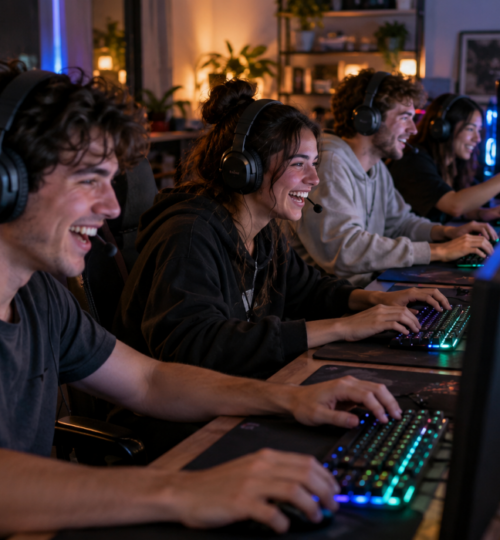
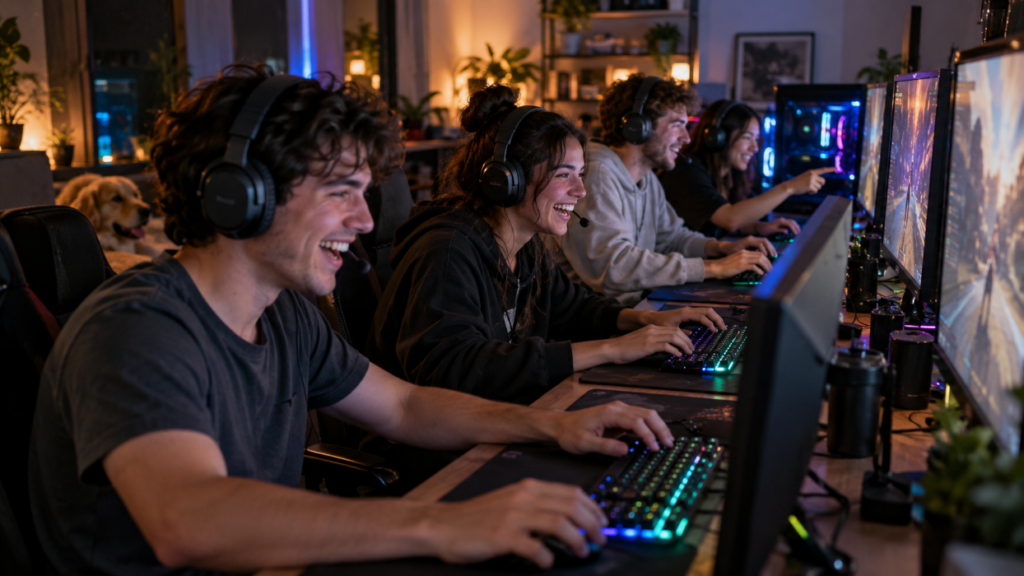
A familiar game can feel like a different product the moment familiar voices join the party. The map is unchanged, the weapon balance is unchanged, the physics are unchanged, yet the emotional texture shifts because every match now carries a second layer of information: who is laughing, who is tilted, who always pushes too early, who somehow survives impossible fights, and who will still be talking about the mistake three weeks later.
Multiplayer games are built from systems, but players experience those systems through people. Friends alter attention, risk, memory, pressure, and even the meaning of winning. A round that would be forgettable with strangers can become part of a group’s shared vocabulary, while an ordinary loss can be more entertaining than a clean solo victory because the value of the session is being produced socially as well as mechanically.
Social Presence Changes the Weight of the Match
One reason games feel different with friends is social presence, the sense that another real person is meaningfully there with you rather than merely represented by an avatar or username. Research on presence in games has found that human co-players produce stronger social presence than computer-controlled partners, and cooperative play tends to increase it further compared with competitive play.
That changes where attention goes. A solo player may focus almost entirely on the game state, but a group of friends is processing the match and each other at the same time. A missed shot becomes funny because someone heard the panic in your voice. A dangerous flank becomes more exciting because a teammate trusted the call and followed. The game supplies the event, while the group supplies much of its emotional meaning.
This also explains why some technically repetitive games remain engaging for hundreds or thousands of hours. The content may repeat, but the social combinations do not. The same map can produce a tense ranked push one night, a chaotic reunion the next, and a relaxed background session while friends talk about work, school, hardware, movies, or whatever else happened that week.
Experienced teams gradually stop communicating in complete explanations. A single callout can carry location, timing, intent, danger, and an expected response because everyone already understands the group’s habits. Research on Counter-Strike communication has described callouts as a way players build distributed knowledge of the game state, allowing the team to coordinate information that no single player possesses alone.
With friends, that shared language becomes even more compressed. Players learn who means “one shot” literally and who uses it as an emotional estimate. They know which teammate will rotate early, which one prefers to anchor, who wants permission before taking resources, and who is already halfway through the door before asking whether the team is ready.
This resembles the shared mental models studied in team performance research. Recent esports work has examined how trust, collective confidence, and shared understanding relate to coordination, while broader team research has long connected shared mental models with the ability to anticipate teammate actions and reduce the communication needed during fast decisions.
For players, the result is easy to recognize even without the academic vocabulary. A long-running squad often feels faster than a random group because less has to be said. Players are reading tendencies as much as they are reading the screen, and that creates the feeling that the team is operating one beat ahead.
Playing with friends changes the acceptable level of stupidity. A solo player protecting rank, resources, or a clean run may avoid a low-percentage play. A group of friends may attempt it precisely because the failure itself has entertainment value.
This is why co-op sessions so often produce behavior that looks irrational on paper. Players take the dangerous shortcut, attempt the absurd revive, challenge the better-equipped squad, or try an untested strategy because the group can absorb the cost together. The possibility of a story competes with the possibility of an optimal result.
That does not mean friendship removes competitive pressure. In many groups it increases it, especially when status inside the group matters. Nobody wants to be the person who threw the round after talking confidently for ten minutes. The difference is that the consequences exist on two levels: the scoreboard records the loss, while the group decides whether the moment becomes frustration, comedy, blame, or legend.
Cooperation Can Make Success Feel More Personal
A win earned with friends often feels different from a win earned beside anonymous teammates because contribution is easier to read. You know who made the ugly support play that created the opening. You know who changed roles because the matchup was bad, who stayed calm after the early collapse, and who quietly carried the information load while someone else collected the kills.
Research on cooperative play has repeatedly found links between cooperation, trust, reciprocity, and prosocial behavior. A 2026 experimental study reported that cooperative game contexts increased prosocial behavior compared with competitive and solo conditions, with reciprocal expectations helping explain part of the effect. Earlier work likewise found that helpful teammates could increase expectations of reciprocity and later prosocial behavior.
That gives ordinary support actions more emotional value. Dropping ammo, trading a death, covering an objective, healing at the right time, or giving up a preferred role can become evidence that the group is functioning well. Competitive games often measure individual output poorly, especially the invisible work around positioning, information, space, and sacrifice. Friends tend to notice more of that work because they have context for it.
Losing With Friends Can Be Better Than Winning Alone
Games create a strange equation in which the quality of the result and the quality of the experience can separate. A clean solo win may feel satisfying for ten minutes. A disastrous match with friends can remain funny for years.
Memory plays a major part here. Players rarely preserve a complete statistical record of their gaming lives in their heads. They remember moments: the impossible comeback, the boss kill after twenty failed attempts, the vehicle that rolled down a hill at exactly the wrong time, the teammate who confidently gave the worst call imaginable, the tournament match where everyone suddenly played above their normal level.
Those moments become social memory because several people can retell them. The retelling changes the value of the original session. A failure stops being only a failed objective and becomes a reference point that returns in voice chat, group messages, future matches, and inside jokes. The game functions as a place where the event happened, almost like a digital neighborhood with locations that accumulate history.
Competitive Pressure Changes When the Teammates Matter
Friendship can improve coordination, but it can also make losses sharper. A mistake in front of strangers may disappear when the lobby closes. A mistake in front of friends can follow the player into the next queue, especially in groups where rank, skill, or internal status carries weight.
Research with adolescent friend pairs found that the mode of play affected how they interacted, and competitive play was associated with lower reported friendship quality immediately afterward in that study. The same research also found that positive and prosocial behavior during play predicted higher friendship quality afterward.
The practical point is not that competition is bad for friendship. Competitive groups have been roasting each other over missed shots since long before online matchmaking existed. The more useful distinction is whether the group can separate performance criticism from personal judgment. Teams that can say “that rotate was late” without turning it into “you always ruin games” preserve the competitive value of honest feedback without making every mistake social debt.
This matters even more in organized play. A friend group entering ladders, leagues, tournaments, or ranked team modes eventually discovers that friendship and team structure are related but different things. Good chemistry can help, yet roles, expectations, practice habits, and conflict management still matter once the group cares seriously about results.
Familiar Teammates Change How Skill Develops
Friends can make players better because they create continuity. Random matchmaking constantly changes the social environment, which means part of every match is spent identifying how strangers behave. A regular group removes some of that uncertainty and gives players repeated chances to refine specific patterns together.
This creates feedback loops that are difficult to reproduce in solo queue. One player learns exactly how long a teammate needs to set up an angle. Another starts timing utility around a friend’s entry style. A support player notices that the team collapses whenever two aggressive players chase the same target, so the group gradually adjusts without needing a formal coaching session.
Recent esports research supports the broader idea that coordination is measurable rather than mystical. A 2025 study using behavioral data from professional esports teams found that coordination metrics were significantly related to offensive and defensive outcomes, reinforcing the point that team performance is partly about how players act together rather than simply adding up individual mechanical skill.
Friend groups also create safer spaces for experimentation. A player trying a new role, unfamiliar character, different sensitivity, or strange build is more likely to receive useful context from people who know the baseline. Friends can tell the difference between a bad player and a good player having a bad hour, which makes experimentation less socially expensive.
Voice Chat Becomes Part of the Game Design
Many multiplayer games are designed around information that is easier to coordinate through voice than through pings or text. With friends, voice chat carries tactical information, emotional regulation, humor, and social maintenance at once.
The tactical layer is obvious. Players call positions, cooldowns, resources, timings, health, rotations, and threats. The less obvious layer is emotional pacing. A friend can calm a tilted teammate, turn a bad round into a joke, or recognize when someone needs the group to stop reviewing mistakes and simply queue again.
That emotional control affects how the game feels even when performance does not change. A frustrating mechanic becomes easier to tolerate when the frustration is shared. Downtime becomes conversation. Queue times become social space. Even menus and loading screens can become part of the session instead of empty seconds between the “real” parts of the game.
Friends Can Also Make a Game Feel Worse
The same social forces that improve a session can poison it. Obligation is one of the biggest examples. A player may log into a game they no longer enjoy because the group still plays it, or keep grinding a ranked mode because leaving would disrupt the team.
Different skill levels can create another strain. Stronger players may feel forced into carrying or teaching, while weaker players may feel watched every time they make an error. Matchmaking systems can magnify that problem when grouping with higher-rated friends produces harder opponents or when party composition limits which modes are practical.
There is also the familiar problem of the group becoming more invested in winning than everyone actually agreed to be. One person thought the session was casual, another is reviewing every lost round like a playoff elimination match, and a third is barely listening because they are eating dinner. The conflict is social before it is mechanical, but the game becomes the place where it surfaces.
That is why good long-term groups often develop informal rules without ever writing them down. They learn which nights are serious, which modes are for messing around, when criticism is welcome, when someone needs space, and which friend should never be allowed to choose the next game after midnight.
Games Become Places Where Friendships Accumulate History
Long-running multiplayer groups eventually attach memories to digital spaces in the same way people attach memories to physical ones. A map is no longer only a competitive layout. It is where a team won a league match, where someone pulled off an absurd clutch, where a friendship started, where an argument happened, or where the group returned years later and realized everyone still remembered the old routes.
That history helps explain why veterans can reinstall an aging game and feel something within minutes that a technically superior replacement cannot reproduce. The attachment is partly mechanical familiarity, but it is also social association. Research on Destiny players found that playing with real-life friends, online-only friends, and strangers was associated with different forms of social capital, with existing friends especially connected to bonding ties.
The strongest multiplayer memories often survive long after the servers, metas, and hardware have changed. A friend says the old map name, repeats the old callout, or tells the story of the match everyone has heard fifty times, and the game is briefly present again in far more detail than its textures or frame rate could ever preserve.