Disclaimer: The views and opinions expressed in this article are solely those of the author. The mention of any products, services, or methods does not constitute an endorsement.
Few weapons in competitive shooters generate as much frustration, admiration, and debate as the sniper rifle. A single well-placed shot can dismantle an entire attacking strategy, eliminate a team’s strongest player, or turn an otherwise ordinary defensive position into an almost impassable obstacle. For the player holding the rifle, that moment represents precision, positioning, and preparation. For the opponent watching their character collapse before getting a shot off, it can feel like the game offered very little opportunity to respond.
That tension has followed tactical shooters for decades. From the legendary AWP battles of Counter-Strike to the Operator-dominated sightlines of VALORANT, developers have repeatedly confronted the same balancing problem. Sniper rifles need enough stopping power to reward their limitations, but their ability to eliminate opponents instantly can disrupt the competitive exchange that makes tactical shooters engaging.
The challenge becomes particularly difficult in games where dying means sitting out the remainder of a round. Every elimination carries strategic consequences, and the ability to secure one from a relatively protected position gives sniper rifles an influence that extends far beyond their damage statistics.
Why One-Shot Kills Are So Difficult to Balance
Most tactical shooters establish a relatively predictable relationship between accuracy, damage, and exposure. Automatic rifles generally require players to control recoil, land multiple body shots, or secure a headshot to eliminate an opponent quickly. Both participants may have opportunities to adjust their aim, retreat, or respond during an engagement, although a clean rifle headshot can end the encounter just as abruptly.
Sniper rifles approach that exchange differently. Their ability to kill with a single body shot removes the requirement for sustained accuracy in many situations. A sniper holding a narrow angle only needs one successful trigger pull, while an opponent carrying an automatic rifle may need to land several consecutive hits or secure a precise headshot.
This becomes especially significant in round-based games where player numbers directly influence the outcome. Losing an entry fragger before a site execute can force an attacking team to abandon its original strategy. A sniper securing an early elimination may accomplish more than removing one opponent, particularly if that kill disrupts the timing of an entire coordinated push.
The difficulty for developers is determining how much power should accompany that capability. Reducing sniper damage too aggressively can eliminate the weapon’s defining advantage. Leaving it unrestricted risks producing situations where teams repeatedly lose players attempting to challenge defensive positions.
Counter-Strike’s AWP and the Price of Extreme Lethality
Counter-Strike provides one of competitive gaming’s longest-running examples of sniper balance. The AWP has remained a defining weapon throughout the franchise, capable of eliminating opponents with a single shot to the torso while imposing substantial penalties on mobility, firing frequency, and economic flexibility.
In Counter-Strike 2, the AWP costs $4,750, substantially more than the standard assault rifles. Its five-round magazine, slow firing cycle, reduced scoped movement speed, and relatively modest $100 competitive kill reward impose additional limitations. A missed shot can create an opening for an opponent, especially when multiple attackers are prepared to challenge the same position.
Yet the AWP’s effectiveness has never depended entirely on its mechanical characteristics. Experienced players understand how to position themselves near cover, hold angles that limit exposure, and retreat immediately after firing. A strong AWPer can make an entire section of a map dangerous without needing to fire more than a handful of shots.
Counter-Strike’s economy adds another balancing mechanism. Purchasing an AWP represents a significant team investment, particularly when armor and utility must also be considered. Losing the weapon can damage a team’s purchasing power in subsequent rounds, while recovering an opponent’s dropped AWP can dramatically change the value of a successful engagement.
Valve has continued adjusting the systems surrounding these weapons. Its March 2026 reload overhaul introduced ammunition loss when discarding partially used magazines, making careless reloads more costly. For sniper players, conserving ammunition and choosing when to reload became additional considerations rather than automatic habits.
These restrictions demonstrate how a weapon can retain exceptional lethality while carrying meaningful disadvantages. However, economic penalties only influence balance when opponents have realistic opportunities to exploit the weapon’s weaknesses.
VALORANT’s Operator and the Influence of Agent Abilities
VALORANT inherited much of Counter-Strike’s tactical structure while introducing abilities that fundamentally changed how teams contest sniper positions. Smokes, flashes, reconnaissance tools, movement abilities, and temporary defensive effects all influence the relationship between an Operator user and the players attempting to challenge them.
The Operator remains a powerful angle-holding weapon, capable of eliminating a fully armored opponent with one body shot. Its 4,700-credit price creates a substantial economic commitment, while its slow firing rate and movement penalties discourage careless aggression.
Riot Games recognized early that the weapon could become excessively effective when combined with aggressive movement. In Patch 1.09, released in 2020, the developer increased its price, reduced scoped movement speed, lowered firing frequency, and adjusted movement accuracy. Riot specifically identified aggressive peeking and the ability to repeatedly challenge opponents after being displaced by utility as problems it wanted to address.
The original 5,000-credit price introduced by that update was later reduced to 4,700 credits, but the broader design problem remained. An Operator becomes considerably more threatening when its user can secure an elimination and immediately escape retaliation through an agent ability.
Jett’s movement tools historically made her a natural fit for aggressive Operator play. Chamber later demonstrated how an agent designed around precision weapons and repositioning could create additional balancing difficulties. In both cases, the effective strength of the sniper role depended on the interaction between weapon handling and agent abilities.
This creates a complication that Counter-Strike generally avoids. Developers must consider whether an apparent sniper balance problem originates with the weapon, the agent carrying it, or the interaction between the two.
The Outlaw Shows Why Sniper Balance Goes Beyond Damage
VALORANT’s Outlaw offers another example of how developers experiment with sniper rifles without simply increasing or decreasing damage.
Introduced in January 2024, the Outlaw occupies a middle position between the inexpensive Marshal and the premium Operator. Its two-shot design allows rapid follow-up fire, while its 140 body damage makes it especially dangerous against opponents using Light Shields.
The weapon creates an interesting economic interaction. Players attempting to conserve credits by purchasing lighter protection become vulnerable to a single body shot, while fully armored opponents can survive that same hit when starting at maximum health. Teams must therefore consider the possibility of facing an Outlaw before deciding how to distribute their available credits.
However, the weapon’s rapid second shot introduced its own balancing concerns. In July 2026, Riot adjusted the Outlaw through Patch 13.01, increasing recovery time, spread, and recoil after the first shot. The intention was to preserve the weapon’s power while requiring more control from players attempting immediate follow-up shots.
That adjustment illustrates a useful approach to sniper design. Developers can preserve meaningful damage thresholds while changing how reliably a weapon converts one engagement into multiple eliminations.
For experienced players, that distinction matters. A sniper rifle that reliably eliminates the first exposed opponent may be manageable through coordination. A sniper rifle that can rapidly eliminate the second and third players attempting to trade becomes much harder to challenge.
Map Design Can Make a Balanced Sniper Feel Overpowered
Weapon statistics only describe part of the experience. Map geometry determines how frequently a sniper can exploit its advantages and how much risk accompanies those opportunities.
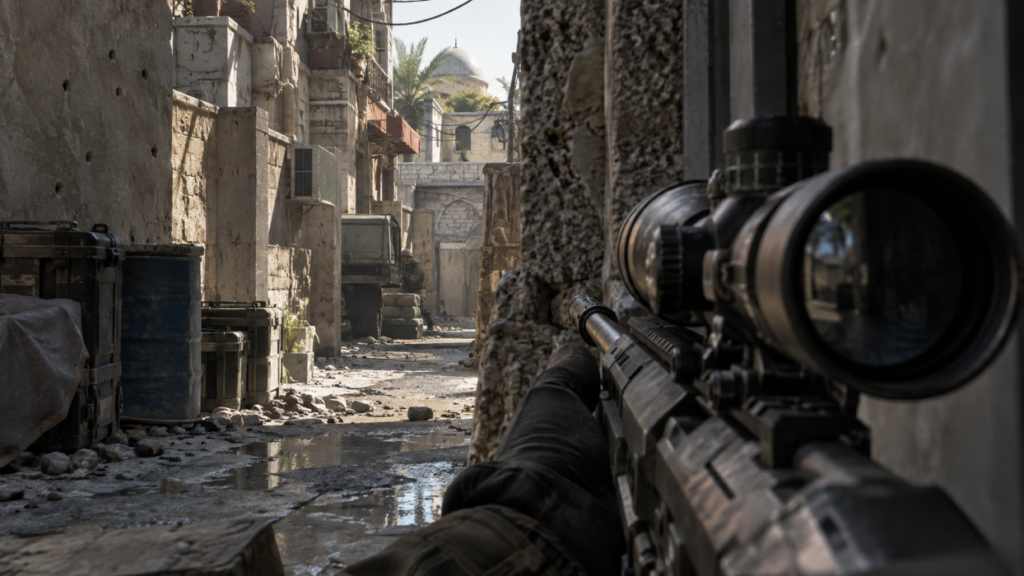
Long, narrow sightlines naturally favor weapons capable of delivering accurate, lethal shots at extended distances. A defending sniper positioned behind cover may see approaching opponents before those opponents can effectively challenge the position. If the approach offers limited alternative routes, the attacking team may have little choice but to commit utility or accept a highly unfavorable engagement.
Counter-Strike maps such as Dust II illustrate how sniper positions become central to strategic planning. Long A and mid have historically created opportunities for AWP users to influence movement and information gathering. Teams developed flashes, smoke lineups, coordinated peeks, and alternative routes partly because challenging those positions without preparation carries considerable risk.
The same principle applies to VALORANT, although agent abilities introduce additional possibilities. A long sightline might initially favor an Operator, but a coordinated combination of smoke coverage, reconnaissance denial, and movement abilities can temporarily remove that advantage.
The effectiveness of these responses depends heavily on surrounding geometry. If a sniper can immediately reposition to another protected angle, the attackers may spend several abilities clearing a position without securing meaningful space.
Map designers therefore influence sniper balance through sightline length, cover placement, alternative routes, vertical angles, and opportunities for coordinated attacks. A weapon that appears oppressive on one map might be comparatively limited on another.
Counterplay Must Begin Before the Sniper Fires
Much of the frustration surrounding sniper rifles comes from the feeling that an opponent can eliminate a player before any meaningful exchange occurs. In tactical shooters, however, counterplay often begins well before the moment of contact.
Information gathering is one of the strongest responses to an entrenched sniper. Identifying an opponent’s likely position allows a team to choose an approach instead of blindly testing an angle. Footsteps, previous round patterns, utility usage, teammate callouts, and observations from earlier engagements can all help establish where a sniper is likely to appear.
Once the position is identified, coordinated utility becomes particularly valuable. Smoke grenades interrupt sightlines, flashbangs force defenders away from their preferred angles, and simultaneous peeks can overwhelm a weapon limited by its firing cycle.
Trading also remains fundamental. A sniper may eliminate the first player entering an angle, but that shot reveals information and can leave the defender temporarily vulnerable. A prepared teammate can exploit the interval before the sniper fires again.
The effectiveness of this strategy depends on spacing and timing. Players entering too far apart offer separate, manageable engagements. Players entering together without coordination may expose themselves to unnecessary risks or obstruct each other’s movement.
Well-executed counterplay frequently demands more teamwork than an ordinary rifle duel. That requirement helps make sniper rifles strategically interesting, although it also explains why they can feel disproportionately powerful in less coordinated matches.
The Difference Between Mechanical Skill and Positional Advantage
Sniping is often associated with exceptional aiming ability, and that reputation is deserved in many situations. Tracking a moving opponent through a narrow sightline, reacting to an unexpected peek, or securing a quick shot under pressure requires considerable mechanical skill.
Yet tactical shooters also reward positioning and anticipation. A player holding a well-chosen angle may need comparatively little mouse movement to secure an elimination. The opponent challenging that position must identify the defender, adjust their crosshair, and fire while potentially moving into danger.
This asymmetry is intentional. Defenders are supposed to benefit from preparation, while attackers compensate through initiative, utility, and coordinated movement.
Problems emerge when the sniper’s positional advantage combines with exceptional mobility or insufficient exposure after firing. A player who can repeatedly take high-damage shots without accepting meaningful risk may undermine the expected relationship between aggressive and defensive play.
For developers, the distinction between impressive skill and excessive weapon power is difficult to establish from isolated highlights. An extraordinary sniper performance may reflect superior positioning and decision-making rather than a balance problem.
The more revealing question is whether similarly skilled opponents have reliable responses when they correctly identify the sniper’s position and coordinate an attack.
Why Small Handling Changes Can Matter More Than Damage Nerfs
Reducing sniper damage is an obvious balancing option, but it often introduces significant consequences. A weapon designed around reliable body-shot eliminations may lose much of its purpose if opponents routinely survive successful hits.
Handling adjustments offer developers greater flexibility. Movement accuracy, scope timing, weapon-switch speed, recovery between shots, and firing penalties can all influence how frequently a sniper produces successful engagements.
A longer recovery period after firing creates a larger opportunity for opponents to advance or trade. Reduced movement accuracy discourages aggressive peeking, while slower weapon handling makes careless repositioning more dangerous.
Sound design also contributes to this relationship. Audio cues can reveal when someone is preparing to challenge an angle, repositioning, or becoming temporarily vulnerable. Players who recognize those sounds can act on information that the sniper would prefer to conceal.
Interestingly, Valve’s September 2026 Counter-Strike 2 update removed the sound produced when un-scoping sniper weapons. It also introduced an option for slower, silent reloading. These changes illustrate how information availability can shift independently of damage or accuracy, altering what nearby opponents can infer from audio.
Such adjustments require careful evaluation. Excessive handling penalties can make a weapon frustrating for skilled users without meaningfully improving the experience of opponents. Too few penalties can allow snipers to dominate positions that should remain contestable.
The Competitive Gap Between Organized Teams and Ranked Matches
Sniper balance can look very different in professional competition than it does in ordinary matchmaking.
Organized teams develop strategies specifically designed to counter dangerous sniper positions. They rehearse utility combinations, establish trading responsibilities, and study opponents’ preferred setups. Even when an elite AWPer dominates a match, opposing teams can adapt their positioning and approach across subsequent rounds.
Ranked matches frequently operate under less predictable conditions. Teammates may lack voice communication, enter engagements independently, or disagree about how to approach a heavily defended position. A sniper exploiting those weaknesses can appear almost impossible to challenge.
This difference creates a difficult problem for developers. Balancing exclusively around professional competition may leave ordinary players struggling against strategies that require extensive coordination to counter. Balancing around uncoordinated matchmaking may remove weapons and techniques that reward high-level tactical preparation.
A reasonable approach is to ensure that counterplay remains accessible without requiring perfect execution. Effective responses should reward communication and teamwork, but basic opportunities to challenge an opponent should still exist when coordination is imperfect.
The availability of alternative routes, affordable utility, and punishable firing windows can help accomplish that. None guarantees success, but each gives players another meaningful decision beyond walking into an occupied sightline.
Preserving the Sniper’s Identity Without Removing Counterplay
Sniper rifles occupy a distinctive position in tactical shooters because they influence how teams move, spend resources, and manage risk. Their presence can slow an attacking team’s advance, force utility expenditure, or discourage repeated challenges through familiar routes.
Removing their ability to threaten opponents decisively would change those strategic relationships. A sniper that cannot reliably punish exposed players provides less incentive for opponents to respect dangerous sightlines, potentially reducing the importance of reconnaissance and coordinated entries.
Excessive lethality creates the opposite problem. If a sniper controls too many positions, escapes retaliation too easily, or produces repeated eliminations without substantial exposure, teams may have fewer useful tactical choices.
The most productive balancing decisions therefore concern the conditions under which a sniper can exercise its power. High damage remains reasonable when the weapon’s user must accept limitations involving positioning, timing, mobility, economics, and vulnerability after firing.
Those conditions become especially apparent during contested site entries. A defender holding a long angle might secure the first elimination, but a properly timed flash and a second attacker approaching from another direction can force the sniper to choose between taking another risky shot and surrendering the position. The outcome then depends on decisions made by both teams, from the initial defensive setup to the attackers’ timing and execution.