
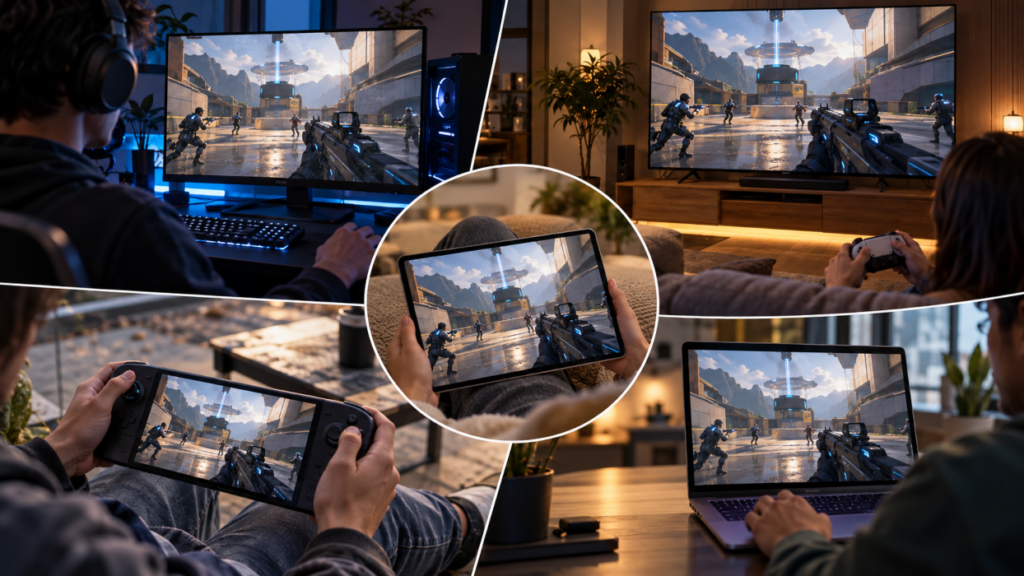
For most of gaming history, the platform was easy to identify because it sat under the television or beside the monitor. The console, PC, or handheld contained the processor, graphics hardware, storage, operating system, and game installation. Remote gaming is steadily breaking that relationship apart. A player can now hold a controller in front of a television, laptop, tablet, handheld, phone, or headset while the machine actually running the game may be in another room, another city, or a commercial data center.
That shift matters far beyond convenience. If rendering, game execution, storage, and much of the platform software can live remotely, the device in front of the player starts to act more like an endpoint than a traditional gaming machine. The future of platform-agnostic gaming may therefore depend less on building one device that runs everything locally and more on making many devices capable of reaching the same remote hardware, account, saves, friends, and game library.
The Gaming Machine Is Moving Away From the Screen
The clearest evidence is already visible in commercial cloud gaming. NVIDIA’s GeForce NOW Ultimate tier now uses RTX 5080-class remote systems and supports streams up to 5K at 120 frames per second, or up to 360 fps at 1080p on supported hardware and connections. NVIDIA has also expanded native client support to Linux and added support for more living-room devices, turning machines that would never run a high-end PC game locally into access points for remote PC hardware.
Microsoft is approaching the same idea through the Xbox ecosystem. Xbox Cloud Gaming is available across PCs, phones, tablets, Xbox consoles, selected smart TVs, Fire TV devices, handhelds, and Meta Quest headsets, while Xbox Remote Play can stream games installed on a player’s own console to many of those same device categories. Microsoft also expanded the Xbox PC app to Arm-based Windows 11 systems in 2026 and continued adding smart-TV support, including VIDAA OS devices.
There is also a more open version of the idea. Shadow provides a full remote Windows PC rather than a fixed game catalog, allowing subscribers to install supported games, launchers, mods, and normal Windows software. Steam Remote Play takes another route by letting the player’s own gaming PC remain the host while Steam Link sends video and audio to another device and returns input to the host. These models are different economically and technically, but they all separate the screen in front of the player from the hardware doing the heavy work.
Platform-Agnostic Does Not Mean Hardware Stops Mattering
A thin client still has a job. It needs a display pipeline, a hardware video decoder, a stable network interface, support for the player’s controller or mouse and keyboard, and enough processing power to decode the stream without adding unnecessary delay. A cheap laptop and an expensive desktop may be receiving the same remotely rendered frames, yet they can still feel different if one has slower decoding, a poor Wi-Fi radio, a 60 Hz display, or weak peripheral support.
Bandwidth figures make this easy to misunderstand because raw download speed is only one part of the connection. NVIDIA currently recommends about 25 Mbps for 1080p60, 45 Mbps for 4K120, and 65 Mbps for 5K120, while also recommending Ethernet or 5 GHz Wi-Fi and low network latency to its data centers. A player with a fast gigabit connection can still have a worse session than somebody on a slower line if routing, congestion, packet loss, Wi-Fi interference, or physical distance adds delay and inconsistency.
Modern codecs and better encoders help reduce the amount of data needed for a high-quality stream, but they do not repeal physics. NVIDIA’s current high-end streaming mode includes AV1 encoding, 10-bit HDR, and 4:4:4 chroma support in supported configurations, all aimed at preserving detail while the game is compressed and transmitted. That improves image quality, especially for fine text, HUD elements, distant geometry, and motion, but every remote session still includes an encode, transport, decode, and display chain that local rendering does not need in the same form.
Competitive Gaming Is the Hardest Test
Competitive players notice the entire input loop. A mouse movement or button press has to reach the remote system, the game has to process it, the GPU has to render the resulting frame, the encoder has to compress it, the network has to send it back, and the local device has to decode and display it. Higher stream frame rates can reduce some waiting inside that chain, which is one reason GeForce NOW now offers modes as high as 360 fps at 1080p, but the network round trip remains part of the experience.
For ranked play, that can be good enough more often than many veteran PC players would have expected a decade ago. For top-level tournament competition, local hardware still offers advantages that are difficult to dismiss: predictable latency, direct peripheral access, fewer network dependencies, easier capture and observer setups, and tighter control over the match environment. The standard for a weekend ladder match is also different from the standard for a LAN final where a few milliseconds, a dropped packet, or a decoder hitch can affect a round.
Remote hardware could still become a larger part of competitive infrastructure. Centralized systems can give players identical CPU and GPU classes, fixed driver versions, standardized game builds, and controlled software images. That may be useful for practice servers, qualifiers, remote events, training rooms, collegiate programs, and temporary tournament stations, especially when organizers need to provision many systems without maintaining a room full of gaming towers.
There is an anti-cheat angle as well, although it is not a simple win. Running the game on provider-controlled hardware can make some forms of local software tampering harder because the player does not control the operating system that executes the game. It does not solve external input manipulation, computer-vision assistance, account abuse, network attacks, or every form of cheating that can operate outside the remote machine. Competitive integrity would still depend on the full chain from player input to server-side detection, not merely on where the GPU happens to be installed.
The Bigger Barrier Is Ownership and Identity
A truly platform-agnostic future needs more than a video stream. The player expects a library, purchases, saves, achievements, settings, friends, DLC, cosmetics, matchmaking identity, and competitive history to remain intact while moving between devices. Hardware can become interchangeable faster than commercial ecosystems can.
Xbox Play Anywhere provides one example of how this can work inside a single ecosystem. Supported titles can share entitlement and progression across Xbox and Windows PC, and Microsoft explicitly describes cross-entitlement and cross-progression as the foundation for moving between devices. Steam Cloud can also support saves across operating systems when developers configure their cloud storage correctly.
The limits are just as revealing. GeForce NOW may connect to existing PC storefront libraries, but games still have to be supported by the service. Xbox Cloud Gaming has a large catalog, yet availability depends on game, region, device, and subscription terms. PlayStation cloud streaming supports selected PS5 titles and selected games from its subscription catalogs, while PlayStation Remote Play depends on a player’s own PS4 or PS5 for locally installed titles.
This is why remote hardware does not automatically create universal gaming. Publishers, platform holders, storefront operators, subscription providers, and developers still decide where a license can run and whether progression travels with it. The technical ability to stream a Windows game to a television is already here. The harder question is whether the player’s purchase, account state, multiplayer identity, mods, and saved progress are allowed to follow.
Remote Hardware Changes the Upgrade Cycle
Traditional gaming hardware asks the player to buy performance in advance. A high-end GPU might spend years under a desk even when the player is browsing the web, watching video, or playing a lightweight indie. Cloud hardware reverses the relationship by letting the provider own the expensive processors and sell access to them across many customers.
That can make old devices useful for much longer. A modest laptop with a capable decoder can display a game being rendered on hardware far beyond anything that could fit inside its chassis, and a smart TV can become a gaming endpoint with little more than an app and controller. GeForce NOW’s move to RTX 5080-class servers is a practical example of an upgrade happening on the remote side rather than requiring subscribers to replace local GPUs.
The tradeoff is economic control. A locally owned graphics card can be used offline, resold, repaired, overclocked, kept for ten years, or moved into another PC. A remote subscription can change price, alter session rules, remove a title, suffer an outage, or disappear entirely. Full-PC services such as Shadow give players more control over software than a curated streaming catalog, while home-hosted options such as Steam Remote Play preserve ownership of the machine itself, but each model moves a different amount of control away from the device in the player’s hands.
That makes the future less likely to be a simple replacement of gaming PCs and consoles. A player might own one strong desktop at home, stream it to a handheld around the house, use a commercial cloud service while traveling, and play locally when latency, mods, offline access, or competitive performance matter more. Remote hardware becomes another layer in the setup rather than a single answer for every situation.
Gaming Devices Can Specialize Around the Endpoint
Once heavy rendering is remote, hardware designers can spend more of the local budget on the parts the player actually touches. A handheld built mainly for streaming can prioritize display quality, Wi-Fi, battery life, ergonomics, speakers, controls, and low-latency decoding rather than carrying a large APU and cooling system. A television can become a usable game system through software. A small Linux box or Arm-based laptop can reach Windows game content that would otherwise have compatibility or performance limits.
The market is already testing pieces of that model. GeForce NOW supports high-frame-rate streaming on handhelds and Linux PCs, Xbox Cloud Gaming reaches smart TVs and handheld devices, and PlayStation Portal can now cloud-stream selected PS5 games for PlayStation Plus Premium members without requiring the owner’s PS5 to be running the session. The endpoint is becoming a product category of its own.
Peripheral support will decide how far that idea can go. Competitive mouse players care about polling behavior, raw input, display refresh, and cursor response. Racing players need wheels, pedals, and force feedback. Flight sim players may need HOTAS hardware, head tracking, multiple displays, or unusual USB devices. A remote platform that works perfectly with a Bluetooth controller can still feel incomplete to a PC player whose setup depends on specialized hardware.
Hybrid Play Could Make Compute Location Invisible
The next stage may be less about choosing between local and cloud gaming and more about software deciding which machine should run a session. A powerful desktop could handle a game locally at home, while the same account sends the workload to a commercial data center when the player switches to an underpowered laptop or television. A handheld could run smaller games on its own processor and stream heavier titles when a stable low-latency connection is available.
That model also creates room for smarter transitions between installation and streaming. A platform could allow a player to begin on remote hardware immediately, continue downloading the local version in the background, then move the session onto the local machine once installation is finished. The reverse could happen when a player leaves home, with cloud saves and account state allowing a remote instance to pick up from the local session without forcing the player to treat it as a separate version of the game.
Multiplayer communities would benefit most if those transitions become invisible to everyone else. Friends lists, party systems, team rosters, matchmaking ratings, tournament identities, voice channels, and player history would remain attached to the account while the physical machine changes underneath it. A player joining a match from a desktop, television, handheld, or rented remote PC would still arrive as the same competitor with the same social and competitive history.
The engineering challenge is moving toward orchestration rather than simple streaming. The player’s device would request a game session, and the platform could decide whether local silicon, a home PC, a nearby data center, or another approved machine is the best place to execute it based on performance, latency, licensing, and availability. Once that kind of handoff becomes reliable, the location of the gaming PC stops being the first question. The more useful question becomes which hardware can provide the session the player needs at that particular moment.