
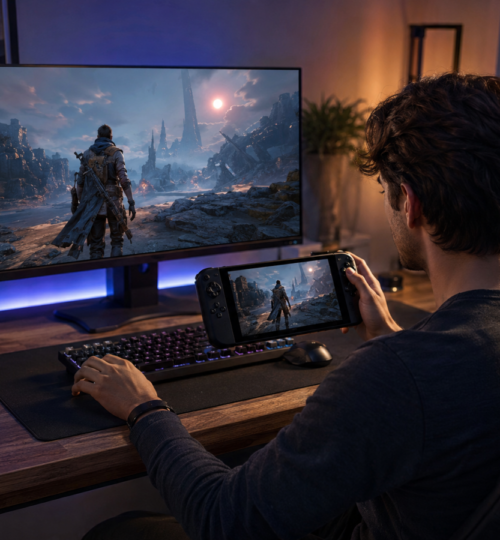
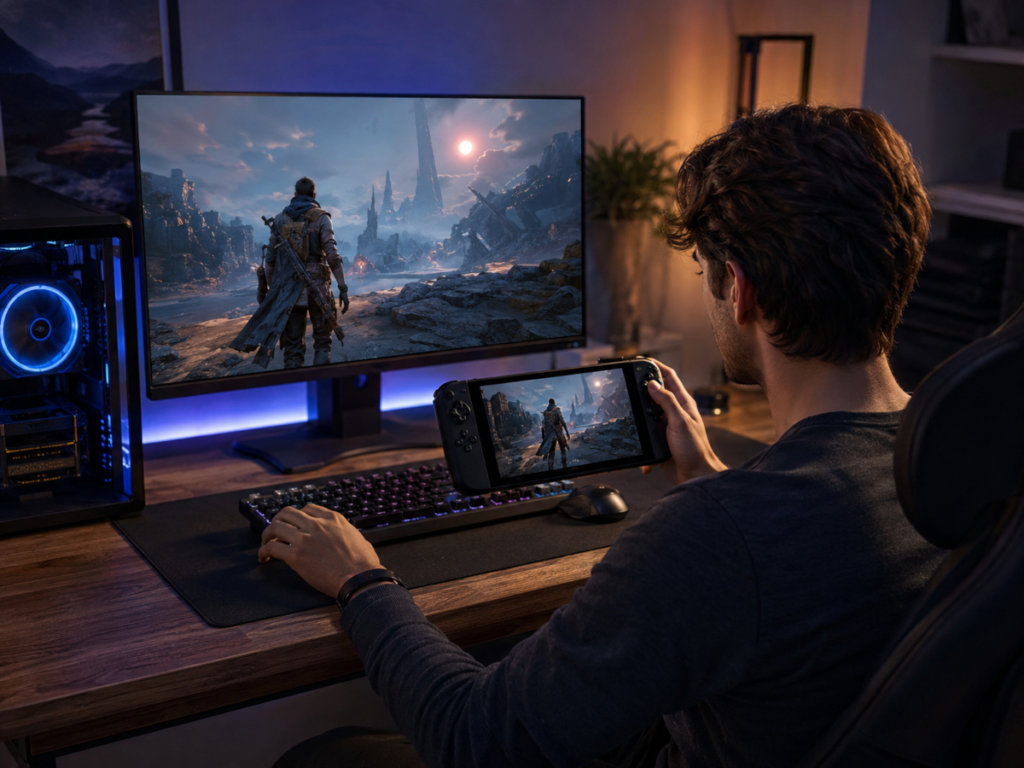
The line between “App” and “Game” is getting blurry. For years, gamers understood the difference between a web app and a native game without needing a technical explanation. A web app lived in a browser. A native game lived on a console, PC, or handheld after an install. One felt temporary and lightweight. The other felt serious, powerful, and permanent. That line is no longer as clean as it used to be.
Today, players can launch console games through a browser, stream PC titles from remote servers, play across handhelds and smart TVs, and continue progress between devices with fewer barriers than ever before. Xbox Cloud Gaming lets players access hundreds of console games on supported devices, including through the browser, while NVIDIA GeForce NOW connects to major PC storefronts such as Steam, Epic, Xbox, and Ubisoft Connect so players can stream games they already own.
At the same time, web technology itself has grown stronger. WebGPU, the modern browser graphics API, is now described by MDN as a successor to WebGL, offering better access to modern GPU features, faster operations, and support for high-performance graphics and compute workloads in the browser.
For players, this shift means gaming is moving toward a world where the device matters less than the account, the connection, and the ecosystem behind the game.
From Browser Games to Browser-Based Platforms
Old-school browser gaming had a certain charm. Many players remember logging into strategy games, Flash games, web-based RPGs, or simple competitive titles during school, work breaks, or late nights. They were accessible, lightweight, and easy to share, but they were rarely seen as direct competition for full PC or console releases. That perception is changing.
Modern web apps are no longer just simple pages with buttons and menus. They can behave like full software platforms. Progressive web apps can install to a home screen, store data locally, update in the background, and feel far closer to traditional applications than the websites many players grew up with.
Cloud gaming takes that one step further. Instead of asking the browser to run the entire game locally, the heavy lifting happens somewhere else. The cloud server renders the game, processes inputs, and streams the result back to the player’s device. To the player, it can feel like the game is simply running on a laptop, phone, tablet, handheld, or TV, even if the actual hardware is sitting in a data center.
That is why the convergence matters. The browser is not just becoming a place where games are played. It is becoming an access layer for entire gaming ecosystems.
Native Gaming Still Has the Performance Crown
Let’s be clear: native gaming is not going away. A powerful local PC or console still offers major advantages. Native gaming gives players direct access to local hardware, lower input latency, higher visual consistency, modding flexibility, offline access, and fewer dependencies on server availability. Competitive players, especially in shooters, fighting games, racing games, and esports titles, still care deeply about frame timing, input response, refresh rate, and system control.
For a veteran multiplayer community, that matters. Anyone who has played competitive matches long enough knows the difference between “playable” and “trusted.” A game can run fine for casual sessions but still feel wrong when every frame, peek, dodge, or reaction matters.
That is the core challenge cloud gaming still faces. It is not just about whether a game can stream. It is about whether players believe the stream is reliable enough when the result matters.
Latency, compression artifacts, connection drops, data caps, Wi-Fi instability, and server distance can all affect the experience. A single-player RPG may feel excellent in the cloud. A turn-based strategy game may feel nearly seamless. A twitch-based competitive shooter, however, has a much higher bar.
The future is not native versus cloud. The real future is choosing the right model for the right player, game, and situation.
Cloud Gaming Makes Access the Main Feature
The biggest strength of cloud development is access. For decades, gaming access was tied to hardware. If a player did not have the right console, GPU, storage space, operating system, or install package, they were locked out. Cloud gaming changes that equation. It gives publishers and platform holders a way to reach more players across more devices without forcing every user to own high-end hardware.
Microsoft frames Xbox Cloud Gaming around playing console games on devices players already have, while its developer-facing material promotes the idea of reaching players on more devices without requiring code changes for cloud support. That has huge implications.
A player with an aging laptop can still access demanding games. A console player can continue a session away from the living room. A handheld user can try games that would otherwise be too large or too demanding. A friend can join a multiplayer session faster because they are not waiting through a massive install.
This does not replace ownership concerns, download preferences, or the appeal of physical hardware. But it does reduce friction, and friction has always been one of gaming’s biggest enemies. When players can click, sign in, and play, the entire path from curiosity to participation gets shorter.
The Browser Becomes the New Launcher
The gaming industry has spent years building launchers. Steam, Epic Games Store, Battle.net, EA app, Ubisoft Connect, Xbox app, PlayStation interfaces, and console dashboards all compete to become the starting point for play.
Cloud-enabled web apps introduce another possibility: the browser as the universal launcher.
NVIDIA already allows GeForce NOW users to play through supported browsers, while also offering native apps for platforms where deeper performance features or system integration may matter. Xbox has also been iterating on its cloud gaming web experience, including a public preview of a refreshed browser portal in early 2026.
That tells us something important. Companies are not treating the web as a second-class doorway anymore. They are treating it as a serious front end for gaming.
For players, this could mean fewer installation barriers and more flexible access. For platforms, it means more control over account systems, subscriptions, libraries, recommendations, and cross-device continuity. For communities, it means getting people into games faster, especially when organizing events, casual nights, beta tests, or public tournaments.
Imagine a revived league community where a player sees a match announcement, clicks into a game page, checks their profile, joins a ladder, and launches a supported game session from the same general web ecosystem. That is where the web app and gaming platform start to merge.
WebGPU and WebAssembly Push the Browser Forward
Cloud streaming is only one side of this story. The other side is local browser performance. WebGPU gives developers more modern access to graphics hardware through the browser. MDN describes it as enabling high-performance computations and complex graphics rendering, while offering better compatibility with modern GPUs than WebGL. Web.dev reported in late 2025 that WebGPU had reached support across major browsers including Chrome, Edge, Firefox, and Safari.
That does not mean every AAA game will suddenly run natively inside a browser tab. Game development is more complicated than flipping a switch. Engines, asset pipelines, memory management, anti-cheat systems, multiplayer infrastructure, platform rules, and monetization models all matter. But it does mean the browser is becoming more capable as a serious runtime.
Combined with WebAssembly, which allows code written in languages such as C, C++, and Rust to run efficiently on the web, the browser is better positioned to support complex interactive experiences. This is especially important for tools around games: match viewers, replay systems, stat dashboards, modding interfaces, character builders, tournament brackets, training tools, and lightweight playable experiences.
The most immediate impact may not be full AAA browser-native games. It may be richer companion experiences that feel native, load quickly, and connect directly to live game services.
What This Means for Competitive Communities
For esports and multiplayer communities, cloud development has both promise and risk. The promise is accessibility. More players can join events without needing perfect hardware. Community nights become easier to organize. Legacy players who no longer maintain gaming rigs can still participate. New players can try games before committing to a download or purchase. Cross-device access lowers the barrier to entry.
That matters for communities built around ladders, tournaments, profiles, and player history. The easier it is to get someone from “interested” to “in match,” the healthier the ecosystem becomes. But the risk is competitive integrity.
If one player is running locally at high refresh with low latency and another is streaming through a weaker network, the experience may not be equal. Competitive communities will need to decide where cloud gaming fits. It may be excellent for casual events, onboarding, practice sessions, community streams, and lower-stakes play. For top-level competition, local play may still remain the standard depending on the game and genre.
There is also the issue of platform control. Cloud gaming can make access easier, but it can also make players more dependent on subscriptions, licensing agreements, regional availability, and service policies. A game available today may not always be available tomorrow. A native install can disappear from sale but still remain playable in some cases. A cloud-only title depends on the service staying alive. Competitive communities should embrace the convenience while staying honest about the limitations.
Game Ownership Gets More Complicated
Cloud gaming also forces players to rethink what ownership means. Some services are subscription-first. Others connect to games players already own. GeForce NOW’s model is especially interesting because it emphasizes linking existing PC game libraries from major storefronts and streaming supported titles rather than replacing the storefront entirely.
That approach feels more familiar to PC players. They still think in terms of libraries, accounts, and purchases. The cloud becomes a performance and access layer rather than the only place the game exists.
Still, there are catches. Not every game is supported. Publishers can control availability. Streaming quality depends on tier, region, network, and server capacity. Mods may be limited or unavailable. Competitive anti-cheat systems may behave differently. Peripheral support may vary.
Players should treat cloud gaming as a powerful option, not a perfect replacement for every use case. The best version of the future gives players choice: install locally when performance, modding, or ownership matters, stream when access and convenience matter, and use web apps to connect the entire experience together.
The Patch Problem Starts to Fade
One of the underrated benefits of cloud gaming is patch management. Modern games are enormous. Players have grown used to huge downloads, shader compilation, storage juggling, and day-one updates. For someone with limited SSD space or slower internet, the decision to play a game can become a storage management chore before the fun even begins.
Cloud gaming changes that. The game runs on maintained server hardware. Updates happen on the service side. The player launches without manually downloading every patch.
That is a big deal for multiplayer communities because updates can fracture participation. One player is patched. Another is not. Someone forgot to reinstall. Someone has no drive space. Someone is stuck waiting on a download while the match lobby fills.
Cloud access cannot solve every problem, but it can make participation smoother, especially for casual sessions or games people rotate in and out of.
Native Apps Are Learning From Web Apps Too
The convergence is not only about web apps becoming more like native games. Native gaming platforms are also becoming more web-like.
Modern game clients are built around live services, cloud saves, account syncing, social graphs, remote libraries, embedded stores, rotating events, web-based overlays, seasonal content, and server-side configuration. Even when a game is installed locally, much of the experience depends on online infrastructure.
That is why the old distinction between local and cloud is weakening. Many native games already behave like connected services. Many web apps now behave like installed software. Cloud gaming sits in the middle, turning games into high-performance streams connected to accounts and platforms.
Players may not care what architecture is underneath as long as the game launches, runs well, respects their purchases, protects their data, and lets them play with friends.
The Player’s Future Is Hybrid
The most realistic future is hybrid.
Hardcore players will still build powerful PCs. Console players will still value dedicated hardware. Handheld players will still want local play for travel and offline use. Competitive players will still demand consistency. Collectors will still care about ownership and preservation.
At the same time, cloud gaming and advanced web apps will keep growing because they solve real problems. They reduce hardware barriers. They simplify access. They make game libraries more portable. They help platforms reach players wherever they are.
For a legacy multiplayer community, this is not something to fear. It is another major shift in how players gather, compete, and stay connected. We have seen the industry move from server browsers to matchmaking, from forums to Discord, from boxed games to live services, from local leaderboards to global competitive ecosystems. The convergence of web apps and native gaming is part of that same long evolution.
The key is remembering what matters most… the players. Technology changes. Platforms change. Delivery methods change. But competition, identity, teamwork, rivalries, community history, and the desire to test yourself against another human being remain the core of multiplayer gaming.
Cloud development will not replace that. At its best, it will make it easier for more players to step into the arena.